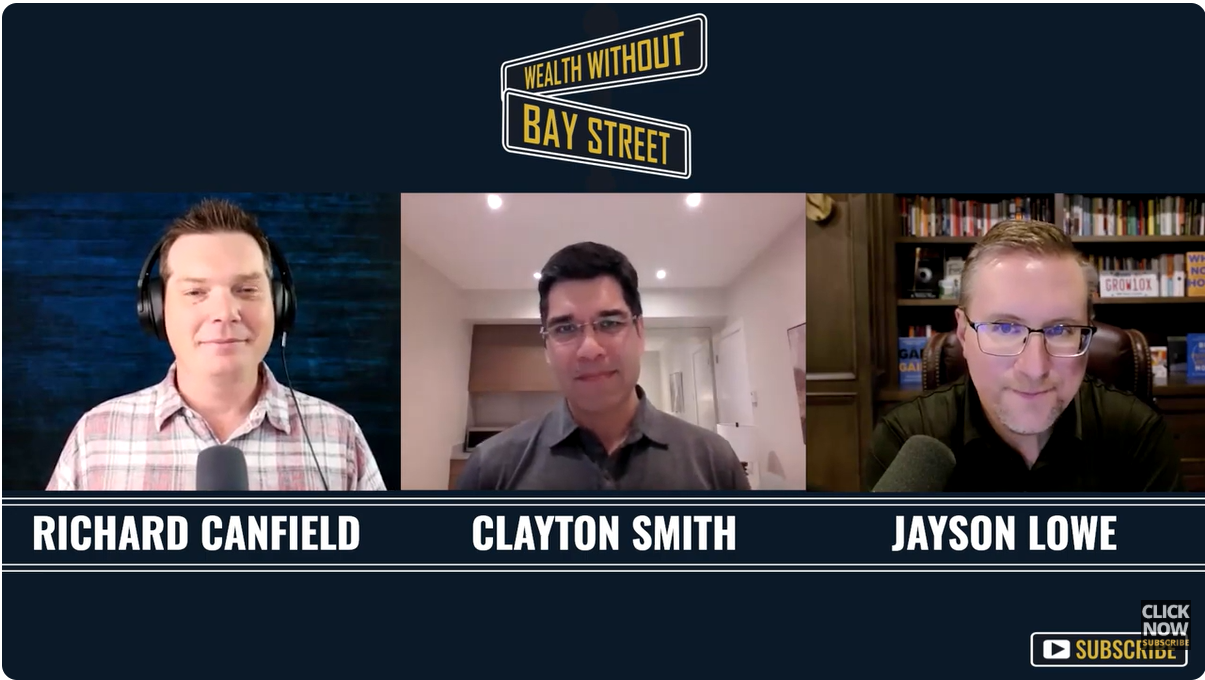
Clayton Smith, a certified engineering technologist and entrepreneur based in Edmonton, Alberta, joins Wealth On Main Street hosts Richard and Jason to share his firsthand experience implementing the Infinite Banking Concept (IBC) across nearly a decade. Rather than approaching the concept through formal study, Clayton began building a policy system intuitively -- drawn primarily by the idea of control over his own capital -- and has since grown it into a family-wide financial infrastructure.
The conversation covers how Clayton transitioned from employee to business owner, drawing on his policy loans as a bridge rather than a burden, and how collapsing RSPs in a low-income year allowed him to redirect capital into policies on favourable tax terms. Throughout, the discussion emphasizes that the path into IBC is personal, that getting started with imperfect knowledge beats waiting for complete understanding, and that incremental practice -- including a personal "repayment on small purchases" habit Clayton developed -- compounds into meaningful financial and behavioral change over time.
The episode closes with Clayton reflecting on the value of planting these habits early for his adult children, and on the shift in worldview that comes from seeing every dollar that flows through your hands as a capital deployment decision rather than a spending event.
Key Points
Clayton was drawn to IBC by the concept of control over repayment terms -- not by a comprehensive understanding of the mechanics -- and that partial clarity was enough to get started.
He built his first policy in 2016 after selling his home and identifying IBC as a better use of the freed-up equity than RSP contributions or debt paydown alone.
When Clayton transitioned out of employment, his existing policy system gave him the breathing room to take that entrepreneurial step without a cash-flow crisis forcing him back into a job.
He actively collapsed RSPs during low-income years to shift capital out of what he calls "money jails" and into policies and other working assets, taking advantage of lower tax brackets during the transition period.
Policy loans function like a HELOC but with one critical difference: there is no mandatory monthly repayment schedule, giving the borrower complete control over when and how the loan is retired.
Clayton developed a micro-practice habit of tracking small purchases (in the $100 range) as if they were loans, setting up automatic repayment transfers to build the repayment mindset at the behavioral level before scaling to larger policy loans.
The "savings jars" model -- saving, spending, and starting over -- is replaced by running all capital through the policy first, preserving the compounding effect continuously rather than interrupting it with each spending event.
IBC was described as "real estate without walls" -- offering similar financial leverage and equity-building characteristics but without property taxes, maintenance obligations, or political risk exposure.
All family members have their own policies, creating a generational financial system rather than a single personal account.
The growth of the system has been driven by Clayton's own curiosity and experimentation -- not by the advisor initiating expansions -- reflecting IBC's core principle that the system grows when the individual's thinking does.
Planning for known future events (children leaving home, income changes, pension drawdown windows) is as important as planning for windfalls, and IBC provides the flexible capital base to act on both.
Starting early -- ideally in one's 20s -- was identified as the single most impactful change Clayton would make in hindsight, as compound growth inside a policy is heavily time-dependent.
Quotable Moments
Quotable moments are auto-generated from the transcript. Speaker attribution and quote accuracy should be verified against the original source before republishing or sharing.
Clayton Smith -- Guest
"I look at every other type of investment now through a lens of degree of control. RSPs are almost like a jail for your money. Philosophically, registration leads to confiscation."
Why it works: Compresses a multi-year intellectual shift into one clean, repeatable frame. The "money jail" image is visceral and portable -- it travels.
Richard -- Host/Advisor
"You can't read about push-ups. You have to do them. Whether you can do two or a hundred, you have to get down and start -- and then you get a coach to walk you through proper form."
Why it works: The push-up analogy collapses the "I need to understand it fully before I start" objection. It reframes getting started as the only prerequisite for learning.
Clayton Smith -- Guest
"It's like real estate without walls. Almost all the financial benefits, without the political risk of property taxes, without unclogging a toilet."
Why it works: Speaks directly to real estate investors in the audience. Frames a complex financial instrument through a reference point they already understand and respect.
Richard -- Host/Advisor
"Nelson taught us it's all about how we think. It has nothing to do with should I invest in X or Y. You're dealing with the money already flowing through your family's hands -- and thinking about when it's going to be flowing in. Big difference."
Why it works: Draws a sharp line between product-selection thinking and system thinking. This reframe is the core of IBC and rarely stated this cleanly in mainstream financial content.
Concepts & Ideas
Core IBC Framework
Becoming Your Own Banker
The Infinite Banking Concept, developed by R. Nelson Nash, proposes using a dividend-paying whole life insurance policy as a personal banking system. Rather than sending money to external institutions for savings or lending, you capitalize your own policy and borrow against it, keeping the compounding environment intact while still accessing the capital.
Control Over Repayment Terms
Unlike a bank loan or a HELOC, policy loans have no mandatory repayment schedule imposed by the insurance company. The company knows the loan will eventually be recovered from the death benefit, so the borrower sets their own repayment timeline. Clayton identified this as the single most compelling feature of the system -- more than any rate-of-return calculation.
The Uninterrupted Compounding Effect
When you borrow against a policy rather than withdrawing from a savings account, the full policy value continues to grow. This is the mechanical core of why IBC outperforms the "save, spend, refill" savings jar model over time -- the compounding is never interrupted by a spending event.
Borrowing Without Reducing Asset Value
A policy loan does not reduce the cash value of the policy -- it is a loan against the policy as collateral. The policy continues earning dividends on its full value while the loan is outstanding. This is the feature Richard emphasized as misunderstood by most people exploring the concept for the first time.
Practical Principles
Running Money Through the Policy First
Rather than treating the policy as a destination for leftover savings, the behavioral shift is to route all incoming capital through the policy and then borrow back what you need. This keeps the compounding base growing continuously and makes every financial decision -- spending, investing, lending -- a conscious capital allocation choice.
Micro-Practice Repayment Habit
Clayton developed a personal practice of treating small purchases ($100 and up) as internal loans and setting up automatic bi-weekly repayments with a 10% premium on top. The financial impact of this at the micro level is modest; the behavioral and cognitive impact is significant. It builds the "banker mindset" in small, low-stakes reps before applying it to larger capital decisions.
Planning for Known Events
Beyond planning for windfalls (property sales, inheritances, death benefits), IBC practitioners are encouraged to map out foreseeable changes in cash flow -- children leaving home, pension availability windows, income transitions. Knowing these events are coming allows for deliberate capital staging rather than reactive financial decisions.
Collapsing Registered Accounts Strategically
RSPs and pension funds are best drawn down during low-income years when the tax hit is minimized. Clayton used his employment-to-entrepreneurship transition as a deliberate RSP drawdown window, cycling that capital into policies and other working assets. This converts "money jail" assets into assets he controls.
The System Grows When Your Thinking Does
One of the more counterintuitive points Richard makes is that the advisor's role is not to push expansion -- it's to respond to the client's own thinking. Every policy Clayton added came from him working through an idea, experimenting, and then coming to Richard with a proposal. The implication is that the ceiling on your IBC system is set by your own curiosity, not by your premium budget.
Adjacent Frameworks Referenced
Real Estate as a Mental Model for IBC
Clayton's years in real estate investing gave him a framework for thinking about equity, leverage, and cash flow that mapped cleanly onto IBC. He described the policy as "real estate without walls" -- similar leverage characteristics, no vacancy risk, no maintenance costs, and no property tax exposure. For real estate investors exploring IBC, this analogy collapses much of the learning curve.
The Fruit Tree / Government Tax Harvesting Frame
Richard offered an image of the government planting fruit trees (registered savings vehicles like RSPs) and then watering them through bank marketing every February so the government can harvest the fruit later. The frame argues that registered accounts are designed to aggregate taxable capital in a predictable, accessible form -- and that getting money outside those structures is a meaningful act of financial self-determination.
Family Banking System
IBC is not a solo product but a family architecture. Clayton has policies for himself, his spouse, and his children. The long-term vision is that each family member eventually takes ownership of their policy, equipped with the thinking framework that makes the tool useful. Financial education becomes embedded in the structure rather than delivered as lectures.
Implementation
Implementation steps are auto-generated from the transcript content and are provided for informational purposes only. They do not constitute professional advice of any kind. Always consult a qualified professional before acting on any information presented here.
1
Start Before You Fully Understand
Clayton's entry point was partial curiosity, not mastery. He had read enough to know the concept appealed to him and then let the meetings with his advisor fill in the gaps. If you are waiting until you can explain every mechanism before you begin, you are using comprehension as a stall. Find a qualified advisor, read "Become Your Own Banker" by Nelson Nash (skimming is fine), and let that be enough to start the conversation.
2
Identify Your Control Metric
Before your first advisor meeting, write down what control over your money actually means to you. Clayton's answer was repayment flexibility -- the ability to set his own loan terms. Your answer may be different: tax position, privacy, access, liquidity, or something else. Knowing your control metric helps you evaluate whether IBC is a fit and gives your advisor a real conversation to respond to rather than a generic prospect intake.
3
Map Your Capital Flow Honestly
Before adding a policy, document where your money actually goes each month -- not a budget aspiration, but what actually happens. The IBC insight is that you are already moving capital through your hands; the question is whether you are capturing any of it or letting it bleed out. Seeing your actual flow makes it possible to identify what could be routed through a policy rather than a savings account or straight to expenses.
4
Build the Repayment Habit at the Micro Level
Clayton's most distinctive contribution to this episode is his small-purchase repayment practice. Choose a real, upcoming discretionary purchase in the $100 to $500 range. Spend the money from your current account. Then set up an automatic transfer to repay that amount over 4 to 8 weeks -- with a 10% premium added. Do not take a policy loan to do this. The point is to build the behavioral pattern of treating spending as borrowing and repayment as non-negotiable, before any policy is involved.
5
Run a Known-Events Timeline
List the foreseeable changes in your household's cash flow over the next 10 years: children finishing school, potential income drops or spikes, retirement eligibility windows, property sales. For each event, estimate the direction of cash flow change. This gives you a capital staging map -- periods when you could increase contributions, periods when you may need to lean on loans, and windows where drawing down registered accounts makes tax sense. Bring this to your advisor meeting.
6
Evaluate Registered Account Exit Timing
If you have RSPs, pension assets, or other registered capital, model what a partial drawdown looks like in a low-income year. Clayton did this during his employment-to-entrepreneurship transition and used the refunds to fund policy contributions. You do not need to collapse everything at once -- the question is whether there is a window, now or in the foreseeable future, where the tax cost of withdrawal is lower than the long-term cost of leaving capital in a structure you do not control. A tax advisor and an IBC advisor should both be in that conversation.
7
Treat Every Investment Through a Control Lens
Clayton described shifting from evaluating investments by rate of return alone to evaluating them by degree of control. Apply this lens to your existing portfolio: what do you actually control, and what are you giving up to participate? This is not an argument against diversification -- it is an argument for being deliberate about what you trade in exchange for yield or convenience. IBC is not the only vehicle that scores well on control, but it forces the question in a useful way.
8
Extend the System to Your Family
If you have children, consider whether a policy on their lives makes sense while they are young and insurable. Clayton's frame was not about managing his children's finances for them -- it was about planting a structural seed they can take ownership of in their 20s, already seasoned with compound growth. The conversation about handing off the policy becomes a financial education milestone, not a sales event.
Full Transcript
This transcript was auto-generated and may contain errors in speaker attribution, transcription accuracy, or formatting. Long transcripts may be truncated due to processing limits. Confirm accuracy and completeness against the original source before referencing or republishing.
[00:00]
Richard: There's this great conversation that takes place about your own thinking and how your thinking leads to how your future can grow around your system. And you did the work -- I didn't jump in and call you and say hey Clayton, why don't you put your money in jars, and then why don't you set up all these automated transfers, and then hey Clayton, once you have enough money in the account, give me a call and we'll get you a policy. It's the exact opposite. And I think that's important for people to take away -- because they kind of want a roadmap for how to do everything. But the reality is how you do everything is different from how I do it and how Jason does it. So you need to find your way, and then by actually doing it, you're going to create capacity to grow and expand.
Richard: So how exactly do you decide to just implement the Infinite Banking Concept without even fully understanding how it works? Why would you even consider doing that? We're going to find out today -- because we've got an incredible guest, a client of mine, Clayton Smith. Clayton is a certified engineering technologist who understands mapping and geomapping and all kinds of important things around data. He has 25 years of experience based out of Edmonton, and he now focuses that knowledge and energy on real estate media and mapping -- drone footage, videos for realtors, and work for government clients. Really cool aspects of his company, C5 Projects. Clayton has been an infinite banker for a number of years, and I have some of the most epically incredible meetings with him -- our discussions take very diverse and fun tracks. So Clayton, thank you for joining Jason and me on the program today.
Clayton: Thank you very much, Richard. It's a pleasure to be here. I hope you didn't overpromise with the intro there, but it sounds pretty good so far.
[~02:00]
Jason: Clayton, tell us a little more about your business. This is the first time we've had a chance to be introduced -- share some context on what your business does and the value it creates.
Clayton: Thank you, Jason. I kind of stumbled onto the idea about a year ago on a road trip -- a bit of a sabbatical. I was out on a walk on Vancouver Island and passed a real estate office with pictures of houses and maps and floor plans. I thought: I can make those. So I started digging into it, looked into a franchise opportunity but decided to go a different direction and combine my years of experience and interests into the kind of business I actually wanted to run.
I started picking up equipment -- a laser measuring device, a 360 camera, and then a drone. A friend of mine who's a real estate agent seemed like an ideal first client, and things started to move. It didn't really feel real until I bought the commercial liability insurance for $2,000 and switched my car to a commercial policy. I thought: okay, now I've got overhead to feed.
Over the months since, I've been making videos for properties -- showcasing them, telling a story about each one, giving people a compelling reason to get excited about buying it.
[~05:00]
Richard: And you caught the Infinite Banking Concept intuitively -- you began implementing it without having complete clarity or the deepest understanding. Why?
Clayton: I first came across the concept years ago and was intrigued. Then in 2016, we decided to sell our house -- the Alberta economy was starting to slide. We cashed out some equity, put some into an RSP, paid down some debt, and then I thought: I've always wanted to try this infinite banking thing. I knew Richard from real estate meetings, so I gave him a call. By the time we met, I'd already decided I wanted to do it -- I just wasn't sure on the exact mechanics. Richard gave me "Become Your Own Banker," I skimmed it, confirmed I wanted to move ahead, and we got started.
Richard: The fun thing is Clayton gives himself less credit than he deserves. He asks a lot of questions. He's very inquisitive, has a thirst for knowledge, puts real time and thought into what he wants to know. We've had a lot of great meetings since that day, every member of the family is now in the system, and there's been meaningful growth -- through all the ups and downs of the Alberta economy over the past decade.
[~08:00]
Richard: Your real estate background feels like a connection point to how the Infinite Banking Concept showed up in your life. We met through real estate investment circles -- through the RAIN group, Don Campbell's work. What comes up for you when you think about your real estate knowledge and how it intersects with IBC?
Clayton: The thing that took the longest for me to wrap my head around was the fact that you borrow back out of your policy and there are no set repayment terms from the insurance company. They don't care if you ever pay it back because they know they'll get their money back when you die. There is interest accumulating, so it is in your interest to pay it down, but having control over those repayment terms was huge for me.
We talked through scenarios early on -- what happens if I lose my job and can't cover the premium? A few years later, I had the opportunity to exercise that contingency plan. The policy has been a real resource to draw on during the transition from employee to business owner. It's a very unique tool that most people don't know or understand, and for some reason I just decided to embrace the whole concept.
[~11:00]
Richard: One of the things I sense is that you realized early that you're not taking control of the entire banking function in your life all at once -- it's meant to happen gradually and incrementally. You saw the advantage of control and didn't need 100% of it to get started. Some people say: if I can't control it all, I'll wait. But you can't read about push-ups -- you have to do them. Whether you can do two or a hundred, you start and you get a coach to walk you through proper form.
Clayton: Honestly, I still don't fully understand how it all works. When Richard talks about internal rates of return on the policies, I'm just like -- okay, that's good. For me, it just works. The big thing was the control aspect. And I now look at every other investment through that lens. RSPs to me are almost like a jail for your money -- very limited control, even accounting for the tax shelter aspect. You're still going to pay tax on it eventually. And philosophically: registration leads to confiscation. The more money in a registered plan, the bigger the target for high-taxing governments. I stopped contributing to RSPs well before my employee-to-business-owner transition and focused on building my policy room.
[~15:00 -- Book Ad]
[Sponsor segment: "Don't Spread the Wealth" book pre-order -- September 12th launch. Visit dontspreadwealth.com.]
[~16:00]
Richard: I had this picture of a fruit tree -- the government plants fruit trees and then waters them every February through bank marketing, getting people to put money into RSPs so it can harvest the fruit later. The concept of control means something different to everyone, but you can almost put a monetary value or a percentage on it. Maybe you have a private loan opportunity paying 12 to 13%, but the value of doing it in an environment where you have control versus not -- how much of that percentage do you assign to control? It's intangible but very tangible in how it affects your daily life.
And your circumstance -- transitioning out of your past career, not entirely by choice -- found you with an opportunity to go in a new direction. We had several meetings about how the policies work in that scenario, what the minimum premium is versus what the potential is, and how to give yourself breathing room to know that the system is not as restrictive as it might seem.
[~18:00]
Richard: The knowledge that you don't have to repay policy loans -- it's not that you don't have to, but knowing the potential is there -- is something you hear about when you're exploring IBC. But to actually experience it is different. You were aware, you read the book, we had the meetings, you understood it. But you didn't truly feel it until you had the experience of holding outstanding loans and nobody showing up with a baseball bat asking for repayment.
Clayton: You captured it pretty well. The control over repayment terms gives you flexibility to invest the money how you want, and it also makes you think more carefully about what you're investing into. I've had some boneheaded decisions over the years that cost real money. When you're borrowing from a policy to invest, you have to make calculations. If the investment doesn't pan out, the policy is still growing -- it just takes a little longer to pay the loan back. That all factors into the calculation.
I recently made a private loan secured across a few properties and vehicles, funded from a combination of lines of credit and policy loans. My plan for any money coming in is to send it to the policy first, or pay down credit lines and then to the policy. I look at it as: it's going to happen anyway, but if I keep the money running through the policies, I keep those numbers front of mind.
[~21:00]
Richard: When you initiated that private loan, you borrowed from the life insurance company without reducing the asset's value -- and without triggering a taxable event. You're paying no tax on the daily buildup, no tax on the death benefit proceeds. The policy is the greatest tax exemption that exists in the Canadian and American tax code. From that position, you went and took advantage of a high-caliber lending opportunity -- not all-in from your policy, but in combination with lines of credit. Don't banks joint venture on deals all the time? You're just sitting in a different seat, with a little more control of the process.
Jason: People really need to take heed of what Clayton described -- the habit of having income go to the policy first. That goes down to behavior and mindset. When we started, it was about what's left over to fund premiums. Over years of curious, engaging conversations, we've moved from "deal with the money left over" -- which is how most people are trained to think -- to "what about the flow of money through your hands." That's a big shift.
[~24:00]
Jason: Another thing that comes up: given your transition from employed to self-employed, you now have some ability to control the timing of your income. You can now strategically draw down registered accounts in a tax-preferential window -- the whole purpose of those is to take them out when you're in a lower bracket. You're now in that position, and we've been talking about how to cycle that capital from old systems into the new one in a deliberate format.
Clayton: It's given me a chance to experiment with ideas I'd had for years. Before the transition you and I had talked about collapsing my RSP and getting it all into policies -- it made more sense from a control standpoint. My RSPs were mostly in cash anyway, so I wasn't doing a lot with them. Same with my pension from work. There have been opportunities to transition a lot of that out of the money jails and into policies and working assets. During the sabbatical I thought: this is actually the time you're supposed to be collapsing RSPs. When your income drops, that's the window the RSP was theoretically designed for. So I started pulling the money out, got some refunds, and cycled that back through my policies and other investing.
[~26:30]
Richard: What would you say to newer listeners about how you went about investigating this concept?
Clayton: Start as soon as you can. Looking back, if I had started these policies in my 20s I'd be in a far stronger financial position now. For the way my mind works, it probably would have made more sense to build equity inside a life insurance policy than to buy real estate. The policies and the lending ability on them -- it works like a HELOC, but you have far more control because there are no mandatory monthly payments. So you have total control over your repayment schedule. Sometimes you need money for a project and won't get paid for two or six months -- knowing you don't have a cash flow crisis while you're waiting is huge. When the money comes back in, you dump it back into the policy, pay the loan off, and go on to the next thing.
And thinking back to something Richard said early on when we were getting the policy started -- he described it as real estate without walls. Once I got into it, I thought: yeah, this has almost all the financial benefits of real estate without the political risk of property taxes skyrocketing, without unclogging a toilet. When you look at the time it takes to build equity in a policy versus in real estate, there's also something interesting: in real estate, tenants help pay down the mortgage over time. Here, if I borrow money to max out my contribution room in a policy, I'm building equity in a different way -- and being in a position where I can decide to what degree and how I want to go about building my future.
[~31:00]
Richard: Something Nelson talked about was planning for windfalls -- selling property, a death claim, things of that nature. But there's also planning for known events. Known events would be like: my kids are going to exit school and take over their own expenses, I won't be feeding two teenagers steak dinners three times a week. What does that freed-up cash flow mean? One client I worked through this with had kids in competitive sport. We actually added up the tournaments, outfits, equipment, gas, coaching -- before they knew it, it was $32,000 a year of after-tax income. One partner's full gross salary, every year, to support one activity. Now you know the timeline on that -- three or four more years, phasing down. That's a known event. You can start funding your system a little more aggressively today, knowing that capital is coming back to you in a few years.
[~35:00]
Clayton: That reminds me of the savings jars. I used to have a vacation jar, a spending jar. The illustration you went through, Richard, was how you build up the savings and then kill the savings, then have to replenish, then kill it again. Instead of that, it finally made sense to me to get the money into the policy first and let it continuously compound for the rest of my life. I can pull money back out in the form of a policy loan and then pay it back from the money that's coming in anyway -- the same money I would have saved in a jar. I'm just running it through the policy, and as it runs through, the compounding keeps going. It made a lot of sense after I started doing it.
All of these experiments -- they've worked out fairly well. They probably allowed me to take the entrepreneurial leap when I did. If I hadn't had the policies started, it might have held me back from choosing to head down this path.
[~37:00]
Richard: Bob Shields wrote "You Don't Have to Die to Win" -- and one thing he said was: if you really want to save money, repay policy loans. Clayton, you just described that activity from firsthand experience. There's one thing Clayton started doing early on that I found interesting -- I asked him to record a video about it, and it's in our Ascended membership site. It circles back to the jars. He put together a small spreadsheet and started being an honest banker -- paying himself on smaller purchases, in the $100 range or less. He would take a purchase, make a repayment schedule over several weeks, add 10% on top, and do it on a bi-weekly basis. And he wasn't taking a policy loan to do this -- it was money from his savings account. The point was to go through the behavioral and mental experience of repayment on a small scale before applying it on a larger scale.
Richard: That's part of Clayton's learning style. Implementing at the micro level enhanced how he could think about doing it at the macro level. Practice begins with practice. It doesn't have to be a $45,000 flip project or an $80,000 truck. It can be a $200 hockey jersey, repaid to your system over four weeks.
[~40:00]
Clayton: That's kind of how I got started. I had savings jars for vacation, for spending. To put the lessons into practice, if I wanted to go on a $500 weekend getaway and I had $1,000 in my vacation fund, I would divide that into payments over several weeks and set up automatic transfers to put the money back. The account would still grow because the transfers were timed to match my paycheque. After a year or two of doing that, I thought: oh, this is what Richard was talking about. And then it just made sense to put the money into the policy first and take it back from there. When you pull from a savings account, you stop any compounding effect. When it's in the policy, you're always capturing that compound growth. So it just made sense to run everything through the policies at that point.
Richard: What's key is that experience and practice is what led to natural expansion. People say: how do I grow my system? Nelson's answer was: as soon as your mind can conceive of it. Because you were doing the work, it prompted questions. You'd call and say: I've been doing this -- maybe I should get another policy? And then we'd look at whether it made sense and, if so, submit the illustration. There's this great conversation that takes place about your own thinking and how your thinking leads to how your future can grow. You did the work. I didn't call you and hand you a roadmap. It's the exact opposite. And how you do it is going to be different from how Jason does it, different from how I do it. Find your way and then do it -- and you'll create the capacity to expand.
[~44:00]
Richard: Clayton, who would you want to be a hero to?
Clayton: My kids. I started policies for them a number of years ago. My philosophy was to be somewhat influential, plant some seeds, and then let them arrive at their own conclusions in their mid-20s. Some of that is starting to happen -- my oldest daughter is working full-time, and we're beginning to have conversations about her taking over the policy, buying it from me, and making it her own financial instrument. If she starts now in her mid-20s, by the time she's my age she could conceivably be financially free -- not just from the policy itself, but from the kind of thinking it requires to use it. Looking at money flowing through your life through a whole different lens, implemented at an early age, leads to financial freedom.
And if there are one or two people watching this sometime down the road and it turns a light bulb on for them -- well, that's great too.
[~46:00]
Richard: Clayton, as always, I appreciate our conversations -- they're much more than just talk about a policy. We go down many different rabbit holes, which is always fun. And you may not know this, but someone's going to watch this and it might be the tipping point for them to implement this in their life. In that regard, you're already showing up as a hero. Thank you for being with us.
Clayton: Thank you very much. You as well -- take care.
AI Master Prompt
The AI prompt on this page is auto-generated from the transcript content and is intended to support further exploration of the topics, concepts, and conclusions discussed. It is provided for informational purposes only. The user is solely responsible for all outcomes resulting from its use.
You are a knowledgeable guide on the Infinite Banking Concept (IBC) as described and practiced by R. Nelson Nash in his book "Become Your Own Banker." This conversation is grounded in a real client journey -- a person who began implementing IBC intuitively, driven by a desire for control over his capital rather than by comprehensive theoretical understanding. He built policies over nearly a decade, used them as a bridge through a career transition, collapsed registered accounts (RSPs) during low-income years to shift capital into policies, made private loans funded partly by policy loans, and developed personal habits -- like treating small purchases as internal loans with scheduled repayments -- to build the behavioral infrastructure that makes the system work.
The Infinite Banking Concept is not a product. It is a framework for thinking about how money flows through your life. At its core: you capitalize a dividend-paying whole life insurance policy, borrow against it when you need capital (without reducing the policy's cash value or triggering a taxable event), and repay those loans on your own schedule. The policy continues compounding during the loan period. Over time, you replace the "save, spend, deplete, refill" cycle with a system where all capital flows through the policy first, preserving the compounding environment continuously.
Key principles from this journey:
- Control over repayment terms is the primary draw -- not rate of return
- You do not need to fully understand the mechanics before getting started; curiosity and a good advisor are sufficient
- The system grows when your thinking does -- expansion is self-initiated, not advisor-pushed
- Planning for known future events (income changes, children leaving home, registered account drawdown windows) is as important as planning for windfalls
- Collapsing registered accounts (RSPs, pensions) during low-income years is a legitimate capital migration strategy
- Micro-practice matters: building repayment habits on small purchases prepares you behaviorally for larger capital decisions
- IBC is a family architecture, not a personal account -- policies on family members create a generational system
What this is NOT: IBC is not a get-rich-quick vehicle. It is not a product comparison exercise (whole life vs. term, etc.). It is not primarily a tax strategy, though tax advantages exist. It is not a substitute for income -- it is a system for deploying the income you already have more intentionally. Do not frame it as an investment competing with stocks or real estate. Frame it as an infrastructure decision about how capital flows.
How to use this chat:
1. CLARIFY: If I describe a financial situation, help me identify which IBC principles are most relevant to it. Ask me questions about my current capital flow, existing registered accounts, debt structure, and what "control" means to me specifically.
2. APPLY: If I describe a specific scenario (a purchase, a loan, a career change, a registered account), help me think through how IBC logic would approach it -- including the trade-offs and the honest risks, not just the upside.
3. PRACTICE-BUILD: If I want to develop the behavioral habits described in the journey (micro-repayment practice, running money through a policy first), give me a concrete, specific exercise I can start this week -- not a conceptual description of the habit.
4. CHALLENGE EGO-SLIPPAGE: If I seem to be looking for validation of a decision I've already made, name that. IBC thinking requires honest self-assessment of capital flow and discipline -- not post-hoc rationalization.
5. CONNECT FRAMEWORKS: If I have a background in real estate investing, business ownership, or engineering, help me map IBC concepts onto mental models I already use. The "real estate without walls" frame is a useful starting point.
6. SCOPE THE CONVERSATION: If I am asking about specific product illustrations, tax filings, or legal structures, remind me that those require a licensed advisor and help me formulate the right questions to bring to that meeting.
Tone: Grounded, practical, and direct. No hype, no sales language, no dismissiveness toward other financial approaches. Help me think clearly, not believe harder.
To begin: What is your current relationship with the concept of controlling your own capital -- and what does that word "control" actually mean to you in the context of your financial life? Take a moment to think about a recent financial decision you made and describe what role control played in it, or didn't. We will start there.