Overview
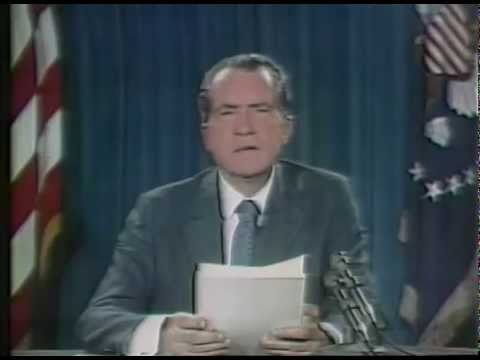
On the evening of August 15, 1971, President Richard Nixon addressed the American nation from the Oval Office to announce the most sweeping economic policy package since the New Deal. The speech -- and the decisions behind it -- became known as the Nixon Shock. In roughly eighteen minutes, Nixon dismantled the Bretton Woods international monetary system that had governed global finance since 1944, imposed the first peacetime wage and price controls in American history, and launched a temporary import surcharge designed to force a realignment of exchange rates among major trading nations.
Nixon framed the announcement around three interlocking threats: unemployment driven by post-Vietnam defence contractions, persistent inflation eating into workers' purchasing power, and a speculative assault on the US dollar by international currency traders. His response was equally three-pronged: job stimulus through tax incentives and spending cuts; a ninety-day freeze on all wages, prices, rents, and dividends; and the unilateral suspension of the dollar's convertibility into gold at $35 per ounce, the rate fixed at Bretton Woods in 1944.
The speech is a rare example of a sitting president announcing, in plain language and in a single evening, a set of decisions that would irreversibly reshape the architecture of the global economy. The gold window closure in particular was not framed as a permanent change -- Nixon called it temporary and spoke of working with the IMF toward a new monetary system. It was, in practice, permanent. The world has operated on a pure fiat dollar standard ever since, a reality with consequences that compound across every subsequent decade in inflation history, commodity pricing, sovereign debt, and the geopolitics of reserve currency status.
For anyone studying macroeconomics, monetary history, or the political economy of major policy decisions, this address is primary source material. It illustrates how large structural changes are often announced with optimistic, competent-sounding framing -- and how the stated intentions and actual long-run outcomes can diverge sharply. The speech rewards careful reading both as a historical document and as a template for how governments frame economic crisis and emergency action.
Why This Matters
The Nixon Shock is one of the most consequential unilateral economic decisions in modern history, yet it is poorly understood by most people who encounter inflation, gold prices, or currency debates today. Every discussion of the petrodollar system, gold as a monetary asset, fiat currency risk, or the structural US trade deficit traces directly back to the decisions announced in this speech. Understanding what Nixon actually said -- and what he did not say -- matters for anyone trying to reason clearly about the monetary system as it exists now.
The speech also offers a model for understanding how structural economic change gets packaged politically. Nixon's language is confident, optimistic, and nationalist in tone. He positioned each measure as temporary, targeted, and in the national interest. The wage-price freeze was sold as breaking the back of inflation without permanent bureaucracy. The gold closure was framed as defending the dollar against speculators rather than abandoning a commitment to convertibility. The import surcharge was cast as levelling a playing field distorted by unfair exchange rates. In each case, the immediate political framing proved more durable than the underlying policy reality.
For investors, the historical retrospective of this speech is instructive in a specific way: the fifty-plus years since August 15, 1971 have produced an enormous expansion in the dollar money supply, episodic but persistent inflation, and a long-run rise in hard asset prices -- particularly gold -- that tracks the transition from a gold-backed to a purely fiat currency regime. The date is not incidental. It is the starting point for much of the analysis offered by commodity and gold investors regarding the long-term purchasing power of fiat currencies.
Finally, the speech documents the moment at which the United States effectively defaulted on its international monetary obligations without calling it a default. Foreign governments holding dollar reserves had been promised convertibility at $35 per ounce. That promise was unilaterally ended. The political and diplomatic handling of that rupture -- managed through the Smithsonian Agreement in December 1971 and the subsequent floating of major currencies -- shaped the geopolitical relationships among major economies for the decades that followed.
Key Points
Three-Front Economic War
Nixon identified three simultaneous economic threats requiring coordinated action: unemployment caused by post-Vietnam defense wind-downs, inflation that had eroded workers' real wages to zero net gain over the prior four years, and speculative attacks on the US dollar in international currency markets. Each front received its own policy response, all announced in a single address.
The Gold Window Closes
Nixon directed Treasury Secretary John Connally to suspend the convertibility of US dollars into gold or other reserve assets. Since 1944, under Bretton Woods, foreign governments could exchange dollar reserves for gold at $35 per ounce. Nixon ended this commitment unilaterally and without negotiation with trading partners, describing it as temporary and defensive against speculators. It was never restored.
Ninety-Day Wage and Price Freeze
For the first time during peacetime, Nixon imposed a nationwide freeze on all wages, prices, rents, and dividends for ninety days. A Cost of Living Council was established to manage the transition to a post-freeze stability mechanism. Nixon emphasized the freeze would be backed by sanctions if needed but would not create a permanent price control bureaucracy.
Ten Percent Import Surcharge
An additional ten percent tariff was imposed on all goods imported into the United States. Nixon framed this as a temporary measure to correct distortions caused by unfair exchange rates -- effectively pressuring trading partners to revalue their currencies upward against the dollar. He stated explicitly that the surcharge would end once unfair exchange rate treatment was corrected.
Investment Tax Credit for Job Creation
Nixon proposed a ten percent job development tax credit for one year, dropping to five percent after August 1972, for businesses investing in new machinery and equipment. The stated goals were to create jobs, raise productivity, and improve the competitiveness of American goods in export markets. Congress would need to approve this through the proposed Job Development Act of 1971.
Auto Excise Tax Repeal
Nixon proposed to repeal the existing seven percent excise tax on automobiles, estimated to reduce vehicle prices by approximately $200 per car. He explicitly demanded that the auto industry pass the savings to consumers rather than absorb them as margin, and tied this directly to job creation -- stating that every additional 100,000 cars sold would generate 25,000 jobs.
Personal Income Tax Exemption Acceleration
An income tax exemption increase already scheduled for January 1, 1973 was proposed to be moved up by one year to January 1, 1972. Each taxpayer would receive an additional $50 deduction per exemption one year earlier than planned, with the intent of boosting consumer spending power in the near term to stimulate growth and employment.
Federal Spending Cuts to Offset Tax Reductions
Nixon paired the tax stimulus with $4.7 billion in federal spending cuts to avoid adding to inflation. Specific measures included postponement of federal pay raises, a five percent cut in government personnel, a ten percent cut in foreign economic aid, and three-month delays on revenue sharing and one year of delay on welfare reform. The intent was to reorder budget priorities toward full employment.
Inflation as the Legacy of War Spending
Nixon framed the inflation problem explicitly as a consequence of war-era fiscal policy, noting that between 1965 and 1969, American workers' wage increases were entirely consumed by price increases. Workers received higher nominal pay but no real gain in purchasing power. He described this as one of the "cruelest legacies" of the prosperity produced by wartime spending -- a direct indictment of Johnson-era fiscal management.
Dollar Defense Framed as Anti-Speculation
Nixon positioned the gold window closure not as an abandonment of monetary commitments but as a defensive action against "international money speculators" waging an all-out war on the dollar. He distinguished between irresponsible speculators and the "responsible members of the international banking community dedicated to stability," promising to cooperate with the IMF on a new monetary system.
Competitive Spirit as National Policy
Nixon closed the address with an explicitly ideological argument: that American greatness was rooted in the competitive spirit, and that every policy announced that evening was designed to nurture and stimulate that spirit. He invoked a 1775 diary entry warning that America had "seen its best days" to dismiss contemporary pessimism and frame the policy package as a renewed national assertion of confidence.
Quotable
Quotes are drawn from the original transcript. Minor transcription artifacts may exist. Verify against the source recording before republishing.
Richard Nixon
"I am today ordering a freeze on all prices and wages throughout the United States for a period of 90 days."
Why It Works
One of the most consequential sentences in post-war American economic history, delivered with characteristic Nixon directness. Peacetime wage and price controls had not been imposed in the United States since World War II. The brevity and finality of the sentence -- no hedging, no qualification -- underscored the extraordinary nature of the action.
Richard Nixon
"I have directed the Secretary of the Treasury to suspend temporarily the convertibility of the dollar into gold or other reserve assets except in amounts and conditions determined to be in the interest of monetary stability and in the best interest of the United States."
Why It Works
The bureaucratic phrasing masks the magnitude of the act. Nixon is announcing the end of the Bretton Woods monetary system -- a commitment the United States had held since 1944 -- in a single sentence framed as a temporary defensive measure. The word "temporarily" did significant political work that evening. It was never reversed.
Richard Nixon
"In the four war years between 1965 and 1969, your wage increases were completely eaten up by price increases. Your paychecks were higher but you were no better off."
Why It Works
A precise, personal, and damning summary of what inflation does to workers. Nixon translates a macroeconomic concept into kitchen-table terms. The framing also assigns implicit blame to the Johnson administration's war spending without naming it directly -- a politically effective move that is also historically accurate.
Richard Nixon
"The speculators have been waging an all-out war on the American dollar. The strength of a nation's currency is based on the strength of that nation's economy and the American economy is by far the strongest in the world."
Why It Works
Nixon reframes a crisis of confidence in US monetary commitments as an external attack rather than an internal policy failure. The assertion that the dollar's strength rests on economic fundamentals rather than gold backing is precisely the argument the US would need the world to accept -- and it is made here as if it were simply true, not as a proposition requiring a new international agreement.
Richard Nixon
"Many thinking people believe America has seen its best days. That was written in 1775 -- just before the American Revolution, the dawn of the most exciting era in the history of man."
Why It Works
A rhetorically elegant close that reframes pessimism as historically recurring and historically wrong. Nixon inverts the declinist narrative by pointing out that similar doubts were voiced at the moment of America's founding -- and were decisively proven wrong. It is both a confidence play and an effective piece of political storytelling.
Richard Nixon
"There is no longer any need for the United States to compete with one hand tied behind her back."
Why It Works
A memorable sports metaphor applied to international trade. Nixon is justifying the import surcharge and dollar devaluation as a correction of competitive disadvantage rather than a protectionist retreat. The framing positions the US as a fair competitor seeking level ground rather than a declining power seeking protection -- a subtle but important distinction in how the action would be received internationally.
Concepts and Ideas
Core Monetary Frameworks
Bretton Woods System
The Bretton Woods Agreement of 1944 established the post-World War II international monetary order. Under this system, the US dollar was fixed to gold at $35 per ounce, and all other major currencies were pegged to the dollar. Foreign central banks and governments could exchange dollar reserves for US gold at this fixed rate, making the dollar the anchor of global monetary stability and effectively giving the United States the role of the world's central bank.
By 1971, the system was under strain. The US had run persistent balance-of-payments deficits -- exporting more dollars than it was receiving through trade -- and foreign governments held far more dollars than the US had gold to redeem. When France and other nations began demanding gold for their dollar holdings, the credibility of the $35 peg collapsed. Nixon's suspension ended the system formally. It had been functionally breaking down for years before the announcement.
The Triffin Dilemma
Economist Robert Triffin identified in the 1960s the fundamental contradiction embedded in Bretton Woods: for the dollar to serve as the world's reserve currency, the US had to supply enough dollars to meet global demand -- which meant running balance-of-payments deficits. But running persistent deficits would eventually undermine confidence in the dollar's gold backing, creating a structural instability that could only be resolved by abandoning convertibility or contracting the money supply sharply enough to restore credibility.
Nixon's 1971 address is essentially the moment when the Triffin Dilemma resolved itself in practice. The United States chose to abandon the gold commitment rather than contract the domestic economy to defend it. This was politically rational but set in motion the long-run expansion of dollar-denominated credit that has characterised the global financial system ever since.
Fiat Currency and Seigniorage
After August 15, 1971, the US dollar became a pure fiat currency -- backed only by the full faith and credit of the United States government, with no commodity anchor. This gave the US government and the Federal Reserve considerably greater flexibility to manage monetary conditions by adjusting money supply without reference to gold reserves. It also transferred a form of seigniorage -- the economic benefit of issuing currency -- from a gold-backed constraint to a politically managed one.
The long-run consequence of fiat currency management is visible in the US dollar's purchasing power since 1971. Inflation has cumulatively eroded the real value of dollars at a rate that would not have been sustainable under the gold standard. This is not inherently disastrous -- fiat systems allow counter-cyclical policy that gold regimes cannot -- but it does create a permanent incentive for governments to inflate, which shapes the investment case for hard assets including gold and commodities.
Policy Instruments
Wage and Price Controls
The imposition of a government-mandated freeze on wages and prices is one of the most interventionist tools available to a government in a market economy. Nixon's ninety-day freeze was the first of its kind in peacetime American history. The theoretical appeal is straightforward: if you can stop prices and wages from rising simultaneously, you can break the wage-price spiral in which each feeds the other. The practical difficulties are substantial.
Controls suppress the price signals on which markets depend for resource allocation. They create shortages in goods where the controlled price is below market-clearing, generate black markets, and create incentives for quality degradation and product reformulation. When controls are lifted, suppressed price pressures often re-emerge rapidly. Nixon's Phase I freeze was followed by progressively more complex Phase II, III, and IV regimes through 1974, each attempting to manage the eventual unwind. The results were mixed at best and contributed to the stagflationary conditions of the mid-1970s.
Import Surcharge as Exchange Rate Lever
A temporary import surcharge was a negotiating instrument as much as a trade policy. By making imports more expensive, Nixon created direct economic pressure on trading partners -- particularly Japan and West Germany -- to revalue their currencies upward against the dollar. A stronger yen or deutschmark would make American exports more competitive without requiring direct negotiation over exchange rates, which would have been slower and more diplomatically sensitive.
The surcharge was explicitly framed as temporary: it would end when the exchange rate distortion was corrected. This was largely achieved through the Smithsonian Agreement in December 1971, where the major industrialised nations agreed to a realignment of currencies and the surcharge was removed. The episode illustrates how trade measures are frequently used as proxies for monetary negotiations when direct currency agreement is politically difficult.
Investment Tax Credits as Demand Stimulus
Providing a temporary tax credit for investment in new equipment is a supply-side demand stimulus -- it reduces the after-tax cost of capital investment, which in theory encourages firms to bring forward investment decisions they might otherwise defer. Nixon's ten percent credit for one year, tapering to five percent, was designed to create a sharp short-term incentive rather than a permanent subsidy. The time-limited structure also contained the long-run revenue cost to the government.
Investment tax credits became a recurring feature of American fiscal policy after 1971, reflecting a broader bipartisan consensus that supply-side incentives could be targeted more efficiently than aggregate demand management through spending. The theory has merit in practice when the constraint on investment is the cost of capital rather than demand expectations -- a distinction that matters greatly in different economic conditions.
Geopolitical and Historical Concepts
Reserve Currency Privilege and Burden
Issuing the world's reserve currency confers significant economic privileges: the US can borrow internationally in its own currency, run trade deficits without immediate balance of payments crises, and finance government spending more cheaply than other nations. These are real advantages. Nixon invoked them implicitly when defending the post-1971 monetary order.
But reserve currency status also imposes a burden that Nixon's speech illustrates clearly: when other nations hold your currency as a reserve, they export deflationary pressure to you and you must supply liquidity to the global system, which requires running the deficits that ultimately destabilise the currency's backing. Managing this tension -- between privilege and constraint -- is the central challenge of reserve currency status, and August 15, 1971 is the moment the United States resolved it decisively in favour of privilege over constraint.
Currency Devaluation as Competitive Strategy
Nixon explicitly reassured domestic audiences that dollar devaluation would have minimal impact on Americans buying American-made products in America. He was correct in the narrow sense but incomplete in the larger one. For holders of dollar-denominated savings and dollar-priced assets, devaluation against foreign currencies reduces the real international purchasing power of those holdings. For exporters, it is competitively beneficial. For importers and consumers of internationally traded goods, it raises costs.
The deliberate use of currency devaluation as a competitive trade strategy became a recurring tension point in international economic relations after 1971. The phrase "currency war" -- used to describe competitive devaluation among trading nations -- has roots in the pressures that led to and followed the Nixon Shock. The US argument that floating exchange rates and open capital markets serve global stability has been contested by trading partners who view dollar management as systematically advantageous to American interests.
Political Framing of Economic Decisions
Perhaps the most instructive aspect of Nixon's address is how it frames each dramatic intervention as moderate, targeted, temporary, and defensive. The wage-price freeze is not permanent control but a brief stabilisation. The gold closure is not a default but a defense against speculators. The import surcharge is not protectionism but a fairness correction. The spending cuts are not austerity but fiscal responsibility paired with stimulus.
This rhetorical architecture is a template visible in most major economic policy announcements. The political requirement is to make decisive action seem measured, to make structural change seem temporary, and to make the costs fall on abstract forces (speculators, foreign competitors, inflation) rather than on identifiable domestic constituencies. Understanding this gap between framing and structural reality is essential for interpreting major policy announcements accurately at the time they occur.
Implementation
This source is historical and informational. Implementation guidance below focuses on how to apply the frameworks and lessons from this material in analysis, research, and decision-making contexts.
Use August 15, 1971 as a Baseline Reference Date
In any analysis involving long-run inflation, gold prices, commodity pricing, or dollar purchasing power, treat August 15, 1971 as the structural break point. Charts and data series spanning this date should be interpreted differently on each side of it -- pre-1971 data reflects a gold-anchored monetary regime; post-1971 data reflects an expanding fiat regime. This distinction changes the baseline assumptions for inflation expectations, commodity price trends, and currency risk analysis.
Recognise the "Temporary" Framing in Policy Announcements
Nixon used the word "temporary" to describe the gold suspension, the import surcharge, and the wage-price freeze. The surcharge lasted four months. The wage-price controls lasted, in various phases, until April 1974. The gold closure is now fifty-plus years old. When evaluating major policy interventions announced as temporary, apply a sceptical prior: emergency measures that alter incentive structures or institutional arrangements tend to become permanent or generate sequelae that are. Analyse what changes if the measure becomes permanent before accepting temporary framing at face value.
Map Policy Packages to Their Structural Incentives, Not Their Stated Goals
Nixon's stated goal was to protect the dollar and fight inflation. The structural incentive created by ending gold convertibility was to expand the money supply without constraint. Fifty years of subsequent inflation, dollar money supply growth, and federal debt expansion followed. When evaluating any economic policy package, map what incentives the structural change creates over the long run, not just what the announced objective is. The incentive structure is more predictive than the stated intent.
Apply the Triffin Dilemma to Current Reserve Currency Dynamics
The tension that broke Bretton Woods -- a reserve currency issuer must run deficits to supply liquidity but persistent deficits undermine the currency's credibility -- has not been resolved. It has been deferred by the absence of a gold anchor and the absence of a credible alternative reserve currency. Monitoring for conditions in which this tension re-emerges (dollar credibility questions, de-dollarisation efforts, US fiscal trajectory) is directly informed by the history Nixon's address represents. The current geopolitical contest over dollar reserve status is a continuation of dynamics visible in 1971.
Evaluate Wage-Price Spiral Risk Using Historical Precedent
Nixon's address provides a detailed contemporary account of what a wage-price spiral looks like from inside government. Wages rise. Prices rise in response. Workers demand higher wages. Prices rise again. Net real wage gains are zero. This dynamic is identifiable in real time by comparing nominal wage growth to CPI and tracking real wage changes over rolling periods. When real wages flatten or decline over multiple quarters despite nominal increases, the conditions Nixon described are present and policy makers will face pressure for similar interventions.
Treat Import Tariffs as Negotiating Instruments, Not Just Trade Policy
Nixon's ten percent import surcharge was removed within four months once the Smithsonian currency realignment was reached. The tariff was a pressure mechanism, not a long-run trade architecture. When evaluating contemporary tariff announcements, distinguish between tariffs as negotiating leverage (likely temporary, targeting a specific structural objective) and tariffs as protectionist industrial policy (intended to be permanent, targeting specific domestic industries). The rhetoric often obscures which is operating, but the terms on which they are removed are usually diagnostic.
Consider Hard Asset Allocation in Persistent Fiat Regimes
The investment implication of August 15, 1971 is that the monetary anchor for the dollar was permanently removed and replaced with a policy commitment subject to political pressure. Gold, which was fixed at $35 per ounce on that date, traded above $2,000 per ounce in subsequent decades. This is not a coincidence -- it reflects the long-run purchasing power erosion of fiat currency relative to finite hard assets. Any portfolio construction framework built on long-term real return assumptions should account for the structurally inflationary bias of the post-1971 fiat monetary regime.
Study Presidential Addresses as Political Economy Documents
Nixon's address is a masterclass in how major economic decisions are communicated to a mass audience. The techniques -- framing crisis as external attack, describing structural change as temporary, pairing painful measures with popular ones, closing on optimistic national identity -- are reusable templates visible across subsequent administrations. Developing the analytical habit of reading policy communications for their rhetorical structure alongside their substantive content produces more accurate early assessment of what is actually changing versus what is being positioned.
Historical Retrospective
This section evaluates each major initiative announced in Nixon's August 15, 1971 address against the historical record. Analysis covers immediate outcomes, medium-term consequences, and lasting structural effects where applicable. Sources include US Bureau of Labor Statistics, Federal Reserve Economic Data (FRED), US Treasury historical records, and standard economic histories of the period.
Initiative 1
Suspension of Dollar-Gold Convertibility (The Nixon Shock)
Nixon called the gold window closure temporary and pledged cooperation with the IMF on a new monetary system. In practice, convertibility was never restored. The Smithsonian Agreement of December 1971 produced a modest dollar devaluation -- from $35 to $38 per ounce -- and a currency realignment among major trading nations, but this arrangement collapsed by early 1973 when floating exchange rates became the de facto global standard. The Bretton Woods system was formally dead.
The consequences were enormous and compound across every subsequent decade. Gold, fixed at $35 per ounce on August 15, 1971, rose to $850 by January 1980 -- an increase of roughly 2,300 percent in under a decade. After a long bear market, gold resumed its rise, trading above $1,900 by 2011 and above $2,000 by the 2020s. The dollar, freed from gold constraint, has lost approximately 85 to 90 percent of its 1971 purchasing power through cumulative inflation as measured by the US CPI.
The transition to a pure fiat dollar standard had geopolitical implications as significant as its monetary ones. The petrodollar arrangement -- in which Saudi Arabia and OPEC agreed to price oil in US dollars in exchange for security guarantees -- became the functional replacement for the gold anchor as the basis of dollar demand. This arrangement shaped Middle East policy, US energy policy, and the geopolitics of oil for the next five decades. It is now under increasing pressure as non-Western nations explore alternatives, making the 1971 decision directly relevant to current debates about dollar reserve status.
For investors, August 15, 1971 is frequently cited as the structural explanation for long-run commodity price appreciation, precious metals demand, and the inflationary bias built into a fiat monetary regime. The date appears in the analysis of gold advocates, Austrian economists, and monetary historians as the foundational reference point for understanding the post-war monetary order and its eventual successors.
Initiative 2
Ninety-Day Wage and Price Freeze (Phase I)
The ninety-day freeze was initially popular and appeared to work in its own narrow terms: inflation slowed during the freeze period, public confidence improved, and Nixon's approval ratings rose. Phase I ended in November 1971 and transitioned into Phase II -- a more nuanced system of wage and price guidelines managed by a Pay Board and Price Commission. Phase III in January 1973 relaxed controls further, and Phase IV in mid-1973 attempted to reimpose partial controls amid a resurgence of inflation driven partly by the Arab oil embargo.
The long-run verdict on the controls was poor. They delayed rather than resolved the underlying inflationary pressures, which had been building since the mid-1960s and were now compounded by the dollar's devaluation (which raised import prices) and the oil shocks of 1973-74. By 1974, when controls were finally lifted, inflation was running at double-digit rates. The US experienced stagflation -- simultaneous high unemployment and high inflation -- through the mid-to-late 1970s, a combination that classical economic theory had suggested was impossible and that the wage-price controls may have helped produce by distorting price signals and deferring adjustment.
The episode reinforced in mainstream economic thinking a scepticism of wage and price controls as inflation-fighting tools that persists to the present. The Federal Reserve's anti-inflation approach under Paul Volcker in 1979-82 -- which used sharply higher interest rates rather than controls -- was in part a reaction to the failed controls experience of the Nixon-Ford era. Volcker's approach worked but required a severe recession to achieve, illustrating the alternatives available when the gradual price control approach is abandoned.
Initiative 3
Ten Percent Import Surcharge
The import surcharge was among the most effective of Nixon's announced measures in achieving its stated near-term objective. Trading partners -- particularly Japan and Western European nations -- were alarmed by the combination of dollar devaluation and a blanket tariff. The economic and diplomatic pressure accelerated the negotiation of the Smithsonian Agreement in December 1971. As part of that agreement, the dollar was officially devalued, major trading currencies were revalued upward, and Nixon removed the import surcharge. It had been in place for approximately four months.
The longer-term trade picture was less positive. The US trade deficit, which Nixon cited as evidence of competitive disadvantage caused by unfair exchange rates, continued to grow through the 1970s and beyond. The structural causes of the deficit -- higher domestic consumption relative to production, comparatively lower savings rates, the role of the dollar as the world's reserve currency requiring external dollar holdings by trading partners -- were not addressed by the temporary surcharge or the currency realignment. The US has run persistent current account deficits in virtually every year since 1971.
The episode established a template that subsequent administrations revisited: using tariffs as negotiating leverage for currency and trade framework changes. The Reagan administration's Plaza Accord in 1985, which achieved dollar depreciation through coordinated G5 intervention, and the Trump administration's tariff campaigns of 2018-2019, both reflected the same logic Nixon employed in 1971 -- trade restrictions as leverage for a broader economic realignment. Nixon's four-month surcharge was arguably more focused and more quickly resolved than its successors.
Initiative 4
Job Development Tax Credit and Auto Excise Repeal
Congress passed a version of Nixon's investment tax credit proposal in the Revenue Act of 1971. A seven percent investment tax credit was enacted, slightly modified from Nixon's proposed ten percent, and the seven percent excise tax on automobiles was repealed as proposed. These were direct fiscal stimulus measures targeted at investment and consumer demand in a period of elevated unemployment from post-Vietnam defense contractions.
The unemployment rate did improve through 1972 and 1973, falling from around six percent toward five percent before the oil shock recession of 1973-74 drove it back upward. The extent to which the investment tax credit versus broader economic recovery was responsible for the improvement is debated by economists, but the measures were not harmful in the short run and the auto excise repeal produced the promised price reductions. Nixon's specific demand that automakers pass the savings through to consumers was honoured in the main.
The investment tax credit became a recurring feature of US tax policy in various forms over subsequent decades -- evidence that the basic instrument was regarded as effective enough to retain. It was modified, suspended, and reinstated multiple times, reflecting ongoing congressional interest in using targeted tax incentives to influence capital allocation toward employment-generating investment. The concept Nixon employed in 1971 survives in modified form in contemporary US business tax policy.
Initiative 5
Federal Spending Cuts, Pay Freeze, and Foreign Aid Reduction
Nixon's $4.7 billion in announced spending cuts, federal pay freeze, five percent personnel cut, and foreign aid reduction were real measures but modest relative to total federal outlays. They were intended primarily as a signal of fiscal discipline paired with the tax stimulus -- an acknowledgement that cutting taxes without offsetting spending would add to inflation. The measures were implemented, though the degree of actual personnel reduction and the duration of pay restraint were contested in subsequent budget debates.
Revenue sharing and welfare reform, both delayed by Nixon's announcement, were eventually enacted in different forms. Revenue sharing -- the distribution of federal tax revenues to states and localities -- was passed in 1972 as the State and Local Fiscal Assistance Act. Welfare reform proved more politically complex and was not resolved during Nixon's presidency. The broader federal spending trajectory through the 1970s was upward despite the announced restraint, reflecting the difficulty of holding discretionary spending cuts in place against competing political pressures.
The pattern Nixon attempted in 1971 -- pairing demand stimulus with offsetting spending reductions to avoid net fiscal expansion -- has been attempted by multiple administrations since and has rarely produced the intended fiscal neutrality. The political incentives favour enacting the stimulus and deferring or diluting the offsetting cuts. Nixon's 1971 effort was more disciplined than many successors, but it did not fundamentally alter the long-run federal spending trajectory, which accelerated sharply through the decade.
Tools and Resources
Mentioned Resources
| Resource | Description |
|---|---|
| Nixon Foundation -- Original Video | The full address as uploaded by the Richard Nixon Foundation on YouTube. Primary source recording of the August 15, 1971 speech. |
| Richard Nixon Foundation | Official foundation preserving Nixon-era archives, speeches, and primary source documents. Maintains the presidential library in Yorba Linda, California. |
| IMF (International Monetary Fund) | Referenced by Nixon as the cooperative institution through which a new international monetary system would be developed post-Bretton Woods. The IMF's Special Drawing Rights (SDRs) became one element of the post-1971 monetary order. |
| US Treasury -- Secretary John Connally and the Nixon Shock | Nixon directed Treasury Secretary Connally to implement the gold suspension and monetary defense measures. Connally was the primary architect of the Nixon Shock alongside the Camp David advisors. The IMF's 50th anniversary article on the event covers Connally's role and the Treasury's decision-making in detail. |
Suggested Resources
| Resource | Description |
|---|---|
| Macrotrends -- Gold Price History | 100-year historical gold price chart in USD. Essential for visualising the post-1971 trajectory of gold from $35 per ounce to present prices. Shows the structural break clearly at 1971 and all subsequent cycles. |
| Macrotrends -- US Inflation Rate History | Historical US CPI inflation data from 1914 to present. Allows direct comparison of pre- and post-1971 inflation rates and the trajectory through the 1970s stagflation period, Volcker disinflation, and subsequent decades. |
| FRED -- Federal Reserve Economic Data | The Federal Reserve Bank of St. Louis's comprehensive economic data repository. Contains historical series for the money supply (M1, M2), CPI, federal funds rate, unemployment, trade balance, and dollar exchange rates -- all directly relevant to understanding the post-1971 economic environment. |
| NBER -- The Bretton Woods International Monetary System: A Historical Overview | Michael Bordo's authoritative overview chapter from the NBER's Bretton Woods retrospective volume (University of Chicago Press, 1993). Covers the system's structure, performance, and collapse. Free PDF. The definitive scholarly reference for understanding what Nixon ended. |
| IMF -- The End of the Bretton Woods System | The International Monetary Fund's own account of the Bretton Woods collapse and the transition to floating exchange rates. Useful for the institutional perspective on how the post-1971 order was negotiated and formalised. |
Source Material
[00:01]
Good evening. I have addressed the nation a number of times over the past two years on the problems of ending a war. Because of the progress we have made toward achieving that goal, this Sunday evening is an appropriate time for us to turn our attention to the challenges of peace. America today has the best opportunity in this century to achieve two of its greatest ideals: to bring about a full generation of peace and to create a new prosperity without war. This not only requires bold leadership ready to take bold action -- it calls forth the greatness in a great people. Prosperity without war requires action on three fronts. We must create more and better jobs. We must stop the rise in the cost of living. We must protect the dollar from the attacks of international money speculators.
[01:01]
We are going to take that action -- not timidly, not half-heartedly, and not in piecemeal fashion. We are going to move forward to the new prosperity without war as befits a great people -- all together and along a broad front. The time has come for a new economic policy for the United States. Its targets are unemployment, inflation, and international speculation. And this is how we are going to attack those targets. First, on the subject of jobs. We all know why we have an unemployment problem. Two million workers have been released from the armed forces and defense plants because of our success in winding down the war in Vietnam. Putting those people back to work is one of the challenges of peace and we have begun to make progress. Our unemployment rate today is below the average of the four peacetime years of the 1960s.
[02:00]
But we can and we must do better than that. The time has come for American industry -- which has produced more jobs at higher real wages than any other industrial system in history -- to embark on a bold program of new investment, of production for peace. To give that system a powerful new stimulus, I shall ask the Congress when it reconvenes after its summer recess to consider as its first priority the enactment of the Job Development Act of 1971. I will propose to provide the strongest short-term incentive in our history to invest in new machinery and equipment that will create new jobs for Americans: a 10% job development credit for one year, effective as of today, with a 5% credit after August 15, 1972. This tax credit for investment in new equipment will not only generate new jobs.
[03:01]
It will raise productivity. It will make our goods more competitive in the years ahead. Second, I will propose to repeal the 7% excise tax on automobiles, effective today. This will mean a reduction in price of about $200 per car. I shall insist that the American auto industry pass this tax reduction on to the nearly eight million customers who are buying automobiles this year. Lower prices will mean that more people will be able to afford new cars, and every additional 100,000 cars sold means 25,000 new jobs. Third, I proposed to speed up the personal income tax exemption scheduled for January 1, 1973 to January 1, 1972, so that taxpayers can deduct an extra $50 for each exemption one year earlier than planned. This increase in consumer
[04:02]
spending power will provide a strong boost to the economy in general and to employment in particular. The tax reductions I am recommending, together with this broad upturn of the economy which has taken place in the first half of this year, will move us strongly forward toward a goal this nation has not reached since 1956 -- 15 years ago -- prosperity with full employment in peacetime. Looking to the future, I have directed the Secretary of the Treasury to recommend to the Congress in January new tax proposals for stimulating research and development of new industries and new techniques to help provide the 20 million new jobs that America needs for the young people who will be coming into the job market in the next decade. To offset the loss of revenue from these tax cuts which directly stimulate new jobs, I have ordered today
[05:01]
a $4.7 billion dollar cut in federal spending. Tax cuts to stimulate employment must be matched by spending cuts to restrain inflation. To check the rise in the cost of government, I have ordered a postponement of pay raises and a 5% cut in government personnel. I have ordered a 10% cut in foreign economic aid. In addition, since the Congress has already delayed action on two of the great initiatives of this administration, I will ask Congress to amend my proposals to postpone the implementation of revenue sharing for three months, and welfare reform for one year. In this way I am reordering our budget priorities so as to concentrate more on achieving our goal of full employment. The second indispensable element of the new prosperity is to stop the rise in the cost of living.
[06:00]
One of the cruelest legacies of the artificial prosperity produced by war is inflation. Inflation robs every American -- every one of you. The 20 million who are retired and living on fixed incomes -- they are particularly hard hit. Homemakers find it harder than ever to balance the family budget. And 80 million American wage earners have been on a treadmill. For example, in the four war years between 1965 and 1969, your wage increases were completely eaten up by price increases. Your paychecks were higher but you were no better off. We have made progress against the rise in the cost of living. From the high point of 6% a year in 1969, the rise in consumer prices has been cut to 4% in the first half of 1971. But just as is the case in our fight against unemployment, we can and we must
[07:00]
do better than that. The time has come for decisive action -- action that will break the vicious circle of spiraling prices and costs. I am today ordering a freeze on all prices and wages throughout the United States for a period of 90 days. In addition, I call upon corporations to extend the wage price freeze to all dividends. I have today appointed a Cost of Living Council within the government. I have directed this council to work with leaders of labor and business to set up the proper mechanism for achieving continued price and wage stability after the 90-day freeze is over. Let me emphasize two characteristics -- two characteristics of this action. First, it is temporary. To put the strong vigorous American economy into a permanent straitjacket would lock in unfairness. It would stifle the expansion of our free enterprise
[08:00]
system. And second, while the wage price freeze will be backed by government sanctions if necessary, it will not be accompanied by the establishment of a huge price control bureaucracy. I am relying on the voluntary cooperation of all Americans -- each one of you: workers, employers, consumers -- to make this freeze work. Working together, we will break the back of inflation, and we will do it without the mandatory wage and price controls that crush economic and personal freedom. The third indispensable element in building the new prosperity is closely related to creating new jobs and holding inflation. We must protect the position of the American dollar as a pillar of monetary stability around the world. In the past seven years there has been an average of one international monetary crisis every year.
[09:00]
Now who gains from these crises? Not the working man. Not the investor. Not the real producers of wealth. The gainers are the international money speculators. Because they thrive on crises, they help to create them. In recent weeks the speculators have been waging an all-out war on the American dollar. The strength of a nation's currency is based on the strength of that nation's economy -- and the American economy is by far the strongest in the world. Accordingly, I have directed the Secretary of the Treasury to take the action necessary to defend the dollar against the speculators. I have directed Secretary Connally to suspend temporarily the convertibility of the dollar into gold or other reserve assets except in amounts and conditions determined to be in the interest of monetary stability and in the best interest of the United States. Now what is this action -- which
[10:01]
is very technical -- what does it mean for you? Let me lay to rest the bugaboo of what is called devaluation. If you want to buy a foreign car or take a trip abroad, market conditions may cause your dollar to buy slightly less. But if you are among the overwhelming majority of Americans who buy American-made products in America, your dollar will be worth just as much tomorrow as it is today. The effect of this action, in other words, will be to stabilize the dollar. This action will not win us any friends among the international money traders, but our primary concern is with the American workers and with fair competition around the world. To our friends abroad, including the many responsible members of the international banking community who are dedicated to stability in the flow of trade, I give
[11:02]
this assurance: the United States has always been and will continue to be a forward-looking and trustworthy trading partner. In full cooperation with the International Monetary Fund and those who trade with us, we will press for the necessary reforms to set up an urgently needed new international monetary system. Stability and equal treatment is in everybody's best interest. I am determined that the American dollar must never again be a hostage in the hands of international speculators. I'm taking one further step to protect the dollar, to improve our balance of payments, and to increase jobs for Americans. As a temporary measure, I am today imposing an additional tax of 10 percent on goods imported into the United States.
[12:00]
This is a better solution for international trade than direct controls on the amount of imports. This import tax is a temporary action. It isn't directed against any other country. It's an action to make certain that American products will not be at a disadvantage because of unfair exchange rates. When the unfair treatment is ended, the import tax will end as well. As a result of these actions, the product of American labor will be more competitive, and the unfair edge that some of our foreign competition has will be removed. This is a major reason why our trade balance has eroded over the past 15 years. At the end of World War II, the economies of the major industrial nations of Europe and Asia were shattered. To help them get on their feet and to protect their freedom, the United States has provided over the past 25
[13:02]
years billions of dollars in foreign aid. That was the right thing for us to do. Today, largely with our help, they have regained their vitality. They have become our strong competitors -- and we welcome their success. But now that other nations are economically strong, the time has come for them to bear their fair share of the burden of defending freedom around the world. The time has come for exchange rates to be set straight and for the major nations to compete as equals. There is no longer any need for the United States to compete with one hand tied behind her back. The range of actions I have taken and proposed tonight -- on the job front, on the inflation front, on the monetary front -- is the most comprehensive new economic
[14:00]
policy to be undertaken in this nation in four decades. We are fortunate to live in a nation with an economic system capable of producing for its people the highest standard of living in the world -- a system flexible enough to change its ways dramatically when circumstances call for change, and most important, a system resourceful enough to produce prosperity with freedom and opportunity unmatched in the history of nations. The purposes of the government actions I have announced tonight are to lay the basis for renewed confidence, to make it possible for us to compete fairly with the rest of the world, to open the door to new prosperity. But government, with all of its powers, does not hold the key to the success of a people.
[15:00]
That key, my fellow Americans, is in your hands. A nation, like a person, has to have a certain inner drive in order to succeed. In economic affairs, that inner drive is called the competitive spirit. Every action I have taken tonight is designed to nurture and stimulate that competitive spirit -- to help us snap out of the self-doubt, the self-disparagement that saps our energy and erodes our confidence in ourselves. Whether this nation stays number one in the world's economy or resigns itself to second, third, or fourth place; whether we as a people have faith in ourselves or lose that faith; whether we hold fast to the strength that makes peace and freedom possible in this world or lose our grip -- all that depends on you, on your competitive spirit, your sense of personal destiny,
[16:01]
your pride in your country and in yourself. We can be certain of this: as the threat of war recedes, the challenge of peaceful competition in the world will greatly increase. And we welcome competition because America is at her greatest when she is called on to compete. As there's always been in our history, there will be voices urging us to shrink from that challenge of competition, to build a protective wall around ourselves, to crawl into a shell as the rest of the world moves ahead. Two hundred years ago, a man wrote in his diary these words: "Many thinking people believe America has seen its best days." That was written in 1775 -- just before the American Revolution, the dawn of the most exciting era
[17:03]
in the history of man. And today we hear the echoes of those voices preaching a gospel of gloom and defeat -- saying the same thing: we have seen our best days. I say let Americans reply: our best days lie ahead. As we move into a generation of peace, as we blaze the trail toward the new prosperity, I say to every American: let us raise our spirits, let us raise our sights. Let all of us contribute all we can to this great and good country that has contributed so much to the progress of mankind. Let us invest in our nation's future and let us revitalize that faith in ourselves that built a great nation in the past
[18:02]
and that will shape the world of the future. Thank you and good evening.
AI Prompt
This prompt is generated specifically for this source. Load it into a fresh AI session to work with the material in depth. All seven sections are included in the copyable prompt below.
AI Implementation Prompt
CONTEXT On the evening of August 15, 1971, President Richard Nixon delivered a nationally televised address announcing the most sweeping peacetime economic policy package in American history. The speech dismantled the Bretton Woods international monetary system by suspending the US dollar's convertibility into gold at the $35 per ounce rate fixed in 1944, imposed the first peacetime wage and price freeze in American history, announced a 10% tariff on all imports, and paired tax stimulus measures with federal spending cuts. The core argument of the speech: the United States faced simultaneous threats from unemployment (driven by post-Vietnam defense contractions), inflation (eroding workers' real wages to zero net gain over the prior four years), and speculative attacks on the dollar in international currency markets. Each required decisive, coordinated action. Nixon framed each measure as temporary, targeted, and defensive rather than structural. In practice, the gold convertibility suspension was never reversed. The event is known as the Nixon Shock and marks the beginning of the current global fiat monetary regime. The speech was delivered at Camp David after a secret weekend of meetings with Treasury Secretary John Connally, Federal Reserve Chairman Arthur Burns, and senior economic advisors. Trading partners were not consulted in advance. The Smithsonian Agreement in December 1971 produced a currency realignment and ended the import surcharge, but the gold window remained closed. Floating exchange rates became the standard by 1973. KEY PRINCIPLES 1. Structural monetary changes announced as temporary tend to become permanent -- the gold window has been closed for over 50 years. 2. Reserve currency status creates a fundamental tension: supplying global liquidity requires running deficits that eventually undermine currency credibility (the Triffin Dilemma). 3. Wage-price controls can suppress inflation symptoms in the short term but delay rather than resolve underlying pressures, which re-emerge upon removal. 4. Import tariffs are frequently used as negotiating instruments for currency and trade framework changes rather than as long-run trade architecture. 5. Fiat currency regimes removed from commodity anchors create a structural inflationary bias as governments face less constraint on money supply expansion. 6. The purchasing power of hard assets -- particularly gold -- tends to appreciate relative to fiat currencies over multi-decade time horizons following the removal of a gold anchor. 7. Political framing of economic decisions routinely packages structural change as temporary, emergency response rather than permanent restructuring. 8. The US dollar's reserve currency privilege depends on petrodollar arrangements and absence of credible alternatives, not on commodity backing -- making it geopolitically contingent. 9. Consumer price stability and wage gains interact: real wage growth requires that nominal increases exceed the inflation rate, which policy must account for, not just nominal wage levels. 10. Devaluation benefits exporters and burdens importers and savers -- the distributional effects of currency management are asymmetric across economic actors. KEY LEVERS - Monetary anchor: the relationship between currency and hard assets (gold, commodities) is the foundational lever; removing or restoring an anchor has compounding long-run effects - Reserve currency status: the privilege of issuing the world's reserve currency is maintained through credibility, petrodollar arrangements, and military reach -- all subject to erosion - Inflation vs. growth tradeoff: tightening to fight inflation vs. easing to support employment is the central recurring tension in post-1971 monetary management - Fiscal discipline: the pairing of stimulus with spending cuts determines whether net fiscal expansion adds to inflationary pressure - Exchange rate management: currency value relative to trading partners affects export competitiveness, import costs, and the terms of international debt WHAT THIS IS NOT - This is not a defence of the gold standard as a return policy proposal -- it is an analysis of what the removal of the gold standard produced structurally - Nixon's speech is not evidence that inflation is always and only a monetary phenomenon -- it was a product of both fiscal excess (Vietnam spending) and monetary accommodation - The Nixon Shock is not the same as deliberate currency devaluation for competitive advantage -- it was primarily a defensive response to a gold drain crisis, though devaluation was a consequence - The wage-price freeze is not equivalent to modern price regulation -- it was an emergency temporary measure that subsequent administrations have not attempted to replicate - August 15, 1971 is not a sufficient explanation for all subsequent inflation -- it established structural conditions but individual inflation episodes have varied proximate causes IMPLEMENTATION MODES 1. MONETARY HISTORY ANALYSIS -- Use this material to understand the structural architecture of the current global monetary system and how it differs from the Bretton Woods era 2. GOLD AND COMMODITY RESEARCH -- Ground analysis of gold price trends and real asset returns in the structural context of the post-1971 fiat regime 3. INFLATION FRAMEWORK -- Apply Nixon's real-world description of the wage-price spiral to evaluate current inflationary conditions and policy responses 4. POLICY COMMUNICATION ANALYSIS -- Deconstruct contemporary economic policy announcements using Nixon's address as a template for identifying gap between framing and structural reality 5. TRADE POLICY EVALUATION -- Use the import surcharge episode to assess whether current tariff measures are negotiating instruments or long-run architecture 6. PORTFOLIO CONSTRUCTION -- Integrate the post-1971 fiat monetary context into long-run asset allocation assumptions, particularly regarding hard assets and inflation hedges 7. GEOPOLITICAL RISK ASSESSMENT -- Analyse current dollar reserve status pressures and de-dollarisation efforts in the context of the post-1971 petrodollar arrangement 8. HISTORICAL COMPARISON -- Compare Nixon-era stagflation conditions and policy responses to current or prospective economic conditions to identify analogues and divergences 9. TEACHING AND EXPLANATION -- Use this source to explain the origins of the current monetary system to audiences encountering inflation, gold, or fiat currency debates for the first time 10. SCENARIO PLANNING -- Explore what conditions might produce a future restructuring of the global monetary system analogous to 1971, and what the policy response options might be AI OPERATING INSTRUCTIONS Remain grounded in the historical record of this specific speech and the documented outcomes of the policies announced. Do not extrapolate into ideological positions about fiat currency or gold standards beyond what the evidence supports. Focus on practical frameworks for analysing monetary conditions, not on advocacy for specific investment positions. Ask clarifying questions when the user's situation is ambiguous -- the application of 1971 monetary history to a current investment, policy, or analytical question requires knowing the specific context. Challenge weak analogies between 1971 conditions and current conditions where the differences are material. Draw connections between the Bretton Woods collapse and current geopolitical monetary dynamics where the linkage is documented and direct. GUIDED DISCOVERY Ask me up to three questions, one at a time, to determine: (1) what I am trying to accomplish -- whether that is investment analysis, policy research, historical understanding, or something else; (2) which specific elements of the Nixon Shock and its aftermath are most relevant to my situation; (3) how the monetary history and policy frameworks from this source could be applied most effectively to my current work. Once you understand my situation, help me build a practical implementation plan grounded in the historical record.