Overview
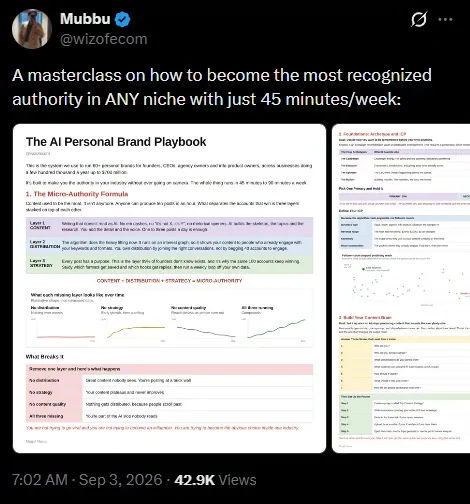
Mubbu (@wizofecom), co-founder of Mogul Media, published a three-slide playbook for becoming the recognized authority in any niche in 45 to 90 minutes a week, without going on camera. The system is the one his team uses to run 60+ personal brands for founders, CEOs, agency owners, and info product owners whose businesses range from a few hundred thousand a year to $700 million.
The core claim is that content is no longer a moat. Anyone can produce ten posts in an hour. What separates winning accounts is three stacked layers: content that does not read as AI, distribution through the interest graph rather than engagement begging, and a weekly strategy loop run off your own data. Missing any one layer stalls the account. Running all three compounds.
The rest of the playbook is installation, not inspiration. Pick one archetype and hold it 70/20/10. Define an ICP the algorithm can read (business type, revenue range, keywords, micro-communities). Build a "content brain" so AI stops sounding generic. Then run a four-step weekly research loop, publish from seven post types on a seven-day calendar, and spend the first 30 days standing the machine up.
The stated goal is not virality and not influencer status. It is becoming the obvious choice inside one industry. The same system can be run yourself, done with you, or done for you. The only question is who operates it.
Content volume collapsed as a differentiator the moment AI made ten posts an hour cheap. Reach now tracks whether the system can tell who you are for, whether you show up in the conversations your buyers already watch, and whether each post has a purpose you can measure. Founders who only write, or only post, or only "do AI" stall for structural reasons, not talent reasons.
This playbook matters because it treats personal brand as an operating system with a weekly cadence, not a talent contest. The 45-minute constraint forces the work onto the layers that actually move an account: voice on top of an AI skeleton, interest-graph distribution, and a closed research loop. That is a usable model for anyone who needs authority without becoming a full-time creator.
Key Points
- Content is no longer the moat. Anyone can produce ten posts in an hour. Winning accounts stack three layers: content, distribution, and strategy.
- Layer 1 is writing that does not read as AI. AI builds the skeleton, topics, and research. You add detail and voice. One to three posts a day is enough.
- Layer 2 is distribution on the interest graph. Own it by joining the right conversations, not by begging 40 accounts to engage.
- Layer 3 is strategy. Every post has a purpose. Study which formats get saved and which hooks get replies, then run a weekly loop off your own data. This is the layer 99% of founders miss.
- Remove distribution and great content hits a brick wall. Remove strategy and the account plateaus. Remove content quality and people scroll past. Remove all three and you are AI slop.
- Pick one primary archetype and hold it 70/20/10. The four options are Contrarian, Educator, Operator, and Builder. Trying to be all four dilutes you into noise.
- The algorithm reads keywords, not follower counts. Define ICP by business type, revenue range, exact keywords, and micro-communities. A 2,000-follower account with a clear signal can out-reach a 200,000-follower account with none.
- Build a content brain once. Answer seven questions out loud into a Loom, write project instructions, paste the transcript, upload three months of analytics, and open two chats: topic generation and performance analysis.
- The weekly research loop is performance review, market analysis of 10 to 100 niche accounts, trend analysis by topic vs format, then ten generated topics with name, description, anchor question, and recommended format. End with a written hypothesis you will measure.
- Seven post types sit over 151 styles: Conviction, Story, Promotion, Doc post, Hot take, Vulnerability, Transformation. Cut AI tells on sight: em dashes, "it's not X, it's Y", rhetorical openers, TED intros, stacked one-line closers, and same-shape posts.
- The seven-day calendar assigns a job to each day: top of funnel, authority, story, distribution, promotion, repurpose, strategy. Friday is the sell day. Sunday writes next week's hypothesis.
- First 30 days: Week 1 foundations, Week 2 publish and install the research engine, Week 3 generate topics from data, Week 4 run the performance loop and keep it. Run it yourself, done with you, or done for you.
Quotable
AI-generated from source material. Verify important details against the original source.
Mubbu
You are not trying to go viral and you are not trying to become an influencer. You are trying to become the obvious choice inside one industry.
The goal statement that keeps the system from collapsing into growth-hacking or personal-brand theatre.
Mubbu
Content + Distribution + Strategy = Micro-Authority
The whole playbook in one equation. Any missing term explains why a "good content" account still dies.
Mubbu
Follower count stopped predicting reach. What decides distribution now is how clearly the system can tell who you're for.
The ICP and keyword work is not branding fluff. It is how the interest graph decides who sees you.
Mubbu
Set it up once and it knows you. Skip it and you get the same output as everyone else using the same tool.
The content-brain setup is the unglamorous step that determines whether AI is an amplifier or a generic slop machine.
Mubbu
Your audience spots AI from a mile away, and the second they do, they're gone.
Why the AI tell list exists, and why voice-on-top-of-skeleton is non-negotiable.
Mubbu
Same system either way. The only question is who operates it.
Closes the DIY / done-with-you / done-for-you fork without changing the operating model.
Concepts
The Authority Stack
Micro-Authority
Not fame and not virality. Being the obvious choice inside one industry because content, distribution, and strategy are stacked. The unit of success is recognition among a defined ICP, not follower count.
Three Layers
Content is human voice on an AI skeleton. Distribution is interest-graph placement by joining the right conversations. Strategy is purpose per post plus a weekly loop off your own save/reply data. One to three posts a day is enough if the stack is intact.
What Missing Layers Do
No distribution: nothing moves. No strategy: early growth, then a ceiling. No content quality: reach decays as people tune out. All three running: compounds. All three missing: AI slop nobody reads.
Foundations
Four Archetypes
Contrarian (challenger energy, backed hot takes). Educator (frameworks and what actually works). Operator (CEO view, behind the scenes). Builder (building in public: numbers, wins, losses). A follow is an exchange for predictable value or predictable entertainment, which requires picking a lane.
70 / 20 / 10 Hold
Primary archetype 70%, secondary 20%, remainder 10%. The founders you can describe in one sentence picked a lane and held it. All four at once is noise.
ICP the Algorithm Can Read
Business type, revenue range (floor and ceiling), exact keywords the buyer uses, and the micro-communities where they already engage. Find those pockets, then own them. Clarity of signal now beats follower count.
The Operating System
Content Brain
A persistent AI project that already knows who you are, who you attract, which conversations you own, what proof you have, how you sound, what you need created, and how the project gets smarter. Without this context, every prompt produces the same generic output as everyone else.
Weekly Research Loop
Four steps every seven days: performance review of the last week, market analysis of 10 to 100 niche accounts, trend analysis split by topic vs format, topic generation of ten named ideas with description, anchor question, and recommended format. Each pass makes the next set of topics better. Close with a written hypothesis you will measure.
Seven Post Types
Conviction, Story, Promotion, Doc post, Hot take, Vulnerability, Transformation. Underneath sit 151+ styles. Use the ones performing now as structure rather than inventing a new shape each day.
AI Tell List
Cut on sight: em dashes, "it's not X, it's Y", rhetorical openers, TED talk intros, stacked one-line closers, and every post the same shape. These are the tells that make an audience leave.
Seven-Day Calendar
Mon: top of funnel / hot take plus one native LinkedIn post. Tue: authority proof and engage dream accounts. Wed: story and reply to DMs. Thu: distribution by quoting a live conversation. Fri: promotion (the sell day). Sat: repurpose what worked. Sun: strategy review and next week's hypothesis.
Three Ways to Run It
Run it yourself from the document. Done with you: control panel, AI suite, and a strategist. Done for you: they run it, about 45 minutes a week from you. Same system. Different operator.
Implementation
AI-generated from source material. Verify important details against the original source.
Pick the archetype and write the one-sentence lane
Choose Contrarian, Educator, Operator, or Builder as the 70% primary. Name a 20% secondary. Write the one sentence that describes you. If you cannot say it in one sentence, you have not picked a lane yet. Do this before any drafting.
Define the four ICP fields
Write business type, revenue range (floor and ceiling), the exact keywords the buyer uses, and the micro-communities where they already engage. Those four fields are what the interest graph reads. Follower count is not one of them.
Answer the seven questions out loud into a Loom
Who are you. Who are you trying to attract. What conversations do you want to own. What evidence can you give it. How should it sound. What should it help you create. How will the project get smarter over time. Speak it. Do not type a polished version first.
Stand up the content-brain project
Create a project called "My Content Strategy". Write instructions covering niche, ICP, and archetype. Paste the Loom transcript. Upload three months of X analytics if you have them. Open two chats only: topic generation and performance analysis.
Install the weekly research loop
Every seven days: upload last week's winners and losers, pull top content from 10 to 100 niche accounts, split what is working by topic vs format, then ask for ten topics with name, short description, anchor question, and recommended format. Write the hypothesis: "I think this format will perform best this week based on last week's data, and I will measure it with X."
Draft from the seven types and cut the AI tells
Use Conviction, Story, Promotion, Doc post, Hot take, Vulnerability, or Transformation as the frame. Let AI build the skeleton. You add detail and voice. Before publishing, strip em dashes, "it's not X, it's Y", rhetorical openers, TED intros, stacked one-line closers, and same-shape posts.
Run the seven-day calendar
Mon top of funnel plus one native LinkedIn post. Tue authority proof and engage dream accounts. Wed story and DMs. Thu quote a live conversation in your space. Fri sell. Sat repurpose what worked. Sun review data and write next week's hypothesis. One to three posts a day is the ceiling.
Use the first 30 days as a stand-up, not a content binge
Week 1: foundations and the seven answers. Week 2: start publishing off those foundations and install the research engine. Week 3: generate topics from data instead of a blank page. Week 4: run the performance loop, then keep running it every week after that.
Tools & Resources
These resources are curated in two groups. Mentioned Resources are pulled directly from the source material, and Suggested Resources are added to help you expand and apply the ideas beyond the original.
The following resources may contain affiliate links. As an Amazon Associate I earn from qualifying purchases at no extra cost to you. This does not influence the placement of links on this page.
Mentioned Resources
| Resource | Description |
|---|---|
| Original X post | The source thread and three-slide playbook from Mubbu (@wizofecom). |
| Mogul Media | The agency behind the system. Done-with-you and done-for-you personal brand operations for 7- and 8-figure founders, designed around a 45-minute weekly involvement. |
| X | Primary distribution surface in the playbook. Analytics from X are uploaded into the content-brain project. Thursday's job is quoting a live conversation on the platform. |
| Named in the Monday calendar slot: one native LinkedIn post as part of top-of-funnel work. | |
| Loom | Capture tool for the seven foundation answers. Speak them out loud into a Loom, then paste the transcript into the project so the model hears your actual voice. |
| ChatGPT Projects | The "create a project called My Content Strategy" step maps to a persistent AI project with instructions, transcript, and analytics, plus two dedicated chats for topics and performance. |
Suggested Resources
| Resource | Description |
|---|---|
| KNOWN, Mark W. Schaefer | A method for becoming the go-to name in a defined field. Useful companion to the micro-authority goal and the "obvious choice inside one industry" frame. |
| Building a StoryBrand 2.0, Donald Miller | Clarifies the one-sentence lane and the customer-facing message before you feed an AI project a pile of undifferentiated context. |
| This Is Marketing, Seth Godin | Positioning as deciding who it is for and who it is not for. Maps directly onto archetype hold and ICP keywords. |
| Building a Second Brain, Tiago Forte | A durable capture-and-retrieve system for the evidence, transcripts, and weekly performance notes the content brain is supposed to compound. |
| 1,000 True Fans, Kevin Kelly | The counting argument behind niche authority. A small, correctly defined ICP is enough if you actually own the conversation. |
AI Prompt
AI-generated from source material. Verify important details against the original source.
Custom Prompt