Overview
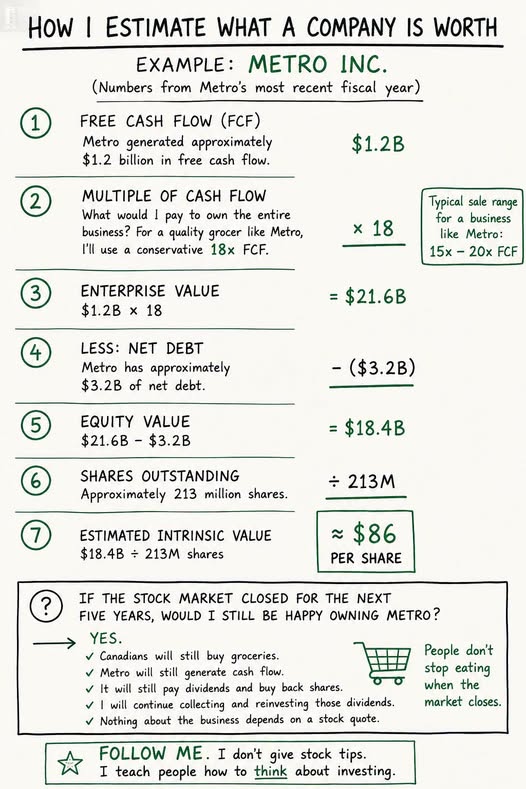
This post was seen online, shared publicly on Facebook by Jayson Lowe as one of his "LoweDown" posts. It pairs a written commentary with a hand drawn infographic that walks through a complete back of the napkin valuation of Metro Inc., the Canadian grocer, using figures from Metro's most recent fiscal year.
Lowe, who describes himself as a dividend investor of 32 years, frames the exercise around one guiding principle: approximate what the business is worth before you look at the share price. The infographic executes that principle in seven steps. Metro's roughly $1.2 billion in free cash flow is multiplied by a conservative 18x (within a typical 15x to 20x sale range for a quality grocer) to produce a $21.6 billion enterprise value. Subtracting approximately $3.2 billion of net debt leaves $18.4 billion of equity value, and dividing by roughly 213 million shares outstanding yields an estimated intrinsic value of approximately $86 per share.
The valuation is then stress tested against a behavioural question: if the stock market closed for the next five years, would he still be happy owning Metro? His answer is yes, because Canadians will still buy groceries, Metro will still generate cash flow, it will still pay dividends and buy back shares, and nothing about the business depends on a daily stock quote.
The post ends with a demonstration of discipline rather than a stock tip. Asked whether he would add more Metro to his DRIP portfolio today, Lowe answers no. The market is not offering the business at a meaningful discount to his estimate, so he waits. The lesson, in his words, is not the number. The lesson is the process: value the business first, then compare it to the stock price, never the other way around.
The framework here is durable because every input is observable and every step is arithmetic. Free cash flow, a sanity checked multiple, net debt, and share count are available for any public company, which makes the seven step sequence a repeatable template rather than a one off opinion about Metro. It compresses the core of intrinsic value investing into something that fits on a single page.
The five year market closure test is the more valuable half of the post. It converts an abstract idea, owning businesses rather than tickers, into a concrete pass or fail question that filters out companies whose appeal depends on price momentum rather than cash generation. Businesses that survive the test tend to be the ones worth holding through drawdowns.
Finally, the ending models the hardest part of any valuation discipline: doing nothing. Lowe likes the business, owns the business, and still declines to buy more because price and value are not far enough apart. That separation of conviction about a business from action on its stock is the behaviour most investors fail to execute, and seeing it demonstrated on a real position makes the page worth keeping.
Key Points
- Value the business before looking at the share price. Lowe never starts with the quote; he always starts with the business, then compares his estimate against what the market is asking.
- The valuation begins with free cash flow, not earnings. Metro generated approximately $1.2 billion in free cash flow in its most recent fiscal year, and that figure anchors everything that follows.
- The multiple is framed as an ownership question: what would you pay to own the entire business? For a quality grocer like Metro, Lowe uses a conservative 18x free cash flow, inside a typical 15x to 20x sale range for a business of this type.
- Free cash flow times the multiple gives enterprise value: $1.2 billion times 18 equals $21.6 billion for the whole business.
- Net debt is subtracted from enterprise value to reach equity value. Metro carries approximately $3.2 billion of net debt, leaving $18.4 billion for shareholders.
- Equity value divided by roughly 213 million shares outstanding produces an estimated intrinsic value of approximately $86 per share.
- The five year market closure test is the ownership filter: if the stock market shut down for five years, would you still be happy owning the business? Metro passes because people do not stop eating when the market closes.
- A business worth owning generates cash, pays dividends, and buys back shares regardless of whether a quote is visible. Nothing about Metro's operations depends on the stock market being open.
- An intrinsic value estimate only triggers action at a meaningful discount. If the market asks more than the business is worth, the disciplined response is to wait for a higher calibre opportunity.
- Lowe applies his own rule against his own holding: despite owning Metro and liking the business, he would not add more to his DRIP portfolio at current prices.
- The lesson is not the $86 figure. The lesson is the repeatable process, which can be applied to any dividend paying business using publicly available numbers.
- Lowe explicitly does not give stock tips; his stated purpose is teaching people how to think about dividend investing and the infinite banking concept.
Quotable
AI-generated from source material. Verify important details against the original source.
Jayson Lowe
"I NEVER start with the share price. I ALWAYS start with the business."
Why it works: two short parallel sentences that capture the entire framework. The emphasis on never and always makes the rule absolute and easy to remember under pressure.
Jayson Lowe
"People don't stop eating because the stock market closes."
Why it works: one concrete image separates the business from its quote. It anchors the abstract idea of intrinsic value to something a reader cannot argue with.
Jayson Lowe
"The lesson isn't the number. The lesson is the process."
Why it works: it inoculates the reader against treating $86 as a target and redirects attention to the repeatable method, which is the actual asset being shared.
Jayson Lowe
"Value the business first. Then compare it to the stock price. Never the other way around."
Why it works: a three sentence operating instruction. It states the sequence, the comparison, and the prohibition, leaving no ambiguity about the order of operations.
Jayson Lowe
"If the market offered me the business at a meaningful discount, I would get interested. If it asks me to pay more than I think it's worth, I have the discipline to wait for a higher calibre opportunity."
Why it works: it defines both the buy trigger and the default state of waiting. Most valuation content stops at the number; this quote explains what to do with it.
Concepts
Core Framework
Business First Valuation
The organizing principle of the post is sequence. An investor forms an independent estimate of what the business is worth using its own financials, and only afterward looks at the market quote to see whether an opportunity exists. Reversing the order, starting with the price and rationalizing toward it, anchors the analysis to whatever the market currently believes. Lowe credits this single habit with protecting his capital across 32 years of dividend investing.
The Seven Step Valuation Sequence
The infographic compresses a full private buyer valuation into seven steps: identify free cash flow, choose a multiple, compute enterprise value, subtract net debt, arrive at equity value, divide by shares outstanding, and read off intrinsic value per share. For Metro the chain runs $1.2B in FCF, times 18, equals $21.6B enterprise value, minus $3.2B net debt, equals $18.4B equity value, divided by 213M shares, equals approximately $86 per share. Every input is publicly available, which makes the sequence portable to any listed company.
Free Cash Flow as the Starting Point
The framework begins with free cash flow rather than revenue, net income, or EBITDA. Free cash flow is the money left after the business pays for its operations and capital needs, which makes it the closest proxy for what an owner could actually extract or redeploy. Starting here filters out businesses that report accounting profits but consume cash, and it aligns the valuation with the dividend investor's real concern: the cash available to pay and grow distributions.
The Ownership Multiple
Rather than treating the multiple as a market statistic, Lowe frames it as a purchase decision: what would I pay to own the entire business? For a quality grocer he selects 18x free cash flow, deliberately inside the typical 15x to 20x range at which comparable businesses change hands. The framing matters because it forces the multiple to be justified by business quality, stability, and durability rather than by whatever the sector happens to trade at this quarter.
Supporting Mechanics
Enterprise Value Versus Equity Value
Multiplying cash flow by the ownership multiple prices the whole enterprise, debts included. A buyer of the entire company inherits its obligations, so net debt (total debt less cash on hand) must be subtracted to find what the equity is actually worth. For Metro this is the difference between $21.6 billion and $18.4 billion. Skipping this step is one of the most common retail valuation errors, and it systematically flatters leveraged companies.
Per Share Translation
Equity value divided by shares outstanding converts the whole company estimate into the unit an investor can actually buy. The share count also embeds a quiet quality signal: a company that buys back shares, as Metro does, shrinks the denominator over time, raising per share intrinsic value even when total business value is flat. This is why buybacks appear on Lowe's list of reasons he is happy to own the business.
Approximation Over Precision
Every figure in the walkthrough is prefixed with approximately, and the final answer is presented as roughly $86, not $86.15. The method deliberately trades false precision for speed and robustness. If a thesis only works when the inputs are exact, it is not a margin of safety thesis. Rounded inputs and a conservative multiple mean the estimate is meant to identify obvious gaps between price and value, not to arbitrate small ones.
Behavioural Filters
The Five Year Market Closure Test
The central thought experiment: if the stock market closed for the next five years, would you still be happy owning this business? The test strips away price feedback entirely and asks whether the underlying enterprise justifies ownership on its own. Metro passes on five grounds: Canadians will still buy groceries, the company will still generate cash flow, it will still pay dividends and buy back shares, the owner will keep collecting and reinvesting those dividends, and nothing about the business depends on a stock quote. Any holding that fails this test is a speculation on price, not an investment in a business.
Discount Discipline
An intrinsic value estimate is only useful when paired with a rule for acting on it. Lowe's rule has two sides: interest is triggered only when the market offers the business at a meaningful discount to the estimate, and when it does not, the correct action is to wait. The post demonstrates the rule live. Despite liking and owning Metro, he declines to add more at current prices because the discount is not there. The discipline is symmetrical: conviction in a business does not obligate buying its stock at any price.
Dividends as the Return Engine
The framework sits inside a broader dividend reinvestment (DRIP) strategy. The return comes from collecting distributions and reinvesting them into more shares, compounding ownership of the cash flow stream over time. This is why the market closure test is livable rather than hypothetical for Lowe: a closed market interrupts quotes, not dividend cheques. Price only matters at the moments of buying at a discount or, rarely, selling at an excess.
Process Over Prediction
Lowe explicitly refuses the stock tip framing. The $86 figure will go stale as Metro's cash flow, debt, and share count change, but the seven step process and the five year test do not expire. Teaching the process rather than the answer is also the content strategy of the post itself: it positions the author as an educator on how to think about dividend investing and the infinite banking concept rather than a source of picks.
Implementation
AI-generated from source material. Verify important details against the original source.
Pick a Business, Not a Ticker
Choose a company whose product or service you can explain in one sentence and whose demand survives recessions, ideally a dividend payer. Commit to completing the full valuation before looking at the current share price, and write your estimate down before you check the quote.
Find Free Cash Flow
Free cash flow is operating cash flow minus capital expenditures. Where to find it: open the company's annual report and go to the statement of cash flows. Take the line "cash flows from operating activities" and subtract "additions to property, plant and equipment" (the capital expenditure line, sometimes listed under investing activities). For Canadian companies the filings are on SEDAR+ or the investor relations page; many data platforms also report free cash flow as a precomputed figure, but verify it against the filing at least once. Round it to a clean number the way the source rounds Metro to $1.2 billion; precision beyond two significant figures adds nothing at this stage.
Choose an Ownership Multiple
Ask what a rational buyer would pay for the entire business, not what the sector trades at. Research the typical private sale range for businesses of similar quality and stability, then pick a figure at or below the middle of that range. Metro, a durable grocer, gets 18x inside a 15x to 20x range; a cyclical or lower quality business deserves less. For background on how valuation multiples work, Investopedia's explainer covers the mechanics and the common pitfalls.
Compute Enterprise Value and Strip Out Net Debt
Multiply free cash flow by your multiple to get enterprise value. Then find net debt on the balance sheet: add long term debt, the current portion of long term debt, and (for a conservative reading) lease obligations, then subtract cash and cash equivalents. Some annual reports state net debt directly in the MD&A or a capital management note. Subtract it from enterprise value; the remainder is equity value, which is what shareholders actually own. Never skip the debt step; it is where leveraged companies hide their risk.
Divide by Shares Outstanding
Divide equity value by shares outstanding to produce your intrinsic value per share. Where to find the count: the cover page of the annual report or annual information form states shares outstanding as of a recent date, the share capital note in the financial statements gives the detailed breakdown, and the bottom of the income statement reports the weighted average basic and diluted counts used for earnings per share. Use the diluted figure to be conservative. Note whether the count has been shrinking through buybacks or growing through issuance, since the direction of that trend changes per share value over time even when the business itself is unchanged.
Run the Five Year Market Closure Test
Before comparing anything to price, ask: if the stock market closed for five years, would I still be happy owning this business? List the specific reasons, as the source does for Metro (demand persists, cash flow continues, dividends and buybacks continue). If you cannot fill that list without mentioning the share price, the company fails the test regardless of how cheap it looks.
Only Now Compare Price to Value
Check the current quote against your written estimate of intrinsic value. Define ahead of time what a meaningful discount means to you, for example 20 to 30 percent below your figure, which is the same idea Benjamin Graham called a margin of safety, and act only when the market crosses that line. If the price sits at or above your estimate, the correct action is documented patience, not a smaller position.
Apply the Rule to Businesses You Already Own
Rerun the sequence on existing holdings the way the source does with Metro. Liking a business you own does not justify adding at any price. Separating your conviction in the business from your willingness to buy the stock today is the discipline the whole framework exists to build.
Refresh Annually and Keep a Log
Update the inputs once a year when new fiscal figures arrive, and keep a simple log of each estimate, the date, and the prevailing price. Over time the log becomes evidence of whether your multiples and discount thresholds are calibrated, and it turns a one page trick into a durable personal valuation process.
Tools & Resources
Mentioned Resources
| Resource | Description |
|---|---|
| Original Facebook Post | The source post and infographic, published as part of Jayson Lowe's recurring "LoweDown" series. |
| The Banker Next Door | Jayson Lowe's Facebook page covering dividend investing and the infinite banking concept. |
| Metro Inc. Investor Relations | Primary source for the financial figures used in the walkthrough: free cash flow, net debt, and shares outstanding from Metro's annual reports. |
Suggested Resources
| Resource | Description |
|---|---|
| Berkshire Hathaway Shareholder Letters | Warren Buffett's letters are the original home of the owner mindset and the market closure framing that this post applies to Metro. |
| SEDAR+ | Canada's official filing system for public company disclosures, where Metro's audited financial statements can be verified directly. |
| The Intelligent Investor by Benjamin Graham | The foundational text on intrinsic value, margin of safety, and treating market prices as an offer to be judged rather than a verdict to be obeyed. |
| The Little Book of Valuation by Aswath Damodaran | A compact treatment of cash flow based valuation (Updated Edition) that formalizes the enterprise value to equity value bridge used in the seven step sequence. |
| Investopedia | Reference library for every term in the framework: free cash flow, enterprise value, net debt, shares outstanding, intrinsic value, and margin of safety. The Implementation tab links directly to the relevant explainers. |
| TradingView | Charting and fundamentals platform useful for pulling free cash flow, debt, and share count data when running the sequence on other companies. |
Source Material
Original source attribution, metadata, and publication details are available in the Overview tab. This source material may originate from a transcript, article, report, presentation, newsletter, notes, or other media. Where applicable, transcription, formatting, extraction, or attribution errors may exist. Verify against the original source before republishing or relying upon the material.
Post Text
If the stock market closed for the next five years, would you still be happy owning the businesses in your portfolio?
Let's use Metro Inc. as one of the companies I am a share owner of.
I've been investing in dividend paying companies for 32 years.
Over those three decades, one principle has protected my capital and guided my decisions.
Approximate what the business is worth before you look at the share price.
How do I approximate what Metro is worth?
See the infographic.
I NEVER start with the share price.
I ALWAYS start with the business.
And my answer to the 5 year question is yes.
Why?
People don't stop eating because the stock market closes.
Nothing about Metro's business depends on me being able to see a stock quote every day.
The lesson isn't the number.
The lesson is the process.
Value the business first. Then compare it to the stock price. Never the other way around.
If the market offered me the business at a meaningful discount, I would get interested.
If it asks me to pay more than I think it's worth, I have the discipline to wait for a higher calibre opportunity.
And so would I add more Metro to my DRIP portfolio today?
No.
I don't give stock tips. I teach people how to think about dividend investing and the infinite banking concept. Follow me if that interests you.
And that my friends, is today's "LoweDown",
Jay
Infographic Transcription
Title: How I Estimate What a Company Is Worth. Example: Metro Inc. (Numbers from Metro's most recent fiscal year.)
Step 1. Free Cash Flow (FCF): Metro generated approximately $1.2 billion in free cash flow. Value shown: $1.2B.
Step 2. Multiple of Cash Flow: "What would I pay to own the entire business? For a quality grocer like Metro, I'll use a conservative 18x FCF." Multiplier shown: x 18. Sidebar note: typical sale range for a business like Metro is 15x to 20x FCF.
Step 3. Enterprise Value: $1.2B x 18 = $21.6B.
Step 4. Less: Net Debt: Metro has approximately $3.2B of net debt. Shown as minus ($3.2B).
Step 5. Equity Value: $21.6B minus $3.2B = $18.4B.
Step 6. Shares Outstanding: approximately 213 million shares. Shown as divided by 213M.
Step 7. Estimated Intrinsic Value: $18.4B divided by 213M shares = approximately $86 per share.
Closing question: "If the stock market closed for the next five years, would I still be happy owning Metro?" Answer: Yes, with five checkmarked reasons: Canadians will still buy groceries. Metro will still generate cash flow. It will still pay dividends and buy back shares. I will continue collecting and reinvesting those dividends. Nothing about the business depends on a stock quote. Margin note beside a shopping cart drawing: "People don't stop eating when the market closes."
Footer: "Follow me. I don't give stock tips. I teach people how to think about investing."
AI Prompt
AI-generated from source material. Verify important details against the original source.
AI Implementation Prompt
CONTEXT You are working from a valuation framework published by Jayson Lowe, a Canadian dividend investor of 32 years, in a Facebook post and hand drawn infographic titled "How I Estimate What a Company Is Worth." The core thesis: approximate what a business is worth before you ever look at its share price, then act only when the market offers the business at a meaningful discount to that estimate. The framework is demonstrated on Metro Inc., a Canadian grocer, using figures from its most recent fiscal year: approximately $1.2 billion in free cash flow, multiplied by a conservative 18x ownership multiple (within a typical 15x to 20x sale range for a quality grocer) to give $21.6 billion enterprise value, less approximately $3.2 billion net debt for $18.4 billion equity value, divided by roughly 213 million shares outstanding for an estimated intrinsic value of approximately $86 per share. The valuation is paired with a behavioural filter, the five year market closure test: if the stock market closed for the next five years, would the investor still be happy owning the business? Metro passes because demand for groceries persists, cash flow continues, dividends and buybacks continue, and nothing about the business depends on a visible stock quote. The post closes with Lowe declining to add more Metro to his dividend reinvestment (DRIP) portfolio at current prices because the discount is insufficient, demonstrating that conviction in a business does not obligate buying its stock at any price. KEY PRINCIPLES 1. Sequence is everything: value the business first, then compare to the stock price, never the reverse. 2. Free cash flow is the starting input because it represents what an owner could actually extract or redeploy. 3. The multiple is an ownership question (what would I pay for the whole business?), justified by business quality, not by current sector trading levels. 4. Net debt must be subtracted from enterprise value before dividing by shares; skipping this flatters leveraged companies. 5. Approximation beats false precision; rounded inputs and conservative multiples are features, not shortcuts. 6. The five year market closure test filters investments from speculations: a holding must justify itself without price feedback. 7. Action requires a meaningful discount between price and estimated value; otherwise the correct behaviour is to wait. 8. Discipline applies to existing holdings: liking a business you own does not justify adding at any price. 9. Dividends and reinvestment are the return engine; the quote only matters at the moments of buying or selling. 10. The lesson is the process, not the number; every output goes stale, the method does not. KEY LEVERS The primary leverage points in this framework are: (1) input quality, meaning accurate free cash flow, net debt, and diluted share count from primary filings; (2) multiple selection, the single largest driver of the estimate and the easiest place to fool yourself; (3) the discount threshold, the predefined gap between price and value that triggers buying; (4) the closure test, which controls what enters the candidate pool at all; and (5) patience, the default state between opportunities. WHAT THIS IS NOT This is not a discounted cash flow model; there are no projections, growth rates, or discount rates, only current cash flow and a sanity checked multiple. It is not a trading system, a momentum strategy, or a market timing tool; it says nothing about when prices will converge to value. It is not a claim that $86 is Metro's correct price; the figure is one investor's rounded estimate from one fiscal year and expires as the inputs change. It is not a recommendation to buy Metro; the author himself declines to buy at current prices. And it is not the same as buying low P/E stocks; the framework can reject statistically cheap companies that fail the five year closure test. IMPLEMENTATION MODES 1. Apply: walk me through the seven step sequence on a specific company I name, prompting me for each input and flagging where to find it in the filings. 2. Build: help me construct a reusable worksheet or spreadsheet template that takes FCF, multiple, net debt, and share count and outputs intrinsic value per share. 3. Diagnose: review a valuation I have already done and identify where my multiple, debt treatment, or share count may be flattering the result. 4. Critique: stress test the framework itself against a company where it might mislead, such as a cyclical, a high growth reinvestor, or a company with volatile FCF. 5. Teach: explain any step of the sequence at whatever depth I request, from beginner definitions to the enterprise value to equity value bridge. 6. Screen: help me design criteria for finding businesses likely to pass the five year market closure test before I run any numbers. 7. Decision Support: given my estimate and the current price, help me define and hold a meaningful discount threshold instead of rationalizing a purchase. 8. Content Creation: help me turn a valuation I have completed into clear educational content in my own voice, process focused, without giving stock tips. 9. Research Expansion: identify what additional information (segment data, lease obligations, dilution history) would most improve the reliability of a given estimate. AI OPERATING INSTRUCTIONS Stay grounded in this framework; do not drift into unrelated valuation methods unless I ask for a comparison. Focus on practical implementation with real numbers over abstract theory. Avoid generic motivational language about investing. Ask clarifying questions when my inputs are ambiguous or my company choice does not fit the framework's assumptions. Challenge weak assumptions directly, especially optimistic multiples and ignored debt. Draw connections to related ideas, such as margin of safety or owner earnings, when they sharpen the work. Never present any output as a stock recommendation; frame everything as process education. Do not use em dashes in any output. GUIDED DISCOVERY Ask me up to three questions, one at a time, to determine: (1) what I am trying to accomplish, (2) which ideas from this source are most relevant to my situation, (3) how these concepts could be applied most effectively. Once you understand my situation, help me build a practical implementation plan.