Overview
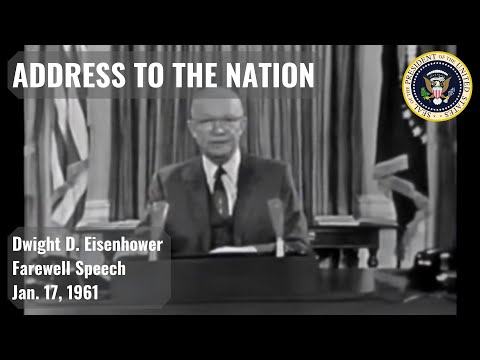
On January 17, 1961, three days before handing the presidency to John F. Kennedy, Dwight D. Eisenhower addressed the American people for the final time from the Oval Office. The speech had been years in development. It was not a warm farewell -- it was a structured warning from a man who had spent half a century in public service, much of it in uniform, and who understood the machinery of power more intimately than almost anyone alive at the time.
The core warning concerned what Eisenhower called the military-industrial complex: the new and unprecedented conjunction of a massive standing military with a permanent armaments industry. He acknowledged this combination was necessary -- the United States could no longer improvise its defenses in a time of crisis as it once had -- but he insisted that necessity did not mean safety. The total influence of this structure, he warned, was felt in every city, every statehouse, and every federal office. Unwarranted influence, whether sought or unsought, was a genuine danger to democratic processes and to liberty itself.
A second warning, less frequently quoted but equally significant, addressed the transformation of scientific research. The solitary inventor had been replaced by organized teams funded through government contracts. Universities, historically the fountainhead of free ideas, were now dependent on federal allocations. The danger ran both ways: scholars could be dominated by the power of government money, and public policy could be captured by a scientific-technological elite. Both outcomes were threats to self-governance.
Eisenhower framed all of this within a broader philosophy of balance -- between public and private, between present needs and future obligations, between military strength and democratic purpose. He explicitly warned against mortgaging the material and political heritage of future generations for the convenience of the present. And he was candid about his disappointment: after eight years, a lasting peace was not in sight, only avoided. He left office with hope tempered by honesty.
The speech is roughly sixteen minutes long. It has grown in stature every decade since it was delivered. The phrase "military-industrial complex" has entered the permanent vocabulary of political analysis, but the full speech rewards close reading -- it is more nuanced, more philosophically grounded, and more practically oriented than the single phrase suggests.
Why This Matters
Eisenhower was not a peacenik or an anti-military voice. He was the Supreme Commander of Allied Forces in Europe during the Second World War and a two-term president who oversaw the build-up of American nuclear deterrence throughout the Cold War. His warning about the military-industrial complex carries weight precisely because it came from someone who had operated at the center of that complex for decades. When a general warns about the military, it is worth listening.
The structural forces he identified have not diminished. Defense spending, the revolving door between the Pentagon and defense contractors, the concentration of federal research funding in a small number of institutions, and the political influence of industries dependent on government contracts are all more entrenched today than they were in 1961. The dynamics he described -- the unwarranted accumulation of influence by any single sector, however necessary its core function -- continue to shape policy in ways that most citizens never see.
His warning about the scientific-technological elite is equally relevant. The concentration of technical expertise in a small number of actors, and the dependence of public policy on their judgments, raises questions about democratic accountability that have no easy answers. Who governs when the governing decisions require specialized knowledge that elected officials do not possess and cannot easily evaluate?
Beyond the specific warnings, the speech models a kind of political thinking that is now rare: a willingness to identify structural dangers, to name the institutions that create them, and to trust the public with the honest assessment. Eisenhower left office not with reassurance but with a considered brief on what could go wrong. That clarity is itself a resource.
Key Points
- Eisenhower opened by noting that America was ten years past the midpoint of a century that had seen four major wars, and that American leadership depended not only on material strength but on how that strength was used in the interest of peace and human betterment.
- He identified a "hostile ideology" as the defining threat of the era -- global in scope, atheistic in character, ruthless in purpose, and insidious in method -- and argued that meeting it would require sustained, steady effort rather than emotional or transitory sacrifices.
- He warned against the recurring political temptation to reach for spectacular, costly solutions to problems -- dramatic increases in defense, sweeping agricultural programs, massive research expansions -- without weighing each proposal against the broader need for balance.
- He defined balance as the central discipline of sound governance: between public and private economy, between necessary and merely desirable, between national requirements and individual duties, and between present action and future welfare.
- The United States had never before maintained a permanent armaments industry. Until recent decades, makers of civilian goods could be converted to defense production when needed. That era was over. A permanent defense establishment of vast proportions was now a structural feature of American life.
- The conjunction of a massive military establishment with a large arms industry was new in the American experience. Its economic, political, and even spiritual influence was felt in every level of government and society -- and this influence posed a genuine risk of becoming unwarranted.
- "We must guard against the acquisition of unwarranted influence, whether sought or unsought, by the military-industrial complex. The potential for the disastrous rise of misplaced power exists and will persist."
- Only an alert and knowledgeable citizenry, Eisenhower argued, could compel the proper meshing of the defense machinery with peaceful methods and goals -- so that security and liberty could prosper together.
- Scientific research had been transformed from an individual enterprise to a massive federal undertaking. Government contracts had become a substitute for intellectual curiosity. Universities now conducted research not from independent discovery but from federal direction and funding.
- This created a dual danger: first, that the nation's scholars would become dominated by federal employment and the power of money; and second, that public policy itself would become the captive of a scientific-technological elite whose accountability to democratic processes was limited.
- He warned against living only for today -- against plundering the resources of tomorrow for present ease and convenience. Mortgaging the material assets of future generations also risked the loss of their political and spiritual heritage.
- He closed with a frank admission of disappointment: despite eight years of effort, a lasting peace was not achieved -- only avoided. He remained hopeful, but was honest that much remained to be done.
Quotable
AI-generated from source material. Verify important details against the original source.
Dwight D. Eisenhower
"In the councils of government, we must guard against the acquisition of unwarranted influence, whether sought or unsought, by the military-industrial complex. The potential for the disastrous rise of misplaced power exists and will persist."
The defining statement of the speech and one of the most quoted lines in American political history. Its weight comes from its source: a five-star general and two-term president naming the danger that he himself had inhabited for decades. The phrase "whether sought or unsought" is crucial -- it makes clear the concern is structural, not conspiratorial.
Dwight D. Eisenhower
"Only an alert and knowledgeable citizenry can compel the proper meshing of the huge industrial and military machinery of defense with our peaceful methods and goals, so that security and liberty may prosper together."
This is the operational prescription that follows the warning. Eisenhower did not believe the government could police itself -- the check had to come from citizens who understood what they were watching. The phrase "prosper together" signals that he was not arguing for weakness, only for balance.
Dwight D. Eisenhower
"The prospect of domination of the nation's scholars by Federal employment, project allocations, and the power of money is ever present and is gravely to be regarded. Yet, in holding scientific research and discovery in respect, as we should, we must also be alert to the equal and opposite danger that public policy could itself become the captive of a scientific-technological elite."
Less cited than the military-industrial complex warning but equally prescient. Eisenhower identified the two-way risk: government corrupting science, and science capturing government. Both are observable dynamics in modern policy-making.
Dwight D. Eisenhower
"We cannot mortgage the material assets of our grandchildren without risking the loss also of their political and spiritual heritage. We want democracy to survive for all generations to come, not to become the insolvent phantom of tomorrow."
A line that extends the speech's concern from military-industrial influence to fiscal and generational responsibility. "The insolvent phantom of tomorrow" is an unusually vivid image for a political speech -- and a memorable compression of a serious idea.
Dwight D. Eisenhower
"Good judgment seeks balance and progress; lack of it eventually finds imbalance and frustration."
A precise, aphoristic statement of the speech's central governing principle. It functions as both description and prescription -- this is how good governance works, and this is what failure looks like. Short enough to remember, dense enough to apply.
Concepts and Ideas
Core Warnings
The Military-Industrial Complex
Prior to World War II, the United States had no permanent arms industry. When crises arose, civilian manufacturers were converted to military production. By 1961 that was no longer possible -- the nature of modern warfare and deterrence required a standing industrial capacity dedicated to defense. Three and a half million people were directly employed in the defense establishment. Annual military spending exceeded the total net income of all American corporations.
Eisenhower was not arguing this development was wrong. He explicitly said the need was imperative. What he was arguing was that this scale of influence -- economic, political, and spiritual -- created structural conditions for misplaced power that the country had never faced before. The phrase "whether sought or unsought" was deliberate: the danger was not simply corruption or conspiracy, but the natural gravitational pull of a massive concentrated interest on every decision made in its vicinity.
The Scientific-Technological Elite
The transformation of scientific research from individual enterprise to federally funded institutional activity created a second, parallel risk. Universities and research institutions that had historically been sources of independent intellectual inquiry were now, in large part, extensions of federal funding priorities. The government contract had become a substitute for intellectual curiosity.
Eisenhower saw this as a two-way danger. On one side, scholars and institutions could be dominated by the need for federal money, shaping their work to match funding priorities rather than independent inquiry. On the other side, and more subtly, public policy could become captive to the conclusions of technical experts whose judgments were difficult for democratic processes to evaluate or challenge. Expertise and democratic accountability exist in tension, and Eisenhower was one of the first major political figures to name that tension explicitly.
Unwarranted Influence as a Structural Problem
Throughout the speech, Eisenhower used the phrase "unwarranted influence" carefully. He was not alleging that military contractors were corrupt or that scientists were dishonest. He was describing something more systemic: the way that large concentrations of institutional interest, even when their core purpose is legitimate and necessary, naturally generate pressure on decision-making that goes beyond what is warranted by that purpose alone.
This is a useful analytical frame for evaluating any powerful institution or industry -- not whether it is bad in itself, but whether its influence on governance, policy, and public discourse has grown beyond what the underlying purpose can justify. The question applies to defense, to finance, to technology, to pharmaceutical companies, and to many other sectors with sustained federal relationships.
Governing Principles
Balance as the Central Discipline of Governance
Eisenhower returned to the concept of balance repeatedly throughout the speech. He enumerated specific pairs: public economy and private economy, cost and hoped-for advantage, the clearly necessary and the comfortably desirable, national requirements and individual duties, and actions of the moment and the national welfare of the future.
This was not a vague appeal to moderation. Eisenhower was arguing that governance is fundamentally an exercise in maintaining equilibrium among competing legitimate claims, and that the failure to maintain that equilibrium -- even in the direction of something genuinely good, like defense or research -- inevitably produces imbalance and frustration. The discipline of balance is active, not passive: it requires constant weighing, not simply avoiding extremes.
The Temptation of the Spectacular Solution
Eisenhower described a recurring political temptation: the idea that some dramatic, costly action -- a huge defense buildup, a sweeping agricultural program, a massive research initiative -- could serve as a miraculous solution to complex problems. The temptation is understandable. Crises produce pressure for visible, decisive responses. But each spectacular proposal, however promising on its own terms, must be evaluated against the broader requirement for balance among national programs.
This is a sharp critique of a certain style of political leadership that prioritizes the appearance of decisive action over the harder discipline of proportionate response. It applies across the political spectrum and across eras.
Intergenerational Obligation
Eisenhower's warning about mortgaging the assets of future generations was not purely fiscal -- though it included fiscal responsibility. His deeper point was that the political and spiritual heritage of a democracy is as real and as fragile as its material assets, and that both can be consumed by short-term thinking. A democracy that mortgages its future for present convenience may find that the political infrastructure -- the habits, institutions, and shared commitments that make self-governance possible -- has been degraded in ways that are hard to reverse.
Supporting Concepts
The Alert and Knowledgeable Citizenry
Eisenhower's prescription for the dangers he identified was not institutional reform or regulatory constraint -- it was an informed public. Only citizens who understood what the military-industrial complex was and how it worked could generate the political will to constrain its influence. This placed a high burden on civic education and on the public's willingness to engage with structural questions that are complex and not immediately visible in daily life.
This is a demanding standard, and Eisenhower knew it. But his career had given him no illusions about the reliability of institutions to police themselves. External pressure, generated by a citizenry that understood the stakes, was the only reliable check.
The New Permanence of the Defense Establishment
One of the speech's sharpest historical observations was that the United States had crossed a threshold it could not uncross. The old model -- in which a commercial economy could be mobilized for defense when needed and then demobilized afterward -- was gone. The nature of nuclear deterrence, the pace of technological development, and the global scope of American commitments all required a standing military-industrial apparatus that would persist in peacetime indefinitely.
This was not a complaint. Eisenhower accepted it as a reality. But accepting it meant accepting that the political and social dynamics it generated -- the lobbying, the budget pressures, the career incentives aligned with continued defense spending -- were also permanent features of American governance, not temporary conditions that would resolve themselves.
Disarmament with Mutual Honor
In the final sections of the speech, Eisenhower articulated a vision of international order built on mutual trust and respect among equals -- not on the threat of destruction. He described disarmament as a "continuing imperative" and expressed genuine disappointment that it had not been achieved during his presidency. His model was a conference table, however scarred by past failures, rather than a battlefield.
He was not naive about this. He acknowledged that war had been avoided during his tenure, and he counted that as real progress. But he was clear-eyed that avoidance was not peace, and that the goal of genuine disarmament remained both necessary and unfinished.
Implementation
AI-generated from source material. Verify important details against the original source.
Apply the "Unwarranted Influence" Test to Any Powerful Institution
When evaluating any institution, industry, or actor with significant political or economic power, ask whether its influence on policy and public discourse is proportionate to the legitimate function it serves. The question is not whether the institution is corrupt or whether its core purpose is valid -- it is whether the gravitational pull it exerts on decisions extends beyond what that purpose can justify. This test applies to defense contractors, financial institutions, technology companies, pharmaceutical firms, and any other sector with sustained relationships with government.
Evaluate Policy Proposals Against the Balance Requirement
Before endorsing or advocating for any large-scale policy initiative, apply Eisenhower's balance framework. What does this proposal cost, and what are the hoped-for advantages? What does it crowd out? Does it serve the clearly necessary, or the merely comfortably desirable? How does it affect the relationship between public and private economy? What is its impact on future generations, not just current ones? Dramatic proposals that promise miraculous results are a specific red flag -- the temptation to reach for the spectacular is a known failure mode in governance.
Trace the Funding Behind Expert Consensus
Eisenhower's warning about the scientific-technological elite is a practical reminder to investigate who funds the research that shapes policy. When expert consensus is invoked to justify a policy position, ask: who are the experts, who funds their work, and what incentives shape their conclusions? This is not an invitation to dismiss expertise -- it is a requirement to evaluate it with the same structural lens applied to any other concentrated interest. Independence of inquiry is a meaningful variable, not a given.
Build and Maintain Genuine Civic Literacy on Structural Issues
Eisenhower placed the responsibility for constraining misplaced power on an "alert and knowledgeable citizenry." This is a demanding standard that requires active effort. It means understanding how defense budgets are constructed and who benefits from them, how federal research funding shapes institutional priorities, and how the revolving door between industry and government operates. Structural issues are less visible than individual scandals -- but they are more consequential and more durable.
Distinguish Between Necessary and Unwarranted
Eisenhower was explicit that the military-industrial complex was necessary -- the distinction was between necessary and unwarranted influence. This distinction is useful in many contexts. The legitimacy of an institution's core function does not automatically justify every extension of its influence. Learning to make this separation -- between the necessary core and the accumulated excess -- is a practical skill in policy analysis, organizational management, and political evaluation.
Apply Intergenerational Accounting to Major Decisions
For any significant decision involving public resources, debt, or institutional design, ask what the obligation to future generations looks like. This goes beyond fiscal accounting -- it includes the political infrastructure (institutional norms, checks and balances, civic habits) that makes self-governance possible. Decisions that are materially profitable in the short term but that erode institutional capacity or public trust carry real long-term costs that standard accounting does not capture.
Use the Speech as a Structural Audit Tool
Read the Farewell Address as a checklist for any political or institutional environment you are evaluating. Is there a large, permanently funded interest with political influence beyond its core function? Are public policy decisions dependent on a small community of technical experts with limited democratic accountability? Is there pressure to reach for spectacular solutions rather than balanced ones? Is the current generation consuming resources -- material, political, or institutional -- that belong to those who come after? These are diagnostic questions, not rhetorical ones.
Hold Disappointment Honestly Without Abandoning Hope
Eisenhower's admission that he was leaving office with a sense of disappointment -- that lasting peace had not been achieved -- is a model of intellectual honesty in public life. He did not pretend to a success he had not achieved. He also did not abandon hope or counsel despair. This combination -- honest acknowledgment of what was not accomplished, combined with continued commitment to the goal -- is a durable posture for anyone working on problems that are larger than any single tenure, project, or administration.
Tools & Resources
Mentioned Resources
| Resource | Description |
|---|---|
| Farewell Address (YouTube) | Full video recording of the January 17, 1961 farewell address as broadcast, uploaded by War and Military Documentaries. |
| Eisenhower Presidential Library -- Farewell Address | Official archive page with audio recording, reading copy of the speech, and a full set of primary source documents including drafts, memos, and correspondence related to the address. |
| Reading Copy of the Speech (PDF) | The actual reading copy used by Eisenhower during the broadcast, held in the DDE Papers as President, Speech Series. Primary source document from the National Archives. |
| January 17, 1961 Press Release (PDF) | The official press release containing the full text of the address as distributed on the day of delivery. Useful for clean textual reference against the spoken version. |
| Farewell Address Subject Guide (PDF) | Research guide compiled by the Eisenhower Presidential Library covering the history, drafting, and scholarly reception of the farewell address. A useful starting point for deeper research. |
Suggested Resources
| Resource | Description |
|---|---|
| Origin of the Term "Military-Industrial Complex" (PDF) | A 1985 letter from Ralph Williams to Martin Teasley clarifying the drafting history and origin of the specific phrase "military-industrial complex" -- useful for anyone interested in how the speech was constructed. |
| Eisenhower Speeches Archive | Full archive of Eisenhower's major speeches, providing context for the farewell address within the full arc of his public communication over eight years. |
| January 7, 1961 Draft with Milton Eisenhower Edits (PDF) | A late draft of the speech with handwritten editing by Milton Eisenhower, showing the refinement process in the final ten days before delivery. Valuable for understanding how the key passages evolved. |
| 1966 Congressional Record -- Significance of the Speech (PDF) | Senate Congressional Record entry from January 1966 on the significance of Eisenhower's military-industrial complex warning, five years after delivery -- captures early institutional reception of the speech. |
| Congressional Reaction Memo, March 1961 (PDF) | Memo from Bryce Harlow to Eisenhower and Nixon summarizing Congressional reaction to the farewell address, providing a contemporaneous political read on how the speech landed. |
Historical Retrospective
AI-generated assessment based on publicly available historical record. Intended as analytical orientation, not definitive scholarship. Verify claims against primary sources.
The Military-Industrial Complex
Defense Spending and Permanent Armaments Industry -- Confirmed and Deepened
Eisenhower warned that the United States had crossed a threshold it could not uncross: a permanent armaments industry was now a structural feature of American life, not a temporary wartime condition. That forecast proved entirely correct. Defense spending has remained a dominant feature of the federal budget every decade since 1961, averaging well above the levels Eisenhower himself oversaw. The major defense contractors -- Lockheed, Boeing, Raytheon, General Dynamics, Northrop Grumman -- became some of the most durable and politically influential corporations in American history. The revolving door between the Pentagon, defense contractors, and Congress became a recognized and studied phenomenon. By the early 2000s, the United States was spending more on defense than the next several nations combined, and that ratio has remained roughly stable. The permanent armaments industry Eisenhower described not only survived but became structurally embedded in hundreds of congressional districts, making it politically difficult to reduce regardless of strategic need.
Unwarranted Influence on Government -- Substantially Confirmed
The concern that a large defense establishment would accumulate influence in every level of government beyond what its core function warranted has been extensively documented in the decades since 1961. Congressional earmarks directed funds to defense projects in specific districts regardless of military need. Defense contractors became among the largest lobbying spenders in Washington. Senior military officers routinely moved into contractor roles upon retirement. The Iraq War (2003) produced one of the most prominent modern examples: the relationship between government decision-makers and defense and reconstruction contractors drew sustained scrutiny from journalists, congressional investigators, and historians. Whatever one's view of specific decisions, the structural dynamic Eisenhower named -- concentrated institutional interest exerting disproportionate pull on policy -- has been observable and documented across administrations of both parties.
The Scientific-Technological Elite
Federal Dominance of Research Funding -- Confirmed
Eisenhower's observation that government contracts were becoming a substitute for independent intellectual curiosity proved durable. Federal funding -- through agencies like DARPA, NIH, NSF, and the Department of Energy -- became the primary driver of large-scale scientific research in the United States. The concentration of that funding in a relatively small number of elite research universities (MIT, Stanford, Caltech, and a handful of others) shaped the intellectual priorities of entire fields. Scholars and institutions that depended on federal grants learned, often implicitly, to frame their work in terms that matched funding priorities. The old image of the solitary inventor or the independently curious academic did not disappear, but it was no longer the dominant mode of producing major scientific advances in most fields.
Public Policy Captive to a Scientific-Technological Elite -- Partially Confirmed, Contested
Eisenhower's "equal and opposite danger" -- that public policy could become captive to a scientific-technological elite -- has played out unevenly and remains contested. In some domains, expert consensus has driven policy in ways that are difficult to evaluate democratically: nuclear weapons strategy in the Cold War, epidemiological modeling during COVID-19, and climate policy all involved technical judgments made by small expert communities that shaped decisions affecting hundreds of millions of people. Critics from across the political spectrum have argued, at various points, that elected representatives deferred excessively to technical experts -- or, conversely, that they failed to defer enough. The question Eisenhower posed -- who governs when governing requires knowledge that democratic processes cannot easily evaluate? -- has not been resolved and is arguably more acute today, particularly with the rise of AI systems whose design and deployment are controlled by a very small number of technical actors.
The Balance Doctrine
Balance Between Public and Private Economy -- Mixed Record
Eisenhower's call for balance between the public and private economy reflected a mid-century consensus that has since fractured repeatedly. The decades following 1961 saw significant expansions of federal programs (the Great Society), followed by significant contraction pressures (Reagan-era deregulation), followed by further cycles of expansion and retrenchment. The specific balance Eisenhower advocated -- neither crowding out private initiative nor abandoning public function -- proved difficult to maintain politically, as each successive era tended to overcorrect in one direction or the other. His broader point that imbalance in either direction produces frustration has been borne out, though different observers draw the lesson differently depending on their starting priors.
Intergenerational Obligation and Fiscal Heritage -- Not Heeded
Eisenhower's warning against mortgaging the material and political assets of future generations has been most visibly violated in the fiscal domain. The United States national debt at the time of his speech was approximately $290 billion. By 2026 it exceeded $36 trillion. Structural deficits became a permanent feature of federal budgeting through administrations of both parties, driven by defense spending, entitlement programs, tax policy, and a bipartisan political consensus that the costs of near-term decisions could be deferred. Eisenhower's deeper warning -- that the political and spiritual heritage of democracy could be consumed by short-term thinking -- is harder to measure but has found expression in concerns about institutional erosion, declining civic trust, and the weakening of norms that historically constrained political behavior.
Temptation of the Spectacular Solution -- Repeatedly Confirmed
Eisenhower's warning about the political temptation to reach for dramatic, costly solutions as miraculous fixes for complex problems has been confirmed in almost every decade since 1961. The War on Poverty, the War on Drugs, the War on Terror, the 2009 stimulus, and the COVID-era spending packages each reflected, in different degrees, the pattern Eisenhower described: a crisis produces pressure for a large, visible response, and proportionate or incremental approaches are harder to sell politically. This is not an argument that any of these responses was wrong -- some were more warranted than others -- but the structural temptation he identified, and the difficulty of resisting it, has proven to be a durable feature of American governance.
Peace and Disarmament
Disarmament as a Continuing Imperative -- Unfulfilled
Eisenhower left office expressing genuine disappointment that disarmament with mutual honor had not been achieved, and describing it as a continuing imperative. His assessment of where things stood in January 1961 proved to be near the beginning of a decades-long impasse. The Cuban Missile Crisis followed eighteen months later, bringing the world closer to nuclear exchange than at any point before or since. Subsequent arms control agreements -- SALT I and II, START, the INF Treaty -- produced real reductions in deployed warheads from Cold War peaks, but the underlying dynamics of deterrence and great-power competition proved far more durable than the optimists of 1961 hoped. As of the mid-2020s, arms control architecture has deteriorated significantly: Russia suspended its participation in the New START treaty in 2023, and the framework of bilateral nuclear agreements that characterized much of the post-Cold War era is under severe strain.
War Has Been Avoided -- Partially True, with Major Exceptions
Eisenhower's qualified hope -- that war had been avoided even if lasting peace had not been achieved -- applied specifically to great-power conflict. On that narrow measure, the record through the 2020s is better than many Cold War observers feared: the United States and Soviet Union (and later Russia and China) have not fought each other directly. But Eisenhower's framing understated the scale of armed conflict that has occurred since 1961. The Vietnam War, which escalated dramatically within three years of his farewell address, killed approximately 58,000 Americans and an estimated two to three million Vietnamese. American military involvement in Korea, the Persian Gulf, Afghanistan, Iraq, and a range of smaller engagements has been nearly continuous. The speech's hope for a world settling differences with intellect and decent purpose rather than arms has not been realized.
The Alert and Knowledgeable Citizenry
Civic Knowledge as the Primary Check -- The Most Uncertain Verdict
Eisenhower placed the burden of constraining misplaced power on an alert and knowledgeable citizenry. By most measures, that citizenry has not emerged in the form he envisioned. Survey data consistently shows limited public knowledge of federal budget composition, defense contracting relationships, or the structural dynamics of federal research funding. At the same time, the late twentieth and early twenty-first centuries did produce significant episodes of citizen-driven institutional accountability -- investigative journalism, whistleblower activity, public interest litigation, and grassroots political mobilization -- that partially fulfilled the role he described. The internet made more information available than at any prior point in history, while simultaneously demonstrating that information abundance does not automatically produce informed citizens. The relationship between civic knowledge, civic engagement, and actual constraint on institutional excess remains, sixty-five years after the speech, genuinely unresolved.
Source Material
Original source attribution, metadata, and publication details are available in the Overview tab. This source material may originate from a transcript, article, report, presentation, newsletter, notes, or other media. Where applicable, transcription, formatting, extraction, or attribution errors may exist. Verify against the original source before republishing or relying upon the material.
[00:03]
From the White House in the office of the President of the United States we present an address by Dwight D. Eisenhower. This is the farewell address for President Eisenhower whose eight years as Chief Executive come to an end at noon Friday. Mr. Eisenhower has chosen this time for his final speech. Ladies and gentlemen, the President of the United States.
[00:30]
Good evening my fellow Americans. First I should like to express my gratitude to the radio and television networks for the opportunities they have given me over the years to bring reports and messages to our nation. My special thanks go to them for the opportunity of addressing you this evening. Three days from now, after half a century in the service of our country, I shall lay down the responsibilities of office as in traditional and solemn ceremony the authority of the presidency is vested in my successor.
[01:01]
This evening I come to you with a message of leave-taking and farewell, and to share a few final thoughts with you my country. Like every other citizen, I wish the new President and all who will labor with him Godspeed. I pray that the coming years will be blessed with peace and prosperity for all our people. I expect their President and the Congress to find essential agreement on issues of great moment the wise resolution of which will better shape the future of the nation.
[01:40]
My own relations with the Congress, which began on a remote and tenuous basis when long ago a member of the Senate appointed me to West Point, have since ranged to the enemy during the war and immediate post-war period, and finally to the mutually interdependent during these past eight years. In this final relationship the Congress and the administration have on most vital issues cooperated well to serve the nation's good rather than mere partisanship, and so have assured that the business of the nation should go forward. So my official relationship with the Congress ends in a feeling on my part of gratitude that we have been able to do so much together.
[02:30]
We now stand ten years past the midpoint of a century that has witnessed four major wars among great nations. Three of these involved our own country. Despite these holocausts, America is today the strongest, the most influential, and most productive nation in the world. Understandably proud of this preeminence, we yet realize that America's leadership and prestige depend not merely upon our unmatched material progress, riches, and military strength, but on how we use our power in the interest of world peace and human betterment.
[03:10]
Throughout America's adventure in free government, our basic purposes have been to keep the peace, to foster progress in human achievement, and to enhance liberty, dignity, and integrity among peoples and among nations. To strive for less would be unworthy of a free and religious people. Any failure traceable to arrogance or our lack of comprehension or readiness to sacrifice would inflict upon us grievous hurt both at home and abroad.
[03:45]
Progress toward these noble goals is persistently threatened by the conflict now engulfing the world. It commands our whole attention, absorbs our very beings. We face a hostile ideology -- global in scope, atheistic in character, ruthless in purpose, and insidious in method. Unhappily the danger it poses promises to be of indefinite duration. To meet it successfully there is call for not so much the emotional and transitory sacrifices of crisis, but rather those which enable us to carry forward steadily, surely, and without complaint the burdens of a prolonged and complex struggle -- with liberty the stake.
[04:40]
Only thus shall we remain, despite every provocation, on our charted course toward permanent peace and human betterment. Crises there will continue to be. In meeting them, whether foreign or domestic, great or small, there is a recurring temptation to feel that some spectacular and costly action could become the miraculous solution to all current difficulties. A huge increase in newer elements of our defenses, development of unrealistic programs to cure every ill in agriculture, a dramatic expansion in basic and applied research -- these and many other possibilities, each possibly promising in itself, may be suggested as the only way to the road we wish to travel.
[05:30]
But each proposal must be weighed in the light of a broader consideration: the need to maintain balance in and among national programs -- balance between the private and the public economy, balance between the cost and hoped-for advantages, balance between the clearly necessary and the comfortably desirable, balance between our essential requirements as a nation and the duties imposed by the nation upon the individual, balance between actions of the moment and the national welfare of the future. Good judgment seeks balance and progress; lack of it eventually finds imbalance and frustration.
[06:15]
The record of many decades stands as proof that our people and their government have in the main understood these truths and have responded to them well in the face of threat and stress. But threats new in kind or degree constantly arise. Of these I mention two only. A vital element in keeping the peace is our military establishment. Our arms must be mighty, ready for instant action, so that no potential aggressor may be tempted to risk his own destruction.
[07:01]
Our military organization today bears little relation to that known of any of my predecessors in peacetime, or indeed by the fighting men of World War II or Korea. Until the latest of our world conflicts, the United States had no armaments industry. American makers of plowshares could with time and as required make swords as well. But we can no longer risk emergency improvisation of national defense. We have been compelled to create a permanent armaments industry of vast proportions. Added to this, three and a half million men and women are directly engaged in the defense establishment. We annually spend on military security alone more than the net income of all United States corporations.
[08:01]
Now this conjunction of an immense military establishment and a large arms industry is new in the American experience. The total influence -- economic, political, even spiritual -- is felt in every city, every statehouse, every office of the federal government. We recognize the imperative need for this development. Yet we must not fail to comprehend its grave implications. Our toil, resources, and livelihood are all involved; so is the very structure of our society. In the councils of government, we must guard against the acquisition of unwarranted influence, whether sought or unsought, by the military-industrial complex. The potential for the disastrous rise of misplaced power exists and will persist.
[09:00]
We must never let the weight of this combination endanger our liberties or democratic processes. We should take nothing for granted. Only an alert and knowledgeable citizenry can compel the proper meshing of the huge industrial and military machinery of defense with our peaceful methods and goals, so that security and liberty may prosper together.
[09:25]
Akin to, and largely responsible for, the sweeping changes in our industrial-military posture has been the technological revolution during recent decades. In this revolution, research has become central; it also becomes more formalized, complex, and costly. A steadily increasing share is conducted for, by, or at the direction of the federal government. Today the solitary inventor, tinkering in his shop, has been overshadowed by task forces of scientists in laboratories and testing fields.
[10:00]
In the same fashion, the free university, historically the fountainhead of free ideas and scientific discovery, has experienced a revolution in the conduct of research. Partly because of the huge costs involved, a government contract becomes virtually a substitute for intellectual curiosity. For every old blackboard there are now hundreds of new electronic computers. The prospect of domination of the nation's scholars by Federal employment, project allocations, and the power of money is ever present and is gravely to be regarded. Yet, in holding scientific research and discovery in respect, as we should, we must also be alert to the equal and opposite danger that public policy could itself become the captive of a scientific-technological elite. It is the task of statesmanship to mold, to balance, and to integrate these and other forces, new and old, within the principles of our democratic system, ever aiming toward the supreme goals of our free society.
[11:15]
Another factor in maintaining balance involves the element of time. As we peer into society's future, we -- you and I and our government -- must avoid the impulse to live only for today, plundering for our own ease and convenience the precious resources of tomorrow. We cannot mortgage the material assets of our grandchildren without risking the loss also of their political and spiritual heritage. We want democracy to survive for all generations to come, not to become the insolvent phantom of tomorrow.
[12:00]
During the long lane of the history yet to be written, America knows that this world of ours, ever growing smaller, must avoid becoming a community of dreadful fear and hate, and be instead a proud confederation of mutual trust and respect. Such a confederation must be one of equals. The weakest must come to the conference table with the same competence as do we, protected as we are by our moral, economic, and military strength. That table, though scarred by many past frustrations, cannot be abandoned for the certain agony of disarmament of the battlefield. Disarmament, with mutual honor and confidence, is a continuing imperative.
[13:01]
Together we must learn how to compose differences, not with arms, but with intellect and decent purpose. Because this need is so sharp and apparent, I confess that I lay down my official responsibilities in this field with a definite sense of disappointment. As one who has witnessed the horror and the lingering sadness of war -- as one who knows that another war could utterly destroy this civilization which has been so slowly and painfully built over thousands of years -- I wish I could say tonight that a lasting peace is in sight. Happily, I can say that war has been avoided. Steady progress toward our ultimate goal has been made. But so much remains to be done. As a private citizen, I shall never cease to do what little I can to help the world advance along that road.
[14:02]
So in this, my last good night to you as your President, I thank you for the many opportunities you have given me for public service in war and in peace. I trust that in that service you find some things worthy. As for the rest of it, I know you will find ways to improve performance in the future. You and I -- my fellow citizens -- need to be strong in our faith that all nations under God will reach the goal of peace with justice. May we be ever unswerving in devotion to principle, confident but humble with power, diligent in pursuit of the nation's great goals.
[14:45]
To all the peoples of the world, I once more give expression to America's prayerful and continuing aspiration: We pray that peoples of all faiths, all races, all nations, may have their great human needs satisfied; that those now denied opportunity shall come to enjoy it to the full; that all who yearn for freedom may experience its few spiritual blessings; those who have freedom will understand also its heavy responsibility; that all who are insensitive to the needs of others will learn charity; and that the scourges of poverty, disease, and ignorance will be made to disappear from the earth; and that in the goodness of time, all peoples will come to live together in a peace guaranteed by the binding force of mutual respect and love.
[15:40]
Now, on Friday noon, I am to become a private citizen. I am proud to do so. I look forward to it. Thank you and good night.
AI Prompt
AI-generated from source material. Verify important details against the original source.
AI Implementation Prompt
CONTEXT This prompt is built from Dwight D. Eisenhower's Farewell Address, delivered on January 17, 1961, three days before he handed the presidency to John F. Kennedy. It was broadcast live from the Oval Office and has been described as one of the most significant speeches in American political history. Eisenhower was the Supreme Commander of Allied Forces in Europe during World War II and served two full terms as the 34th President of the United States. He came to the speech with a half-century of public service and an intimate knowledge of the military, the defense industry, and the machinery of federal government. The speech has two primary warnings. The first is the military-industrial complex: the new and unprecedented combination of a permanent standing military with a large permanent arms industry. Eisenhower acknowledged this development was necessary -- the United States could no longer improvise its defenses in a crisis -- but warned that the total influence of this combination, economic, political, and spiritual, reached into every level of government and society, and that the potential for the disastrous rise of misplaced power was real and persistent. The second warning concerned the transformation of scientific research. The federal government had become the dominant funder of research, replacing independent inquiry with contract-driven work. Universities had been changed in character. This created a dual risk: scholars dominated by the power of federal money, and public policy captured by a scientific-technological elite with limited democratic accountability. Running through both warnings was a governing philosophy of balance -- between public and private, between necessary and desirable, between present action and future obligation. Eisenhower identified the temptation to reach for spectacular, costly solutions as a recurring political failure mode. He closed with an honest admission of disappointment that lasting peace had not been achieved, combined with a continued commitment to the goal. KEY PRINCIPLES 1. Unwarranted influence is a structural problem, not a personal one. The danger from the military-industrial complex does not require corruption or bad intent -- it emerges from the natural gravitational pull of concentrated institutional interest on decisions made in its vicinity. 2. Balance is the central discipline of sound governance. Good judgment seeks balance across competing legitimate claims. Lack of balance eventually produces imbalance and frustration, regardless of the direction of the excess. 3. Necessary does not mean unlimited. The legitimacy of an institution's core function does not justify every extension of its influence. The gap between necessary and unwarranted is where democratic oversight must operate. 4. Expertise and democratic accountability are in genuine tension. When public policy depends on technical judgments that elected officials cannot easily evaluate, democratic control of outcomes is weakened. This is not an argument against expertise -- it is an argument for designing systems that preserve accountability. 5. The spectacular solution temptation is a known failure mode. Political crises generate pressure for dramatic, visible responses. Proportionate and balanced responses are harder to communicate and easier to dismiss as insufficient. 6. An alert and knowledgeable citizenry is the primary check on institutional excess. Eisenhower placed the burden of constraint on citizens who understood what they were watching, not on institutions policing themselves. 7. Intergenerational obligation extends beyond fiscal balance. The political and spiritual heritage of a democracy -- its institutions, norms, and civic habits -- is as real and as fragile as its material assets, and can be consumed by short-term thinking. 8. Disappointment and hope are not contradictory. Honest acknowledgment of what was not achieved is compatible with continued commitment to the goal. Self-deception about outcomes serves no one. 9. Disarmament requires mutual honor, not unilateral concession. A conference table scarred by past failures is still preferable to a battlefield. The goal is a confederation of equals, not submission or dominance. 10. The threshold crossed cannot easily be uncrossed. The permanence of the defense establishment was not a temporary condition -- it was a structural feature of modern American governance. Accepting that reality was the starting point for managing it responsibly. KEY LEVERS - Institutional concentration of influence: the primary mechanism by which misplaced power accumulates - Democratic accountability: the counter-force that must be actively maintained, not assumed - Balance across competing legitimate claims: the operating discipline of sound governance - Civic knowledge and alertness: the distributed capacity that generates political will to constrain excess - Intergenerational accounting: the time horizon that reveals costs invisible in short-term analysis WHAT THIS IS NOT This speech is not an argument for pacifism or against military spending. Eisenhower was explicit that the defense establishment was necessary. It is not a conspiracy theory. The danger he described does not require hidden coordination -- it emerges from the structural dynamics of large concentrated interests operating near political decision-making. It is not a partisan document. The warnings apply equally to Democratic and Republican administrations, to liberal and conservative policy agendas. It is not a call for dismantling institutions. The prescription is oversight, balance, and informed citizenship -- not abolition. It is not a general anti-government argument. Eisenhower's concern was with specific structural dynamics, not with the legitimacy of government as such. IMPLEMENTATION MODES 1. Structural Analysis -- help me identify and evaluate the structural dynamics Eisenhower described in a specific institution, industry, or policy domain I am examining. 2. Balance Audit -- help me apply Eisenhower's balance framework to a specific policy proposal, budget decision, or organizational initiative to identify imbalances I may be missing. 3. Influence Mapping -- help me trace the funding, incentives, and institutional relationships that shape a particular area of public policy or expert consensus. 4. Historical Comparison -- help me compare the dynamics Eisenhower described in 1961 to analogous situations in other eras or other sectors. 5. Civic Literacy Development -- help me build or teach a deeper understanding of the structural issues Eisenhower identified, for myself or for an audience I am addressing. 6. Communication and Writing -- help me draw on the speech's arguments and framing in writing or communication on political, institutional, or governance topics. 7. Decision Support -- help me apply the principles from this speech to a specific decision I am facing that involves institutional influence, resource allocation, or intergenerational obligation. 8. Research Expansion -- help me identify additional sources, scholars, or frameworks that build on the arguments Eisenhower made in this speech. 9. Critical Evaluation -- help me stress-test the speech's arguments, identify where they have aged poorly, or find cases where the framework does not apply cleanly. 10. Scenario Planning -- help me think through what the dynamics Eisenhower described might look like in a specific future context -- in AI governance, in pharmaceutical policy, in energy transition, or in another domain where institutional concentration and technical expertise intersect with democratic decision-making. AI OPERATING INSTRUCTIONS Stay grounded in what Eisenhower actually said. The speech is specific and should be quoted or paraphrased accurately. Do not attribute positions to him that are not in the text. Focus on practical application. The speech is analytically useful -- help me use its framework to evaluate real situations, not just to understand history. Distinguish between the speech's structural arguments and conspiracy-style interpretations. The value of Eisenhower's framing is precisely that it does not require hidden bad actors -- it explains how misplaced power accumulates through ordinary institutional dynamics. Push back on weak applications. If I try to use the speech's framework in a way that is imprecise or that overgeneralizes, challenge the application. Draw connections where useful. The speech's arguments have clear parallels in institutional economics, political science, and organizational theory. Connect those when they add precision or explanatory power. Ask clarifying questions when the context is ambiguous. The speech is useful across a wide range of applications -- knowing more about my specific situation will make the analysis sharper. GUIDED DISCOVERY Ask me up to three questions, one at a time, to determine: (1) what I am trying to accomplish, (2) which arguments from this speech are most relevant to my situation, (3) how Eisenhower's framework could be applied most usefully to the specific context I am working in. Once you understand my situation, help me build a practical analysis or implementation plan grounded in the speech.