Overview
 Read the original on Substack
Dan Koe argues that the popular obsession with remembering everything you read is misguided. Retention is not the point of reading, and the compulsion to memorize is usually an unconscious status game. People want to sound smart. But sounding smart comes from understanding, not memorization, and understanding demands a different approach than the memorize-and-test model that school conditioned into us.
His central model is that learning is a cybernetic process. Borrowing from the Greek kybernetes (the helmsman who steers a ship), he frames learning as a feedback loop with four parts: a reference signal (the goal), a sensor (perception of your current state), a comparator (the gap between them, which is the error signal), and an actuator (behavior that closes the gap). Without a real goal there is no error signal, so there is no filter and no retention. Learning is an output process, because output is what demands and organizes the input.
The practical path has three moves. Become obsessed with a meaningful goal, often by sitting with where your current trajectory leads. Stop trying to "learn" and instead take the first step toward a project, because a project filters out everything that does not move it forward. And seek specific knowledge, the thing you uniquely do best, rather than hoarding general knowledge to feel productive.
The second half turns on the modern second brain. Koe does not call note systems useless, he calls them misused. Bookmarks and notes that are never revisited are wasted time. The model that actually worked historically was the commonplace book kept by figures like Marcus Aurelius, Leonardo da Vinci, Mark Twain, Montaigne, and Rick Rubin, where collected ideas were fuel for creation rather than a graveyard. He offers two ways to build a modern version: a Claude Code plus Obsidian setup with a couple of custom skills, or an auto-organizing tool like MyMind or his own Eden that embeds ideas in "meaning space" so they can be retrieved by meaning instead of keyword.
He closes the loop on creation. Curate ideas that represent your ideal mind, then build that mind through the act of creating. His writing process pairs a proven topic with a topic you are excited about, moves from braindump to outline to draft, and uses AI to remove friction rather than to articulate your own beliefs.
Why This Matters
The cybernetics framing corrects a mistake most people make. Retention gets treated as an input problem to be solved with better tools and techniques, when it is actually a downstream effect of having a real goal. That inversion is durable. It applies to any skill, any tool, and any era, because it is about the structure of motivation and attention rather than a specific app or method.
For anyone building a knowledge or intelligence system, the piece is a useful guard against tool worship. A second brain only earns its keep when its contents become fuel for output. The distinction between what is related (keyword match) and what is nearby (meaning and embeddings) is a concrete explanation of why some retrieval systems surface genuinely novel connections while others just return synonyms.
The creation section is a practical antidote to writer's block that ties straight back to the learning model. If you have no repository of ideas to pull from, you have nothing to synthesize. In a world where information is free and AI can produce it on demand, the value you offer is not the information but the point of view, and point of view is downstream of the ideas you have deliberately collected and made your own.
Details
Key Points
- If something is truly important, you will remember it. The urge to memorize everything is usually an unconscious status signal, not a learning strategy.
- Understanding, not memorization, is what makes someone sound smart, and the two require completely different approaches.
- Learning is a cybernetic feedback loop: a goal, a reading of your current state, the gap between them (the error signal), and corrective action.
- Without a real, intrinsically generated goal there is no error signal, so there is no filter and nothing gets retained.
- Learning is fundamentally an output process, because output is what demands and organizes the input.
- The chain runs one direction: a goal creates the error signal, the error signal creates the filter, the filter creates relevance, and relevance creates retention.
- People conditioned toward the default path filter out opportunities that sit outside it. The goals you hold determine what you are even able to notice.
- Treat your mind, body, relationships, and finances as projects. A project frames learning by filtering out anything that does not move it forward right now.
- Seek specific knowledge, the thing you uniquely do best, rather than hoarding general knowledge just to feel like you are learning.
- Second brains are not useless, they are misused. Notes and bookmarks that are never revisited are wasted effort.
- The historical model is the commonplace book, where a collection of ideas served as fuel for creation instead of a place ideas go to die.
- Meaning-based retrieval through embeddings surfaces novel connections that keyword search misses, which is what makes a repository useful during creation.
Quotable Moments
AI-generated from source material. Verify important details against the original source.
Dan Koe
"If you need to remember it, it's not important. If it's important, you will remember it."
Inverts the entire premise of the retention craze in a single line, which is why it opens the piece.
Dan Koe
"In reality, learning is an output process, because output demands input."
Compresses the thesis into one sentence and flips the default assumption that learning is about absorbing more material.
Dan Koe
"A goal creates the error signal. The error signal creates the filter. The filter creates relevance. The relevance creates retention."
Lays out the causal chain so cleanly that it doubles as a checklist for diagnosing why learning is not sticking.
Naval Ravikant
"Everyone should be figuring out what it is that they uniquely do best... that makes them irreplaceable."
Frames specific knowledge as the destination, which is the point of self-education over general study.
Devon Eriksen
"Don't get breathless about how 'smart' AI is. Leverage, instead, its ability to do rapid input and output for simple tasks on large datasets."
Sets a grounded expectation for AI that matches how the piece recommends using it, as a friction remover rather than a thinker.
Dan Koe
"When AI can create anything, curation matters more than ever."
Names the scarce skill in an age of infinite output and justifies the whole curation and point-of-view argument.
Concepts & Ideas
Core Frameworks
Learning as a Cybernetic Loop
Cybernetics comes from kybernetes, the helmsman who steers a ship. The helmsman does not point the boat once and walk away. He constantly reads the current conditions, compares them against the intended course, and adjusts. Learning works the same way through four parts: a reference signal (the goal), a sensor (perception of the current state), a comparator (the gap, which is the error signal), and an actuator (behavior that reduces the error).
The practical takeaway is that the loop cannot run without a target. A thermostat needs a set temperature before it can act. A person without a real goal has nothing to compare against, so no error is ever detected and no correction happens.
The Retention Chain
Retention is the last link in a chain, not the first. A goal creates the error signal. The error signal creates a filter. The filter creates relevance by screening out noise. Relevance creates retention. Trying to improve retention directly, with flashcards and spaced repetition, works on the wrong end of the chain. Fix the goal and retention follows.
Output-First Learning
Most people treat learning as an input process. They hoard material and try to absorb it through courses and fundamentals. Koe reverses this. Learning is an output process, because the act of producing something is what demands the input and tells your mind which pieces are worth keeping. You do not learn in order to eventually create. You create in order to learn.
Principles
Specific Knowledge over General Knowledge
School teaches general knowledge and the knowledge required to do a job. It does not teach you to navigate your own path. Self-education is the process of learning only what is necessary to reach a self-generated goal. The aim is specific knowledge, the thing you uniquely do best, which is what makes you hard to replace.
The example is learning After Effects or a guitar. You do not watch every tutorial or study music theory. You choose the project or the song, then learn only the technique needed for the next step. You stack techniques until the next project is easier, and eventually you can create your own.
The Project as a Filter
A project is simply a structured set of goals and milestones. Your mind, body, relationships, and finances can each be treated as a project. The value of a project is that it filters. Anything that does not directly move it forward is not worth learning right now, because you will not retain it anyway. When you want to learn something new, do not start learning. Take the first step toward the goal.
Curation over Consumption
When AI can generate anything, curation becomes the scarce skill. You need a curated space for ideas that spark inspiration, the opposite of an endless social feed. You do not dump everything in. You collect the ideas that would best represent your ideal mind, the lenses you use to make sense of the world.
Systems and Processes
The Commonplace Book (Second Subconscious)
Long before the marketed second brain, thinkers kept commonplace books. Marcus Aurelius' Meditations was essentially a private one. Leonardo da Vinci filled thousands of notebook pages. Twain, Montaigne, and Rick Rubin each had a version. The difference from the modern note hoarder is that their collections were fuel for creation. Seneca's metaphor was to gather pollen from many flowers and digest it into your own honey. In modern terms, steal like an artist.
Two Ways to Build a Modern Repository
Option one is a manual stack: Claude Code plus Obsidian. You store knowledge in an Obsidian vault and use two custom skills, one to save an idea into an inbox folder and one to process the inbox by adding tags, moving notes to the right folder, and adding backlinks. You also ask the AI to help define your taxonomy. Then you can ask it to search the vault for anything related to what you are writing.
Option two is an auto-organizing tool such as MyMind or Eden that tags, categorizes, and embeds everything you save, so retrieval is automatic and does not burn AI usage on every search.
Meaning Space vs Keyword Search
Keyword search and synonym matching find what is related. Embedding an idea as a long vector of numbers, roughly fifteen hundred coordinates that act like GPS for a thought, lets a system find what is nearby in meaning, even when two ideas share zero words. That is what surfaces novel connections, and it is the reason good creative work comes from meaning-based retrieval rather than keyword lookup.
The Writing Process
Pick a topic at the intersection of performance and excitement. Performance means topics that have already proven to do well, which you find by saving viral posts or using an outlier research tool. Excitement means topics you are curious about. Pairing a proven angle with your own curiosity is how you write what you want and still gain traction.
Then move braindump to outline to draft. Dump every idea that could fit, pull from your notes and library, then organize the pile into a simple problem, insight, solution structure before you write a single polished line.
AI as Friction Remover, Not Ghostwriter
The rule is not "never use AI." It is do not use AI to articulate your own beliefs and opinions. Use it the way you would use a mentor or editor while learning a skill. Ask for possible structures, for directions the piece could go, or to research something you do not understand. Copy pasting pure information (a standard explanation you would get from a search) is fine. You remain the one who decides what gets published, and you refine until it represents your values.
Observations and Warnings
Memorization as a Status Signal
The drive to remember everything is often not about learning at all. It is a wish to sound smart and impress people, reinforced by a school system that tested memorization. Recognizing the real motive is the first step to dropping a strategy that does not serve you.
The Second Brain Graveyard
Bookmarking and note taking feel like learning, but ideas that are never seen again are wasted time. Organization only matters if you intend to find something later, and most systems never reach that stage. The failure is not the tool, it is the absence of a project that would ever call the notes back into use.
Point of View as the Real Product
People no longer follow creators for information, since Google and AI supply that instantly. They follow you for your point of view, opinion, interpretation, personality, and story. All of those are downstream of the ideas that compose your worldview, which is exactly why deliberate curation of ideas matters.
Implementation
AI-generated from source material. Verify important details against the original source.
Set a goal big enough to generate an error signal
Look honestly at where your current actions lead and sit with that image until it produces real emotion. Redirect that energy toward a vision of what you do want. The goal has to be intrinsic, not a resolution you adopt to fit in, or it will not create the gap that drives learning.
Convert the goal into a concrete project
Turn the vision into a structured set of goals and milestones. Treat mind, body, relationships, and finances as separate projects. The project is what gives your attention a frame and lets you tell signal from noise.
Replace "learning" with the first project step
Do not open a stack of tutorials or courses. Find the one resource closest to what you are trying to build, take the single technique you need to start, and apply it. Stack techniques project by project rather than front loading theory you will forget.
Filter every input through the project
Ask whether a given piece of information moves the current project forward. If it does not, it is not worth learning right now, even if it is interesting. This is the discipline that turns general study into specific knowledge.
Choose a capture system and commit to one
Pick the manual route (Claude Code plus an Obsidian vault) if you want control, or an auto-organizing tool (MyMind or Eden) if you want retrieval handled for you. The goal either way is a single place to drop ideas and resurface the right ones on demand.
If you go manual, build two skills and a taxonomy
Create a "save an idea" skill that drops a clearly titled note into an inbox folder, and a "process my inbox" skill that tags each note, files it, and adds backlinks to related notes. Have the AI help define your tags and categories so the system stays consistent, then query the vault whenever you write.
Curate ideas that represent your ideal mind
Do not dump everything in. Save the ideas and lenses you want to think with, the ones that best represent the mind you are trying to build. Read more books, follow curated thinkers, and treat research as most of the job rather than a distraction from it.
Create to metabolize what you collect
Close the loop by making something. Pair a proven topic with one you are genuinely excited about, then move braindump to outline to draft. Pull from your library as you go so the collected ideas become honey rather than stored pollen.
Use AI to remove friction, not to voice your beliefs
Let AI suggest structures, propose directions, and research what you do not understand, the way a mentor or editor would. Do not hand it your opinions and interpretations. You decide what gets published and refine until it reflects your values.
Measure by output, not by volume consumed
Judge the system by what it helps you produce, not by how much you have saved or read. If the repository is not feeding creation, it has become a graveyard, and the fix is a project that calls the ideas back into use.
Tools & Resources
The following resources may contain affiliate links. As an Amazon Associate I earn from qualifying purchases at no extra cost to you. This does not influence the placement of links on this page.
Mentioned Resources
| Resource | Description |
|---|---|
| Eden | Koe's own tool for finding trending content and capturing ideas, with a Library, Reader, and Highlights, meaning-based search, and an MCP for connecting to Claude. |
| Eden Creator Bootcamp | The writing and growth program bundled with Eden, referenced in the offer at the top and bottom of the newsletter. |
| Justin Sung | Learning coach and former doctor whose channel on how to learn is cited approvingly as a solid follow. |
| Obsidian | Local-first Markdown note app used in Option 1 as the vault that stores your knowledge base. |
| Claude Code | Anthropic's agentic coding tool, paired with an Obsidian vault to build save-an-idea and process-inbox skills. Claude Cowork is offered as an alternative surface. |
| MyMind | Auto-tagging visual bookmarking tool used as the low-effort Option 2 for saving links and ideas to one searchable library. |
| Roam Research | Networked note tool Koe started with, credited with changing how he writes before he moved on. |
| Kortex | Koe's earlier tool that became a de facto second brain and eventually evolved into Eden. Mentioned as background, no active product page. |
| Meditations, Marcus Aurelius | Cited as essentially a private commonplace book of notes to self and digested philosophy, never meant for publication. Link is the Gregory Hays translation (Modern Library). |
| Steal Like an Artist | Austin Kleon's book, invoked as the modern phrasing of Seneca's pollen-into-honey metaphor for collecting and remixing ideas. |
Suggested Resources
| Resource | Description |
|---|---|
| The Almanack of Naval Ravikant | Free book collecting Naval's thinking on specific knowledge and leverage, which is the source of the quote on doing what you uniquely do best. |
| How to Take Smart Notes | Sonke Ahrens' guide to the Zettelkasten method, a rigorous complement to the commonplace book idea of notes as creative fuel. |
| Building a Second Brain | Tiago Forte's framework for the exact second-brain approach Koe critiques. Worth reading to see both sides of the capture-versus-create debate. |
| Claude Documentation and Skills | Official docs for building the custom skills that power the Claude Code plus Obsidian workflow described in Option 1. |
Source Material
Original source attribution, metadata, and publication details are available in the Overview tab. This source material may originate from a transcript, article, report, presentation, newsletter, notes, or other media. Where applicable, transcription, formatting, extraction, or attribution errors may exist. Verify against the original source before republishing or relying upon the material.
If you need to remember it, it's not important. If it's important, you will remember it.
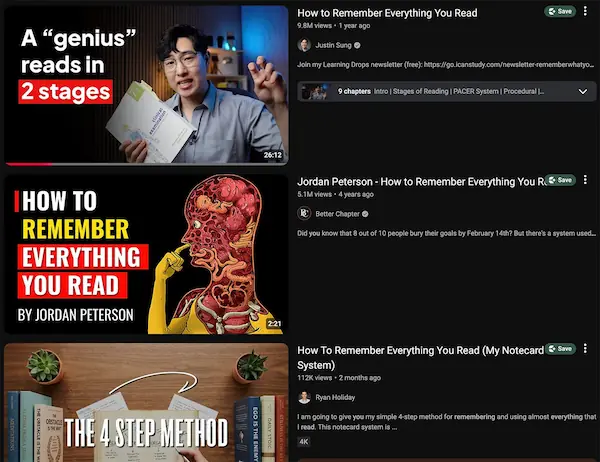
For some reason, it's become an obsession to remember everything you read. There are hundreds of videos about it with millions of views.
(Justin Sung is a great account by the way, solid follow).
You feel like if you don't retain the knowledge, you're a failure, or that you wasted your time, when that's not the point of reading at all. Why would you want to memorize every word of a book?
I know why.
You want to sound smart.
It's an unconscious status symbol for you.
You want to impress others with your articulation and intelligence, but you don't realize that sounding smart comes from understanding, not memorization, and understanding requires a much different approach to learning. It also doesn't help that schools tested you on your ability to memorize. You studied for hours just so you could pencil in the right answer. That's not how life works.
That's what we'll talk about first.
Then, we'll talk about why your note taking system, bookmarks, and even your precious "second brain" (the sex doll for mental masturbators) is largely useless.
Speaking of second brain software, we just added Library, Reader, and Highlights to Eden. Now, not only can you research creator's top content and find your next viral topic (and schedule posts to be published), but you can build an interconnected library of posts, links, and ideas that Eden organizes for you and allows you to search based on meaning.
And, you can save any Substack article, X article, or YouTube video, read the transcript, and highlight so you never lose an idea.
Get 4 months and the Creator Bootcamp free (normally $499) here.
Self-sponsorship over, onto the rest:
How to actually learn anything fast
Most people have no idea how to learn.
Because most people have no idea what the learning process is.
How can do something efficiently if you don't even understand the process?
The reason most learning fails is because their is no negative feedback loop.
Think of it like this.
If you don't have the goal of getting in shape (and I'm talking a deep intrinsically generated goal not a superficial goal you're pursuing to fit in, like a new years resolution) then a night of heavy drinking and partying won't register as a problem (negative feedback), because it doesn't impact your non-existent goal of performing on your run or at the gym the next day. You can go to work just fine with a hangover because you don't give a shit about how well you do at your job.
Learning is a cybernetic process.
Cybernetics sounds like something relating to cyborgs, but it stems from the Greek word kybernetes, meaning steersman or helmsman. The person who steers the ship.
The word "cybernetics" was chosen because the helmsman is the perfect image of a feedback system. The helmsman doesn't just point the ship in a direction once, he constantly reads the current state (wind, waves, heading), compares it against the intended course, and adjusts. In other words, the process of trial and error, and so few people have the direction that allows them to notice errors in their life.
Cybernetics illustrates the properties of intelligent systems.
Reference signal (the goal). The system holds a target state.
Sensor (perception). The system reads its current state.
Comparator (the gap). The system computes the difference between target and current state. The difference is the error signal.
Actuator (behavior). The system acts to reduce the error.
Like how a thermostat turns on the heat when it gets too cold, or how your pancreas releases insulin when blood sugar rises.
That exposes the issue nicely.
When most people try to learn something new, they focus on content. They hoard material and try to absorb it with space repetition, flashcards, courses, and learning the fundamentals. They assume learning is an input process.
In reality, learning is an output process, because output demands input.
A goal creates the error signal.
The error signal creates the filter.
The filter creates relevance (most people fill their mind with noise and things they will never use).
The relevance creates retention.
A person who has been conditioned their entire life to have the nearly unconscious goal of going to school and getting a job will naturally learn and behave in that direction. The destiny they were assigned will inevitably come true.
The person who is deeply conditioned to go down the default path will not even notice money-making opportunities outside of a job, because their brain is filtering it out. The big life goals they were assigned at birth dictate their behavior and learning. They are a puppet of someone else's ideals. They are not in control of their life.
But if you consciously create your own frame, by knowing exactly what you don't want out of life and comparing it to an evolving vision of what you do want out of life, you are only then able to sense when you are off track, notice the error, correct the direction you are heading, and learn as a byproduct.
Makes sense, but what do you actually do?
Step 1) Become obsessed with a meaningful goal.
The way you become obsessed is to look at your current actions and realize where your life will end up if you don't change.
For most people, that outcome is not pretty.
Sit with that image, let it fill you with potent emotion, and redirect that emotional energy toward a better direction for your life.
Only then can you actually align the goals you pursue with the aim of your future. Only then does a useful learning process start, the opposite of schooling, where your learning is determined by the direction and goals society sets for you.
Being extreme changes your brain and enhances neuroplasticity. In my eyes, you're better off making an extreme change than making a lot of small changes.
Burn the boats. Change your life.
2) Don't start learning.
The life you want lies at the end of a series of meaningful projects.
Your mind is to be treated as a project. As is your body, relationships, and financial situation. A project is simply a structured set of goals and milestones. A project creates a frame for your learning (by filtering unimportant noise). Anything that does not directly move the project forward is not worth learning (right now), because you won't retain it anyway.
In other words, when you want to learn something new, don't start learning, take the first step toward the goal instead.
3) Seek specific knowledge.
I ultimately think that everyone should be figuring out what it is that they uniquely do best, that aligns with who they are fundamentally, and that gives them authenticity, that brings them specific knowledge, that gives them competitive advantage, that makes them irreplaceable. And they should just lean into that. And sometimes you don't know what that is until you do it. (Naval)
Schools teach general knowledge, or knowledge required to do a job.
They do not teach how to navigate your own path. They narrow you into one area of study, which by nature does not prepare you to direct your own work through the path of entrepreneurship, or simply doing what you want to do.
Self-education is the process of learning what's necessary to achieve self-generated goals. Again, no hoarding general knowledge to feel like you're learning.
As an example, let's say I want to learn After Effects, the animation software.
It would be stupid to go and watch a bunch of general After Effects tutorials and learn every little thing about the software.
Instead, you need a vision for the project you want to build.
You start the project with the knowledge you have, and if you don't have knowledge, then you find a specific tutorial that is as similar to the project you want to create as it can be.
Now, since you have a filter (what you want to create), most of the tutorial will be useless, but you will find one little technique that allows you to at least start the project.
You apply that and then repeat until you've stacked so many techniques that when you go to create your next project, then the next, it becomes easier and easier.
Same with learning the guitar or an instrument.
You don't go and study music theory.
You choose a song you want to play.
Then you learn the first chord of the song. Then the second. Then the third. And eventually you learn to tune it a specific way, and you pick up little hacks that allow you to play better.
After learning a few songs, you feel as if you could then create your own simple song.
That is how you learn.
The Second Subconscious (Delete Your Note-Taking System)
I've tried all the systems before, and I loved them. I started with Roam Research, and it completely changed how I write. I built a knowledge base of potent ideas, and pulled from those every time I sat down to put words on a screen.
A few years ago, I even built Kortex, which wasn't meant to be second-brain software, but that's what it ended up being before it inevitably failed. Well, it didn't really fail, but it painfully evolved into Eden, which has become the best tool on the market to find what's trending on social media (for creators), and capture ideas from anywhere (for creatives).
So, I'm not hear to say that second brains are useless.
I simply think they're misused.
You bookmark and take notes just for them to never be seen again. You quite literally wasted your time thinking you were learning when you could have been actually learning, as we discussed.
In the past, people didn't have a popularized "second brain" that markets well. They had a commonplace book.
Marcus Aurelius' book, Meditations, is essentially a private commonplace book with notes to himself and digested philosophy. It was never meant to be published.
Leonardo da Vinci filled thousands of notebook pages with sketches, observations, questions, and borrowed ideas.
Mark Twain, H.P. Lovecraft, Thomas Jefferson, Ronald Reagan, Montaigne, Rick Rubin, and many more each had some variation of this.
But there is one major difference between the every day second brain stan and them.
Their collection of ideas were fuel for their creations.
Their inventions, writing, and music would not be what it is today, and I would go as far as saying as you wouldn't even know who those famous people are if they didn't have some variation of a commonplace book.
When you create something, your subconscious spits out relevant ideas that contribute to the quality of the creation, but it's still limited in processing power, and sometimes it decides to not help you at all, leaving you in a creative rut.
A metaphor that Seneca used was to gather pollen from many flowers, then digest it into your own honey.
In modern terms, steal like an artist.
This is the antidote to writers block. You don't have ideas for your writing, content, or videos because you don't have a repository of ideas to pull from. Every single thing I've written in this letter is from articles, videos, social posts, random ideas, and highlights I've saved before.
I think you get it, but how do we actually build this?
How do we create a digital commonplace book, or second subconscious, that we can build throughout our lives that doesn't turn into a cluttered note-taking app where your ideas go to die?
Step 1) Choose The Right Software, Or Create Your Own AI System
Don't get breathless about how "smart" AI is. It's dumber than a sack of wet hammers. Leverage, instead, its ability to do rapid input and output for simple tasks on large datasets. (Devon Eriksen)
Most note-taking and "second brain" software still require manual upkeep.
Some of them have an AI chat tacked on, which is absolutely useful, but they're missing the most useful application of them all: making it so your ideas don't disappear into the void, because your creative work depends on your ability to resurface them.
You have 2 options here.
Our goal is to have somewhere to drop ideas and easily be able to resurface the right ones for our project.
Option 1. Use a combination like Claude Code plus Obsidian to store your knowledge in one place and retrieve ideas with AI.
Option 2. Use a software like MyMind or Eden, which auto-tags, categorizes, and embeds your knowledge in "meaning space" so it can connect seemingly unrelated ideas to birth novel insights.
There are plenty of tutorials on the internet for option 1. It's very popular right now because people swapped their precious collection of Notion templates for a collection of Claude skills (a fad that will fade as they all do), but here's the 80/20 of how to do it yourself:
- Download Obsidian and Claude
- Open Claude Code or Claude Cowork and select your Obsidian vault folder on your computer as the folder you're working in
- Create a "save an idea" skill. Ask claude to create a skill that creates a note in an inbox folder with a clear title
- Create a "process my inbox" skill. Ask claude to create a skill that goes through your inbox folder, add tags, move it to the right folder, and add backlinks to other related notes within the vault
- Ask Claude to help you define your taxonomy so it knows what tags and categories to use
That allows you to capture ideas, notes, and knowledge into a time-tested note-taking tool.
Then, you can ask Claude at anytime to "Search my vault for everything related to [idea I'm writing about]."
That works for finding most ideas, but good writing and creative work come from novel connections, not keyword search or the AI brainstorming synonyms to find related matches.
If you don't want to do all of that manually, then you can use a software like MyMind, which allows you to save any link or idea to one big and searchable library.
Eden does the same thing (you can capture anything fast into your library), but takes it a step further. When you save a link, like a Substack article or YouTube video, it transcribes it, and allows you to highlight it. Plus, you can integrate with Kindle to pull all previous highlights in, which are potent creative fuel.
The way MyMind and Eden differ from Obsidian and Claude is that everything you add to your library is automatically tagged, categorized, and embedded. So you can do the same search that Claude allows you to do, without wasting precious AI usage (Eden also has an MCP if you do want to build and access your knowledge base with Claude.) Plus, if you're a writer or creator, Eden has an outlier search feed where you can find what social posts are performing in your niche and save them straight to your library.
I am not entirely sure if MyMind does this, but with Eden, it also differs in that it can search based on meaning.
Obsidian can show you "what's related," Eden can show you "what's nearby" because each idea is embedded with roughly 1500 numbers that act as GPS coordinates for an idea. They can be found even if they share zero of the same words. This is what allows you to just drop an idea in and forget about it, because you know you will find it exactly when you need it.
It can pull up novel connections without re-searching through your entire knowledge base every time, costing hundreds of thousands of AI tokens.
You probably don't want to maintain a vector database, an embedding API, indexing scripts, re-embedding when notes change, keeping the index in sync when files are renamed or deleted, and caching so you don't re-pay for unchanged content.
All of the tools do this for free, but if you want a true "second subconscious" that you can research while writing, creating, or building projects, Eden may be worth trying out.
Step 2) Capture The Ideas That Best Represent Your Ideal Mind
Now that you have a place to drop ideas without worrying about organization (because you only organize things if you want to find them later, which we just solved), you don't just dump everything in their.
When AI can create anything, curation matters more than ever.
You need a curated space for ideas that spark inspiration. The opposite of an endless fire hose of noise we call a social media feed.
As a writer, creator, or someone trying to do independent work (meaning you need to build an audience by attracting them to the ideas you put out), people don't follow you for your content anymore.
There's Google, AI, and plenty of information that can be found at the click of a button.
They follow you for your point of view. Your opinion. Your interpretation. Your personality. Your story. And all of those things are downstream of the ideas that compose your worldview. The ideas you use to make sense of the world.
As an example, when I get into a conversation about the nature of reality, my mind jumps to ideas about history, integral theory, spiral dynamics, and more, because I've deemed these the most useful lens from which I can view that conversation from. It makes the most sense out of the other ideas I've heard that tend to fall flat.
Those are the ideas you capture.
You curate a large set of knowledge that would best represent your ideal mind.
Because that's what your fancy note-taking system was meant to be right?
You just never got around to solidifying those ideas as a part of yourself, usually through the act of thinking, writing, and sharing in public so that you can receive feedback against from the market and let the best ideas win.
How do you do this?
You read more books. You let your curiosity guide you. You reject doomscrolling and embrace curated lists of authors and thinkers who are dedicated to producing good ideas. You make time for "research," because as a writer or creator, that's 80% of your job.
The rest of your job is just synthesizing that "research" into something that's beneficial to other people.
Step 3) Build Your Ideal Mind Through The Act Of Creation
Let's close the loop.
We have the system for capturing and retrieving knowledge.
But now we need the project to apply it too so that it doesn't go to waste.
And, we still aren't capturing specific knowledge because we don't have a reason to learn. We aren't giving our mind the frame from which it can effectively signal that ideas are important enough to capture, as we discussed.
That's the entire goal we're after, right?
We want to be smarter. We want to retain and remember what we learn. We want to sound articulate. For superficial reasons, maybe, but also because the outcome of our lives depend on the decisions that we make, and our level of smartness and ability to articulate our own value absolutely contribute positively to that.
I can't tell you what to create.
But if you're interested in writing, I can give you a part of my process that recently helped someone else.
For something like writing a Substack article, YouTube script, or X article, here's what I would do:
1) Choose a topic.
Obviously.
The best topics are the ones that lie at the intersection of performance and excitement.
Performance equals topics that have already proven to do well.
You find these by saving social posts that have gone viral, or using a research tool that allows you to find outlier content and study creator's top posts.
(This article I'm writing now is based on "How to remember everything you read," a topic that has gone viral more times than I can count, but I applied my own contrarian perspective to it).
Excitement equals topics and ideas that you want to explore more out of curiosity.
Your job is to pair the topic you want to write about (that probably wouldn't do well on social media) with a topic that has already proven do well, so that you can write about what you want and increase it's potential to actually gain traction.
That's where most beginners fail.
2) Braindump to Outline to Draft
Don't start writing yet.
Writer's don't just open one page and then expect all of the ideas to linearly fall into place.
Start with a braindump. Write down all potential ideas that could fit under the topic you're writing. Look through your notes, ideas, and links and add them inside it too.
Then, start to add some structure with an outline. Take all the ideas in your braindump and try to fit them into a general storytelling framework: Problem to Insight to Solution.
Organize ideas under each of those sections in the outline.
Then, have your outline, ideas, and library of knowledge open and ready to pull from as you string together the ideas in the form of an actual draft.
3) Use AI to remove friction, not write for you.
I'll write about my thoughts on AI writing in a future letter, but when I say "don't use AI for writing," I'm actually saying "don't use AI to articulate your own beliefs and opinions."
Now that Substack has their AI writing estimator, people are going to start pointing out how certain accounts use AI in their writing. I've had a few point out that some of my articles have AI writing in them.
Don't be dense.
Yes, I copy paste straight from AI when providing pure information, like explanations of Greuter's 9 stages of ego development, the same information you'd get from a Google search. I'm not going to waste my breath trying to rewrite it in my own words, because that doesn't need to happen. It's a disservice to myself and the reader.
I think there is value in struggling to articulate your own thoughts and beliefs, which is something the anti-AI people can't seem to do very well as they are kept narrow minded by their new religion.
When I say "use AI to remove friction," I am talking about using it like you would a course or mentor or editor while you are learning the skill.
If you don't know how to structure your article, ask for a list of structures that your ideas could fit into.
If you don't know what to write next, ask for a few directions the article can go.
If you don't understand something, research it, like any writer would in the past with a less efficient method of scouring through the internet for the right information.
All in all, I trust that you have a brain.
You are ultimately the one who decides what gets published.
If it doesn't represent the values, ideas, and beliefs you want it to, then refine it until it does.
I'll leave it at that, because I have much more to say that I'll save for another letter.
Dan
If you want to write but don't know where to start, what to write about, or anything about how to grow on social media, consider joining the bootcamp here.
AI Implementation Prompt
AI-generated from source material. Verify important details against the original source.
AI Implementation Prompt
CONTEXT You are helping me apply the ideas in Dan Koe's newsletter "How to remember everything you read... don't" (published July 25, 2026). Koe is a writer and founder of Eden who teaches independent creators. His core thesis is that trying to remember everything you read is the wrong goal. Retention is not an input problem solved by better tools or memory techniques. It is a downstream effect of having a real, intrinsic goal. He models learning as a cybernetic feedback loop borrowed from the Greek kybernetes (helmsman): a reference signal (the goal), a sensor (your current state), a comparator (the gap, or error signal), and an actuator (behavior that closes the gap). Without a goal there is no error signal, so there is no filter and no retention. Learning is therefore an output process, because output demands and organizes the input. The second half reframes the "second brain." Note systems are not useless, they are misused. Ideas that are captured but never revisited are wasted. The working model is the historical commonplace book (Marcus Aurelius, da Vinci, Twain, Montaigne, Rick Rubin), where a collection of ideas was fuel for creation. Koe gives two ways to build a modern version: a manual Claude Code plus Obsidian vault with custom skills, or an auto-embedding tool like MyMind or Eden that retrieves by meaning rather than keyword. He closes by tying it to creation: curate the ideas that represent your ideal mind, then build that mind by making things. KEY PRINCIPLES 1. If it is important you will remember it. The urge to memorize everything is usually a status signal, not learning. 2. Understanding, not memorization, is what makes someone articulate and sharp. 3. Learning runs on a feedback loop: goal, current state, gap, correction. No goal means no learning. 4. The chain is goal, then error signal, then filter, then relevance, then retention. Work on the goal end, not the retention end. 5. Learning is an output process. Create in order to learn, do not learn in order to eventually create. 6. Seek specific knowledge (what you uniquely do best) over general knowledge collected to feel productive. 7. Treat mind, body, relationships, and finances as projects. A project filters what is worth learning right now. 8. Curation is the scarce skill when AI can generate anything. Collect the ideas that represent your ideal mind. 9. A repository only earns its keep when its contents become fuel for output. 10. Use AI to remove friction, never to articulate your own beliefs and opinions. KEY LEVERS - Goal clarity: the single upstream lever that makes every other part of the loop work. - Project framing: converts a vague goal into a filter for attention and learning. - Capture system: one trusted place to drop ideas and resurface the right ones (manual vault or auto-embedding tool). - Retrieval by meaning: embeddings surface novel connections that keyword search cannot. - Creation cadence: the output that pulls ideas out of storage and turns them into point of view. WHAT THIS IS NOT - This is not anti-note-taking. Koe keeps and relies on a repository. He objects to capture without a project that ever uses it. - This is not a memory-technique system. It is the opposite of flashcards and spaced repetition as a starting point. - This is not "AI writes for you." AI is a friction remover and research aid, not the source of your opinions. - This is not general study. It is self-education aimed at self-generated goals and specific knowledge. - Meaning-based retrieval is not keyword search or synonym matching. It finds what is nearby in meaning, not what shares words. IMPLEMENTATION MODES - Apply: help me install a real goal, convert it into a project, and take the first project step instead of "learning." - Build: help me set up a capture system (Claude Code plus Obsidian, or an auto-embedding tool) and define its taxonomy. - Diagnose: examine why something I studied did not stick, and locate the break in the goal to retention chain. - Critique: pressure-test whether my current note system is fueling output or quietly becoming a graveyard. - Teach: explain the cybernetics model or the commonplace book idea in plain terms with examples from my own work. - Content Creation: run the braindump to outline to draft process, pairing a proven topic with one I am excited about. - Opportunity Discovery: identify specific knowledge I already have that could become a competitive advantage. - System Design: design the two skills (save an idea, process inbox) and the folder and tagging structure for my vault. - Decision Support: help me decide what to learn next by testing it against my active project. - Research Expansion: gather and organize source ideas into my repository as fuel for a specific piece I plan to create. AI OPERATING INSTRUCTIONS Stay grounded in this source and its logic. Focus on practical implementation over motivation. Do not offer generic self-help. When my plan drifts toward capturing or studying without a project attached, flag it and pull me back to the goal-to-output chain. Challenge weak assumptions, especially any claim that I need to remember or collect more before I can start creating. Draw connections between ideas in my repository when it helps, and prefer meaning over keyword matches. Keep my point of view mine. Use your help to remove friction, not to write my beliefs for me. GUIDED DISCOVERY Ask me up to three questions, one at a time, to determine: (1) what I am trying to accomplish, (2) which ideas from this source are most relevant to my situation, and (3) how these concepts could be applied most effectively. Once you understand my situation, help me build a practical implementation plan.