Overview

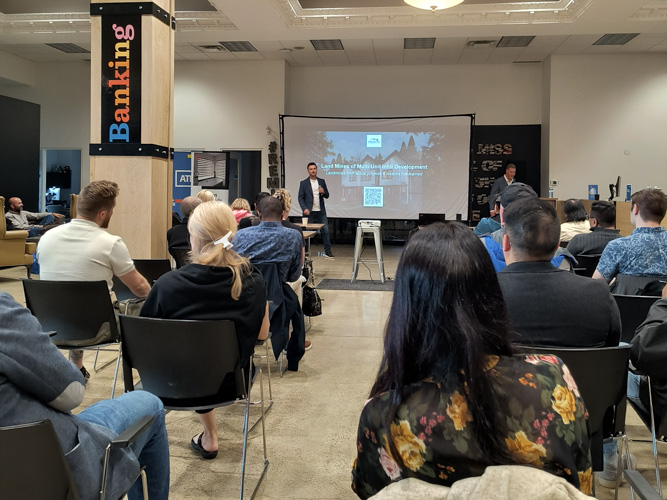
Brian Banks presenting at the EREIA meetup, June 10, 2026

Brian Banks of Freedomvest Properties presented at the Edmonton Real Estate Investors Association (EREIA) meetup on June 10, 2026. The presentation drew on multiple completed and in-progress ground-up infill development projects in Edmonton, walking through the real costs, structural decisions, financing mechanics, and hard-won operational lessons that separate experienced developers from overnight entrants.

Banks covered four major project areas in detail: the Legacy of Park View project (his first infill), the Legacy Sherwood corner lot, a house relocation case study, and CMHC MLI Select financing mechanics. The presentation was grounded in specific dollar figures -- a $52,000 municipal improvement agreement deposit for a sidewalk, CMHC fees doubling from 2.8% to 5.6% overnight, lender fees climbing from $12,500 to $55,000 across successive projects -- and honest post-mortems on what went wrong.

A recurring theme was that the gap between design drawings and site reality is wider than most developers expect, and that functional design decisions -- particularly around bedroom count, garage placement, and storage -- drive tenant satisfaction more directly than aesthetics. Banks also addressed the current supply environment in Edmonton, the tenant profile for two-bedroom units, the CMHC annual compliance review process, and the Perfructs Rental Housing Rebate (100% GST rebate for qualifying projects built after September 15, 2023).

The talk closed with a mindset section: staying focused, avoiding comparison on social media, choosing investor partners carefully, and remembering that developing is a long-term wealth-building play rather than a cash-flow vehicle in the near term.

Why This Matters

Ground-up infill development in Edmonton is one of the highest-leverage real estate strategies available to individual investors right now, but the gap between the promise and the execution is enormous. Most educational content about infill is theoretical or aspirational. Banks delivers something rarer: a detailed, project-by-project accounting of what actually happened, with specific costs, specific mistakes, and specific decision points where things went sideways.

The financial mechanics covered here -- loan-to-cost vs loan-to-value, CMHC MLI Select COI expiry timelines, the annual compliance review with its mortgage buydown risk, the GST rebate eligibility window -- are not well understood by most investors entering the space. Missing any one of these can cost tens of thousands of dollars or derail a project entirely. This presentation condenses hard-earned operational knowledge that would otherwise take years and multiple project cycles to acquire.

The current Edmonton market context -- blanket rezoning, high supply volumes from 2024, inter-provincial migration, and softening renewal rents -- makes the strategic framing here especially relevant. Banks makes a credible case that supply will begin to thin as less capable developers exit, and that well-built, well-located assets will continue to attract quality tenants even in a more competitive environment. That thesis is worth tracking.

Key Points

01

Two-bedroom units outperformed three-bedroom units in Banks' portfolio -- they rented faster and at the same price. Small three-bedroom units were actively turning away prospective tenants who walked in, saw the room sizes, and walked out. Future designs are shifting to two larger primary bedrooms where each can fit a king or queen bed with walkable clearance.

02

Instead of demolishing a habitable house on a development site, Banks sold it for $20,000 and paid to have it relocated. Combined with avoiding $15,000 in asbestos abatement and $15,000 in demolition costs, the swing was approximately $50,000 compared to a standard teardown. The end buyer received the house for approximately $65,000 landed on a pre-built foundation -- versus $200,000+ to build new.

03

A municipal improvement agreement (MIA) for a sidewalk on a corner lot cost $52,000 as a cash security deposit -- required before the city would issue a development permit. This was not financed through CMHC or any lender. The deposit was held by the city for over a year after project completion; $46,000 was returned in March 2026, with $6,000 still outstanding. Corner lots without a curb walk should be budgeted accordingly.

04

CMHC fees have doubled. The premium on MLI Select projects went from 2.8% to 5.6% of the loan amount -- a difference of roughly $60,000 to $120,000 in upfront fees on a typical project. Lender fees on the same project type went from $12,500 to $55,000 across Banks' project history. These cost escalations are structural, not cyclical.

05

Construction financing is loan-to-cost, not loan-to-value. This is a fundamental difference from investment property mortgages. Financing is based on the project cost, not the appraised end value -- which means the leveraged position is more conservative than the 95% LTV figures quoted for standard CMHC products. The refinancing equity extraction familiar from BRRRR strategies does not apply in the same way here.

06

CMHC MLI Select COI (Certificate of Insurance) is valid for one year and starts counting from issuance, not from construction start. If construction is delayed two to three months after COI issuance, those months count against the clock. Extensions are available -- one six-month and one shorter extension -- but they come with penalties and require documented progress.

07

Projects built after September 15, 2023 are eligible for a 100% GST rebate through the Perfructs Rental Housing Rebate program. GST is not financed through CMHC and must be paid in full during construction -- making the rebate, which can be $70,000 to $90,000 or more, a significant cash return. Banks had not yet received a rebate check at the time of presentation but had applications in process.

08

Garage placement on corner lots requires careful attention. Banks described a project where the garage was placed too close to the alley, leaving only a four-foot apron -- forcing tenants to do three-point turns and generating ongoing complaints. The space between the main building and garage could have accommodated a deeper setback. Small design oversights become long-term tenant retention problems.

09

There is a meaningful gap between design drawings and site reality. Door swings, electrical switch placement, lighting locations, backflow preventer positioning, and plumbing locations all have to be field-verified during construction -- not just trusted to the plans. Banks described this as mandatory walkthrough work even when using experienced builders.

10

The Edmonton rental market showed signs of softening for the first time in Banks' experience in 2025-2026. After years of no incentives and lease renewals at the same or higher rate, his team offered a first-month-free incentive and granted a tenant's request for a rent reduction on renewal. Banks expects the supply glut from the 2023-2024 infill boom to thin as less experienced developers exit the market.

11

Investor partner selection matters as much as deal selection. Banks had two projects where signed LOIs (letters of intent) from investors resulted in the investors backing out, leaving him carrying the project and its costs. The lesson: run a thorough vetting process with investors before committing to a project together, even if it takes six months or more to find the right alignment.

12

Avoid completing projects in November or January if possible. Banks described these as "gap zone" months with minimal tenant demand. A project ready in December may be better held until late January when the rental market picks up again -- even though carrying costs continue. Proactive marketing 90 days ahead of completion helps maximize fill rates regardless of season.

Quotable

Quotes extracted and lightly edited for clarity from presentation notes. Verify phrasing against original recording before attribution.

Brian Banks

"If you want some excitement in your life, go skydiving. Let the numbers do the talking."

Attributed by Banks to Don Campbell. Captures the core discipline of development investing -- emotion drives bad decisions, and excitement-seeking has no place in the underwriting process. A useful reset for anyone caught up in the hype around CMHC-backed infill.

Brian Banks

"I was in Mexico reading my email and that's where I found out about the $52,000 sidewalk. Still a great trip, but that's what you're dealing with."

A vivid illustration of how municipal improvement agreements land -- unexpectedly, early in the permitting process, and with no flexibility on timing. The self-deprecating delivery makes the warning stick.

Brian Banks

"The people matter first. The deal comes secondary. There are lots of deals out there."

Spoken in the context of investor partner selection after two LOI backouts. The principle applies equally to builder selection, tenant screening, and any long-term business relationship. Getting the people right is more durable leverage than getting the deal right.

Brian Banks

"We are human beings, not human doings. Remember to enjoy it while you're on the journey."

Also attributed to Don Campbell. Closing mindset thought -- development is a multi-year commitment and the destination keeps moving. The reminder to celebrate progress and protect health and family is more than filler; it is a real risk management note for operators running complex projects.

Brian Banks

"It costs more than you think, and it takes longer than anything."

Delivered as a direct statement about construction timelines and budgets. No elaboration needed. Every experienced developer says some version of this; hearing it alongside specific dollar figures makes it land differently.

Concepts

Design Principles

Functional Design Over Bedroom Count

The instinct to maximize bedroom count in small infill units works against tenant satisfaction and leasing velocity. Banks found that two-bedroom units rented at the same price as three-bedroom units and leased faster -- because tenants who walked through the three-bedroom versions could see that the rooms were too small to live in comfortably. The unit that looks better on paper performs worse in practice.

The corrective design direction is two larger primary bedrooms, each capable of fitting a king or queen bed with clearance to move around furniture. This is a simple standard to apply during design review and a meaningful differentiator in a market with increasing supply.

Flow and Functionality as a Leasing Asset

Banks described thinking like a tenant -- how the mechanics of daily life actually work in the space. Kitchens, living rooms, and bedrooms need to function without friction. Poor door swings, misplaced switches, awkward backflow preventer locations, and insufficient storage all accumulate into a substandard living experience that affects renewals and word-of-mouth.

The curb appeal equivalent for rental units is walkthrough impression. Side-by-side, a thoughtfully designed unit will win over a gray box even when the gray box has comparable finishes.

Cost Management

House Relocation as a Demolition Alternative

When an existing structure is in good enough condition to be habitable, relocating it rather than demolishing it can generate a meaningful financial swing. The savings come from three sources: avoided demolition costs (approximately $15,000), avoided asbestos abatement (approximately $15,000), and a sale price for the structure itself ($20,000 in the case study presented). Total benefit: approximately $50,000 compared to a standard teardown.

Execution requires coordination -- the receiving property needs a pre-built foundation, the move needs to be planned as a point-A-to-point-B trip without intermediate stops, and the size and condition of the structure determines feasibility. Not every house qualifies, but it is worth evaluating on any project where the existing structure is intact.

Municipal Improvement Agreements

A municipal improvement agreement (MIA) is a financial security arrangement between a developer and the city, typically required when a property does not meet current city standards for streetscape elements -- most commonly sidewalks. The city will not issue a development permit until the MIA is in place and the deposit is paid in full.

The deposit is not a fee -- it is held as security against the eventual construction of the improvement to city specifications. Once built and inspected, the city releases the deposit over a timeline that can extend one to two years post-completion. Corner lots with no existing curb walk are particularly exposed. The deposit must be paid from operating capital; it is not financeable through CMHC or standard construction lenders.

Escalating Project Costs

Banks documented a clear cost escalation pattern across his project history. Lender fees went from $12,500 on the first project to $55,000 on recent projects. CMHC MLI Select premiums doubled from 2.8% to 5.6% of the loan amount in a single policy change. Construction costs across every trade category have risen continuously.

The practical implication is that pro formas from two to three years ago are no longer reliable benchmarks. Each new project needs to be re-underwritten from current quotes. Contingency budgets need to be sized to absorb both known cost categories and genuinely unpredictable items like municipal agreements, tree removal, and power pole relocation.

Financing Mechanics

Loan-to-Cost vs Loan-to-Value

Construction financing for ground-up infill is structured on loan-to-cost, not loan-to-value. The lender underwrites against total project cost -- land plus construction plus soft costs -- not against the appraised end value of the completed building. This means that even though CMHC MLI Select can finance up to 95% of cost, the effective loan-to-value position is lower because well-executed development should produce a building worth more than it cost to build.

This is a fundamentally different risk profile than buying a completed property with a high-ratio CMHC mortgage. Developers are in a more conservative financial position relative to the asset value, but they are also exposed to cost overruns that erode that buffer. The equity is built through execution, not through the financing structure.

CMHC MLI Select COI and Extension Risk

The Certificate of Insurance (COI) issued by CMHC for MLI Select projects has a one-year validity window that begins at issuance -- not at construction start. If a project is delayed two to three months between COI issuance and breaking ground, those months count against the certificate's validity. Construction timelines of 12 months or more mean the COI can expire before the project is complete.

CMHC allows a maximum of two extensions. The first extension is substantial (approximately six months). The second is shorter and typically only granted when the project is demonstrably near completion. Extensions carry penalty costs. Missing the extension window can trigger loan acceleration. COI expiry dates need to be tracked actively from day one.

CMHC Annual Compliance Review

MLI Select financing comes with an annual compliance review requirement for the duration of the mortgage term. The lender verifies that the property continues to meet the program criteria -- primarily the affordability threshold and occupancy requirements -- and requires submission of leases and operational documentation. Failure to maintain compliance can result in a requirement to buy down the mortgage or face loan acceleration.

Banks recommended submitting conservative, accurate numbers at application rather than optimistic projections. Compliance reviews use the original application benchmarks. Investors who inflated their numbers to get approved face the risk of breaching those numbers during the review cycle and being forced to pay down the loan -- sometimes in the range of 3% to 5% of the mortgage balance, which on a typical project can be $80,000 to $100,000.

Market and Strategy

The Perfructs Rental Housing Rebate (GST Rebate)

Projects that were built after September 15, 2023 are eligible for a 100% rebate of the GST paid during construction. GST is not financed through CMHC -- it must be paid in full throughout the build, which can represent $70,000 to $90,000 or more in capital outlay. The rebate returns that capital after construction, making it one of the most significant post-completion cash events in a project cycle.

The application process is administered through the CRA and is reportedly slow -- Banks indicated timelines of approximately six months for check issuance. Applications must be submitted correctly and completely. Missing this rebate entirely is a meaningful error; it is not optional paperwork.

Supply Dynamics and the Overnight Developer Problem

The 2023-2024 infill boom in Edmonton brought in a large wave of inexperienced developers attracted by blanket rezoning, favorable CMHC terms, and the visibility of successful projects on social media. Banks observed that many of these entrants are now exiting -- selling projects mid-construction, struggling with timelines and cost overruns, or simply unable to execute. His expectation is that supply growth will slow as this cohort exits.

The implication for experienced developers is that quality and location differentiation will matter more as the market becomes more selective. Well-built, well-located assets will absorb demand; poor-quality units in weak locations will face increasing competition and lower renewal rates.

Long-Term Wealth Preservation vs Short-Term Cash Flow

Banks was explicit that ground-up infill in the current cost environment is not a cash flow play in the near term. Rising construction costs, higher CMHC fees, and softening rents compress the initial yield. The investment thesis is equity building, inflation hedging, and long-term wealth preservation -- not monthly cash flow optimization.

This framing matters because investors who enter expecting near-term positive cash flow will be disappointed and may make poor decisions under pressure. Understanding what the strategy is actually designed to deliver -- and over what timeframe -- is a prerequisite for staying committed through the difficult phases.
Implementation

Implementation guidance is generated from presentation content. Verify all regulatory, financing, and cost details against current sources before acting.

1

Audit Every Corner Lot for Municipal Improvement Obligations

Before submitting any development permit application on a corner lot, contact the City of Edmonton to determine whether a municipal improvement agreement will be required. Check whether a standard sidewalk (rolled curb with a separate walk) or a curb walk (monolithic curb, gutter, and sidewalk combined) is present along all street frontages. If a curb walk is absent and the city standard requires one, budget $40,000 to $60,000 or more as a security deposit that will be held until the improvement is built and inspected. This amount must come from unencumbered capital -- it cannot be financed through CMHC or a construction lender. Add it to your project budget before committing to the land purchase.

2

Evaluate Every Existing Structure for Relocation Before Ordering Demolition

Before scheduling demolition, assess whether the existing structure can be relocated. A house that is structurally intact, free of major hazards, and sized appropriately for road transport may be sellable for $15,000 to $25,000, while also eliminating $15,000 in asbestos abatement and $15,000 in demolition costs. Contact a house relocation company to assess feasibility and cost. Identify prospective buyers -- hobby farmers, rural acreage owners, or people seeking affordable housing stock -- who may be interested in purchasing. The net financial benefit can exceed $45,000 to $50,000 compared to a standard teardown, and the coordination effort is manageable with proper planning.

3

Design for Two Bedrooms When Three Bedrooms Produces Small Rooms

Review your unit designs against a simple standard: can each bedroom fit a king or queen bed with clearance on at least three sides for moving around furniture? If the answer is no, the room will turn away tenants on the walkthrough regardless of how well the rest of the unit presents. Where three-bedroom configurations force substandard room sizes, redesign to two larger primary bedrooms. Review Banks' experience: two-bedroom units in his portfolio rented at the same price as three-bedroom units and leased faster. The lost bedroom is not lost revenue in that context.

4

Build a Construction Walkthrough Checklist and Use It on Site

Do not rely on design drawings to catch site construction errors. Develop a field verification checklist that covers: door swing directions (confirm each door swings in the direction shown on plans and does not interfere with fixtures or walls), electrical switch placement (confirm three-way switches are logically located), lighting fixture locations, backflow preventer positions (keep out of high-traffic areas; ensure access panels are placed), and plumbing stub-out locations relative to fixture placement. Walk the site at rough-in stage before walls are closed. Changes at rough-in cost a fraction of what they cost after finishing work is complete.

5

Track CMHC COI Expiry Dates and Extension Eligibility

Record the COI issuance date immediately upon receipt and mark the one-year expiry on your project calendar. Track construction start date against the COI issuance date to understand how much of the certificate has already been consumed before breaking ground. If your construction schedule will bring you close to the expiry, apply for an extension proactively -- do not wait until the certificate has expired. Document construction progress with dated photographs and progress reports. CMHC grants extensions based on demonstrated progress; projects that appear stalled or undocumented are at greater risk of extension denial.

6

Apply for the GST Rebate as Soon as the Project Is Complete

Confirm that your project qualifies for the Perfructs Rental Housing Rebate (projects completed after September 15, 2023 and used for long-term residential rental). Engage your accountant or a tax specialist familiar with the program before construction is complete so the application can be filed promptly. GST paid during construction is a real cash outlay that ranges from $70,000 to $90,000 or more on a typical project -- the rebate is a significant capital recovery event. Application processing reportedly takes approximately six months; filing early matters.

7

Submit Conservative Numbers on MLI Select Applications

Do not optimize your CMHC MLI Select application by using aggressive rent projections or optimistic operating cost assumptions to achieve a higher loan amount or better score. The annual compliance review will compare actual performance to your application benchmarks. If you fall below the affordability threshold or fail to maintain required occupancy levels, you may face a requirement to buy down the mortgage by 3% to 5% of the loan balance -- a potential $80,000 to $100,000 cash obligation. Use current, verifiable market rents and conservative vacancy assumptions in your application.

8

Plan Project Completion Dates Around Rental Market Seasonality

Target construction completion for February through October where possible. November and January are low-demand months in Edmonton's rental market; units completed during these periods are more likely to sit vacant and may require incentives to lease. If your project is on track to complete in late November or December, evaluate whether delaying the completion date -- or holding the unit off-market until late January -- is more cost-effective than offering concessions during a slow leasing period. Begin marketing units 90 days before projected completion regardless of season to build a prospect pipeline ahead of key turnover.

9

Run a Rigorous Investor Partner Vetting Process

Do not accept a signed LOI as sufficient commitment from a joint venture partner. Banks lost two projects to investors who signed LOIs and then backed out, leaving him holding the project obligations. Before committing to a deal with an investor partner, conduct reference checks with people they have previously co-invested with, discuss worst-case scenarios explicitly to test alignment, understand their actual liquidity position rather than stated net worth, and formalize the relationship with a partnership agreement that addresses exit provisions and decision-making authority. Take as long as needed to get this right -- there will always be another deal.

Resources

Mentioned Resources

Resource Description
Freedomvest Properties Brian Banks' development company. Primary vehicle for infill development projects discussed in the presentation.
CMHC MLI Select Program Canada Mortgage and Housing Corporation's multi-unit residential lending program offering insured financing for purpose-built rental properties. Referenced throughout for construction financing, COI mechanics, affordability point scoring, and annual compliance reviews.
Purpose-Built Rental Housing Rebate Federal GST rebate program covering 100% of GST paid on qualifying new rental housing construction completed after September 15, 2023. Administered through the CRA.
Edmonton Real Estate Investors Association (EREIA) The investor association that hosted this presentation. Meetups feature experienced local operators sharing project-level case studies.

Suggested Resources

Resource Description
City of Edmonton -- Zoning Bylaw and Blanket Rezoning Edmonton's zoning framework reference, covering the blanket rezoning provisions that opened infill development across the city. Critical for understanding what is now permissible by right on residential lots.
Real Estate Investing in Canada -- Don Campbell Foundational Canadian real estate investment text. Banks quoted Campbell twice in this presentation. The numbers-first, emotion-second framework Campbell advocates is directly applicable to infill development underwriting.

AI Prompt

Prompt generated from presentation content. Designed for a fresh AI session with no prior context.

AI Implementation Prompt

CONTEXT This prompt is based on a live presentation given by Brian Banks of Freedomvest Properties at the Edmonton Real Estate Investors Association (EREIA) meetup on June 10, 2026. Brian is an experienced ground-up infill developer in Edmonton, Alberta with multiple completed projects. The presentation walked through real project case studies covering the full development cycle: site acquisition, design decisions, house relocation, municipal improvement agreements, construction financing through CMHC MLI Select, GST rebate applications, builder and investor vetting, and market observations for Edmonton's rental market in 2026. The core thesis is that ground-up infill development in Edmonton is a long-term wealth-building and inflation-hedging strategy -- not a near-term cash flow play. It requires precise execution across design, financing, regulatory, and team management dimensions. The gap between amateur and experienced developers shows up in the details: a $52,000 sidewalk deposit, a $60,000 CMHC fee increase, a $70,000-$90,000 GST rebate that most people miss, or an investor LOI backout that leaves the developer holding obligations. Getting these details right is the edge. KEY PRINCIPLES 1. Let numbers make decisions, not emotions. Excitement and FOMO produce bad underwriting. Every project must justify itself on paper before any capital is committed. 2. Two bedrooms with adequate room sizes outperform three bedrooms with inadequate room sizes. Tenant experience on walkthrough drives leasing velocity and renewal rates. 3. Functional design -- door swings, storage, backflow preventer locations, switch placement -- has direct impact on tenant satisfaction and must be field-verified, not trusted to drawings. 4. Municipal improvement agreements on corner lots must be anticipated and budgeted. A $40,000-$60,000 security deposit that cannot be financed is a real cash requirement that appears early in the permitting process. 5. CMHC MLI Select financing is loan-to-cost, not loan-to-value. This is structurally more conservative than standard investment property mortgages, but it does not behave the same way as BRRRR-style equity extraction. 6. CMHC COI expiry dates run from issuance, not from construction start. Active tracking and early extension requests are required to avoid penalties or loan acceleration. 7. Submit conservative, verifiable numbers on MLI Select applications. The annual compliance review uses those benchmarks; inflated projections create real financial risk over a 10-year mortgage term. 8. The Perfructs Rental Housing Rebate (100% GST rebate for projects after September 15, 2023) is a material capital recovery event that must be applied for promptly. 9. People first, deal second. Builder selection and investor partner selection matter more than deal selection. Vetted relationships absorb problems; unvetted relationships create them. 10. This is a long-term play. Cash flow compression is expected in the current cost environment. The value is in equity accumulation, inflation hedging, and asset quality over time. KEY LEVERS -- Design quality: unit layout and room sizing drive tenant satisfaction, leasing velocity, and renewals -- Cost avoidance: house relocation, early MIA identification, construction field verification -- Financing precision: COI tracking, conservative MLI Select applications, GST rebate application timing -- Team quality: builder vetting, investor partner alignment, professional advisors -- Market timing: avoiding November/January completion, proactive pre-marketing, supply outlook awareness WHAT THIS IS NOT -- This is not a buy-and-hold strategy applied to existing properties. Ground-up development has completely different risk, timeline, and financing structures. -- This is not a cash flow optimization play. Banks explicitly framed this as a wealth-building and inflation-hedging strategy; investors expecting strong early cash flow should recalibrate. -- This is not a system that can be templated and repeated without ongoing attention to regulatory changes, CMHC policy updates, and market conditions. Edmonton's infill environment is changing rapidly. -- This is not a passive investment. Banks described constant problem-solving, field verification, city coordination, and team management as core to execution. IMPLEMENTATION MODES 1. Apply -- Help me evaluate a specific infill site, project, or deal against the frameworks and cost categories discussed in this presentation. 2. Build -- Help me develop a pre-construction checklist, municipal improvement assessment process, or construction field verification protocol based on Banks' lessons. 3. Diagnose -- Help me identify where a current or planned project may be exposed to the risks Banks described: MIA surprises, COI timeline issues, compliance review vulnerability, or design problems. 4. Underwrite -- Help me build or stress-test a project pro forma that incorporates current CMHC fee levels, realistic lender fees, contingency buffers for municipal agreements, and the GST rebate as a post-completion capital recovery item. 5. Critique -- Review a project budget, design plan, or investment thesis against the hard lessons from this presentation and identify gaps or vulnerabilities. 6. Teach -- Explain any concept from this presentation in plain language: MLI Select financing mechanics, COI extension process, the GST rebate program, loan-to-cost vs loan-to-value, or the house relocation economics. 7. Research -- Help me find current information on CMHC MLI Select program criteria, Edmonton affordability thresholds, GST rebate application requirements, or City of Edmonton MIA processes. 8. Decide -- Help me think through a specific decision: two bedrooms vs three bedrooms for a specific unit configuration, whether to relocate or demolish an existing structure, whether to accept a project completion in November or push timing, or how to structure a joint venture with an investor partner. 9. Prepare -- Help me prepare for a conversation with a lender, CMHC advisor, builder, or investor partner by organizing the right questions and framing based on what Banks learned across his project history. 10. Content -- Help me develop educational content for investors or clients that communicates the real cost structure and risk profile of ground-up infill development in Edmonton. AI OPERATING INSTRUCTIONS Stay grounded in what Banks actually said and presented. Do not substitute generic real estate development advice for the specific mechanics covered in this presentation. When the user asks about a concept covered here (CMHC COI, MLI Select compliance, GST rebate, MIA deposits, house relocation), work from this material first. Ask clarifying questions when the context matters. "Should I build two or three bedrooms?" depends on the unit size, location, and tenant demographic target -- ask before answering. Be direct about what this framework does not cover. It addresses Edmonton-specific infill development in the 2024-2026 context. Regulatory details, fee structures, and market conditions change; direct users to verify current information with CMHC, their lender, and City of Edmonton directly. Challenge weak assumptions. If a user describes a project that looks like it will complete in late November, or an investor partner relationship that is not formalized, or a CMHC application with aggressive rent projections, flag the risk clearly. Draw connections between concepts when useful. The COI expiry issue, the compliance review risk, and the GST rebate opportunity are all timing-sensitive -- they compound in projects that run long. Help users see those connections. GUIDED DISCOVERY Ask me up to three questions, one at a time, to determine: (1) what I am trying to accomplish -- evaluating a deal, planning a project, understanding a financing mechanic, or something else; (2) which ideas from this presentation are most relevant to my situation; (3) how these concepts could be applied most effectively given where I am in the development cycle. Once you understand my situation, help me build a practical implementation plan.