Overview
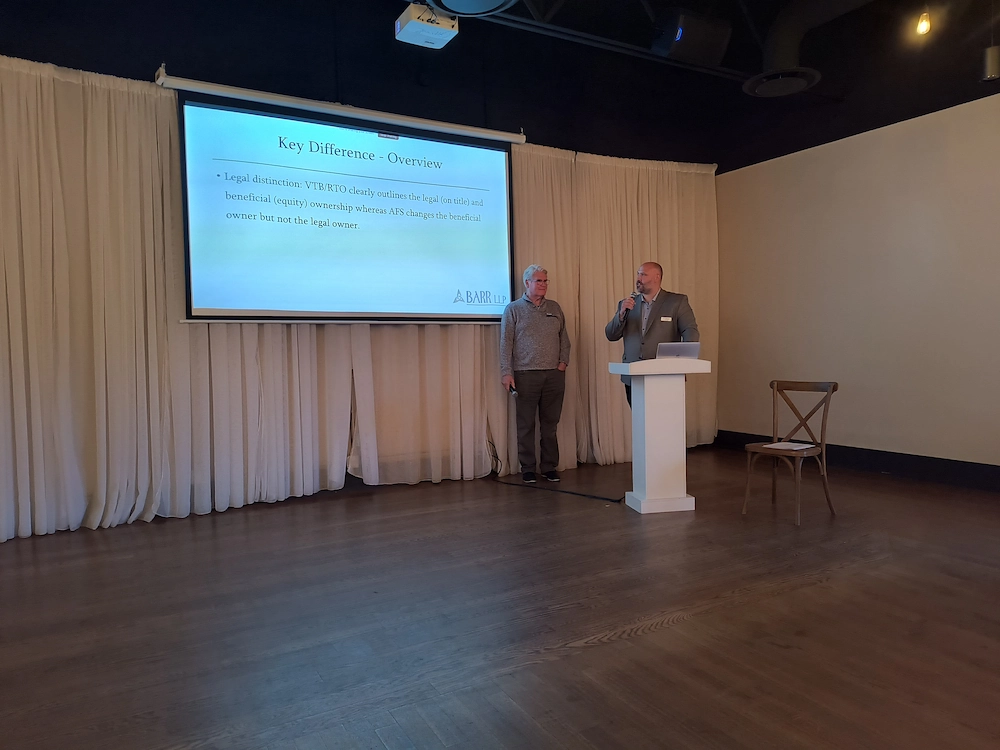
At the Mogul Mastermind Meetup in Edmonton, BARR LLP partners Richard Bell and Brandon Hans delivered a practical legal overview of two creative financing structures widely used in Alberta real estate investing: vendor takebacks (VTBs) and agreements for sale (AFS). The session was intentionally high-level -- a framework presentation, not a drafting guide -- and the lawyers were consistent in urging investors to retain counsel before attempting either structure.
A VTB is structurally a mortgage. The vendor sells the property, transfers title to the buyer, and then lends the buyer money to complete the purchase. The buyer makes payments to the vendor as if to a bank. The vendor registers a mortgage charge on the property for security. If the buyer stops paying, the vendor must foreclose -- the same court process a conventional lender would use. VTBs interact with existing financing, and CMHC-insured deals add an extra layer of complexity that typically rules out standard VTB structures without creative workarounds.
An AFS works differently. The vendor retains legal title to the property while the buyer acquires the beneficial interest -- the equity, the right to manage, collect rents, and benefit from appreciation. The buyer makes payments to the vendor, who uses those funds to service any underlying mortgage. This structure allows buyers who cannot qualify for conventional financing to access a property's economics without triggering a bank application. It also allows the existing mortgage to remain in place undisturbed, at least on paper. The risks are significant: seller bankruptcy, seller refinancing or misappropriation of funds, and the complexity of the exit when the buyer eventually wants title.
Both structures fall under the broad umbrella of creative financing tools, alongside rent-to-own and joint ventures. Bell and Hans emphasized that the Law of Property Act's relief from forfeiture provisions apply to all of them, meaning courts can override default and enforcement mechanisms if they determine equity is being unfairly stripped. The practical message: cooperation between buyer and seller is not optional -- it is the structural foundation of making these deals work. A deal built on distrust is a lawsuit waiting to happen.
VTBs and AFS are legitimate financing tools with a long track record in Alberta, but they are frequently misunderstood -- or worse, copied from online templates without legal review. This session is valuable precisely because it comes from practitioners who regularly close these deals and litigate what happens when they go wrong. The risks outlined here are not theoretical: foreclosure timelines, bankruptcy trustee freezes, and sellers disappearing are actual scenarios the lawyers have encountered on active files.
For investors, the key insight is structural. VTBs look like mortgages and behave like mortgages; the enforcement pathway is foreclosure. AFS structures give the buyer operational control and economic exposure without ever putting them on title, which creates a different risk profile -- one where the buyer has no legal standing to compel a sale or stop a refinance without pre-negotiated protections like a power of attorney and caveat on title.
The case study on the CMHC-restriction workaround using a limited partnership structure is particularly instructive. The lawyers framed it accurately: running vendor financing terms through a partnership unit structure can achieve the same economic result as a VTB without triggering CMHC's prohibition -- but only if the bank is consulted first and the structure is disclosed. The fraud risk of not doing so is real and the consequences severe. This is the kind of applied insight that typically only comes from having worked through the problem on an actual file.
The session also surfaces a principle that applies well beyond real estate financing: the more a deal depends on the other party's cooperation to function, the more important it is to build that cooperation into the legal framework before you need it, not after something goes wrong.
About the Presenters
Richard M. Bell
Partner, BARR LLP • Alberta Bar (1991)
Richard joined BARR LLP in 2020 after over 20 years as managing partner of a boutique Edmonton law firm. His practice focuses on residential and commercial real estate transactions and corporate matters. He has represented a broad range of clients including investors, developers, and homeowners, and is known for direct communication and attention to transaction timing. Richard has worked on and advised clients across a wide range of investor strategies including joint ventures, rent-to-owns, agreements for sale, fix and flip, and long-term rentals. He has spoken at multiple real estate conferences on these topics and is widely regarded as one of the most experienced AFS practitioners in Edmonton.
Brandon K. Hans
Partner, BARR LLP • Alberta Bar (2017)
Brandon joined BARR LLP as an articling student in 2016 and became partner in 2023. He holds a Bachelor of Laws from the University of Kent and a Bachelor of Arts in Political Science and History from the University of Alberta. His practice areas include real estate (commercial and residential), commercial and private lending, corporate law, estate planning, foreclosure, and commercial litigation. Brandon is a past co-chair of the Canadian Bar Association -- Real Property North section and regularly works on complex financing structures including VTBs, partnership agreements, and private lending security.
Key Points
- A vendor takeback (VTB) is functionally a mortgage. The vendor sells the property, transfers title to the buyer, and simultaneously loans the buyer the purchase price (or a portion of it). The buyer makes payments to the vendor; the vendor holds a registered mortgage charge on title for security.
- An agreement for sale (AFS) is fundamentally different: the vendor retains legal title while the buyer acquires beneficial interest. The buyer controls and operates the property, pays down the vendor's underlying mortgage through their payments, and captures all appreciation and equity growth.
- Foreclosure is the enforcement mechanism for VTBs -- and it is slow, expensive, and court-supervised. Sellers must petition a court, allow a redemption period, and list the property at fair market value. Funds are tied up throughout. Assuming a quick recovery is a serious mistake.
- CMHC financing generally prohibits conventional VTB structures. However, creative alternatives exist, including structuring the vendor's interest as a limited partnership unit with built-in return terms. The non-negotiable condition: run any such structure by the lender before closing.
- The AFS exit -- when the buyer wants title -- requires new financing and involves navigating bank unfamiliarity with the structure. It is not a Tuesday-to-Wednesday transaction. Buyers should plan the exit strategy before entering the deal, not while trying to get out.
- Bankruptcy of either party can freeze an AFS entirely. A bankruptcy trustee supersedes any agreement in place and controls what happens to the property. This risk cannot be contracted away -- it can only be managed through counterparty due diligence and having a strong plan B.
- The Law of Property Act's relief from forfeiture provisions apply to VTBs, AFS deals, and rent-to-own structures. Courts can override contractually agreed default remedies if they determine a party's equity is being unfairly wiped out. Enforcement is never as clean as the contract suggests.
- For AFS deals, the two primary tools to protect the buyer's interest are a power of attorney from the vendor (registered on title) and a caveat registering the buyer's beneficial interest. Each has tradeoffs, and the choice depends on the specific deal, lender, and risk tolerance.
- In cooperative AFS deals, a shared bank account where both parties can monitor mortgage payments and fund flows is a practical risk-management tool that reduces the chance of disputes escalating into litigation.
- Both VTBs and AFS can accommodate complex scenarios: clear title properties (full vendor financing), partially mortgaged properties (layered vendor and bank financing), and CMHC apartment buildings (with LP workarounds). Each layer adds complexity and requires tailored legal agreements.
- AFS structures are generally seen more often in commercial and multifamily contexts than single-family homes. VTBs appear across both. The threshold for complexity and risk mitigation effort means AFS deals on low-value or underwater properties often do not pencil out relative to the legal cost and operational burden.
- Agreements should explicitly address death, divorce, incapacity, and addiction as scenarios that can disrupt the deal. These are standard items in a well-drafted AFS. Planning for edge cases is not pessimism -- it is sound deal structure.
Quotable
AI-generated from source material. Verify important details against the original source.
Brandon Hans
"Don't lend money or sell a building without talking to a lawyer. Please, please, please -- if you walk away from one lesson from this talk, it is: call a lawyer."
Repetition for emphasis from a practicing lawyer who has fielded distress calls from investors who skipped this step. The urgency is earned, not performative.
Richard Bell
"The ideal agreement for sale has a buyer and a seller that are cooperative in the agreement. In a perfect world, the buyer and the seller will set up a separate bank account -- they both can monitor it, they can both see the money going in and going out."
This is the operational heart of AFS risk management. The separate monitored account is not a legal requirement -- it is a practical cooperation mechanism that removes the most common failure point.
Brandon Hans
"If the bank gets wind of something and you haven't run it by them, the big fraud flag goes up, and then you're stuck in litigation. Always, always, always run it by your broker first."
Said in the context of the CMHC LP workaround -- but the principle applies broadly. Disclosure and coordination with lenders before closing is not optional when bank financing is involved.
Brandon Hans
"All three of the strategies you've heard tonight -- rent to owns, agreements for sale, vendor takeback financing -- they're tools in the toolbox of investments, like a joint venture, like a partnership agreement, like a holding corporation. Whether that tool is useful to you in your circumstances will be very fact specific."
Reframes creative financing away from "magic solution" thinking and back to the correct framing: situational tools with specific use cases, tradeoffs, and dependencies. Each deal determines which tool fits.
Richard Bell
"I would say, as investors, you can't go into these thinking, 'This is going to be great, I don't have to have a mortgage, I can do all this stuff.' If you have no plan B, you might get burned."
Direct push-back against the marketing framing of creative financing as a workaround for unqualified buyers. The lawyers see the deals that go wrong; the plan B discussion is not hypothetical.
Concepts
Core Structures
Vendor Takeback (VTB)
In a VTB, the vendor sells the property and simultaneously lends the buyer some or all of the purchase price. Title transfers to the buyer at closing. The vendor holds a registered mortgage charge on the property as security. The buyer makes periodic payments to the vendor exactly as they would to a bank. The vendor is, functionally, the lender.
VTBs are relatively straightforward from a legal standpoint -- the mortgage registration process is well-understood and the enforcement mechanism (foreclosure) is established in law. The main complications arise from interaction with conventional lenders and CMHC restrictions, and from the practical reality that foreclosure is slow and expensive if a buyer defaults.
Agreement for Sale (AFS)
An AFS separates legal title (which stays with the vendor) from beneficial interest (which transfers to the buyer). The buyer gets operational control of the property -- the right to rent it, collect income, and capture appreciation and equity growth -- without ever going on title. The vendor's existing mortgage remains in place; the buyer makes payments to the vendor sufficient to cover the mortgage, property taxes, and insurance.
The structure works because the bank sees nothing change: the seller is still on title, still making mortgage payments. The AFS is a private contract between buyer and seller that sits alongside the bank relationship without formally involving it. This creates opportunity (no new mortgage qualification needed) and risk (the vendor could theoretically refinance or misappropriate payments).
Equity as the Core Objective
Both Bell and Hans emphasized that the unifying goal across all creative financing structures is equity -- specifically, the investor's ability to capture property value appreciation over time. Rent-to-own, VTBs, and AFS each lock in equity differently. In an AFS, all appreciation from the contract date forward belongs to the buyer, even though the vendor holds title. In a VTB, the buyer is on title immediately and builds equity through mortgage pay-down and appreciation. Understanding which structure best captures equity in a given deal is the central design question.
Legal Protections and Risk Tools
Caveat on Title
A caveat is a legal notice registered on a property's title in Alberta, alerting the world that a third party has a claim over the property. In an AFS, registering a caveat protects the buyer's beneficial interest by putting any future lender or purchaser on constructive notice. It does not prevent the vendor from attempting to refinance, but it creates a legal obstacle that must be addressed before any new financing can close.
The tradeoff is visibility. Tier-C or private lenders may question a registered caveat and pull the mortgage on the vendor's existing debt if they discover the AFS. Institutional A-lenders are far less likely to pull copies of title for review as long as payments are current -- but the risk exists.
Power of Attorney
In an AFS, the vendor can grant the buyer a power of attorney, registered on title, authorizing the buyer to deal with the property on the vendor's behalf. This is a significant protection because it gives the buyer the legal authority to handle title-level matters -- including, in some scenarios, completing the exit transaction -- without requiring the vendor's active cooperation in the moment.
The lawyers cited a real case where a vendor in an AFS essentially disappeared. The registered power of attorney allowed the deal to close when financing was eventually arranged, because the buyer could act on the vendor's behalf. Without it, the deal would have been stranded.
Registered Mortgage vs. Unregistered Promissory Note
In a VTB, lenders can choose to register the mortgage charge on title or rely solely on a promissory note. Bell and Hans strongly recommended registration. An unregistered promissory note gives the lender no security against the property -- if the borrower defaults, the lender is an unsecured creditor. If the borrower is a corporation, the lender may have no practical recourse at all. Registration is a minimal step with maximum protective value.
Risk Scenarios
Foreclosure
Foreclosure is the court-supervised process a VTB lender must use if a buyer stops paying. It is not a fast process. The borrower receives a redemption period to sell or refinance the property and pay the debt. If that period expires, the court grants an order allowing the lender to take over management of the property, list it, and sell it to recover the outstanding amount. Throughout this process, the lender's funds are effectively locked in the property. This is distinct from simply taking the property back -- courts set a high bar for forfeiting a buyer's equity without the sale process.
Bankruptcy Risk
If either party in an AFS or VTB goes bankrupt, a bankruptcy trustee or receiver steps in and takes control of all decision-making related to that party's assets -- including the property. The AFS contract does not disappear, but nothing can happen without trustee approval. This can freeze the deal for months or longer. The only mitigation is counterparty due diligence before signing and a plan B strong enough to absorb the property if needed.
Relief from Forfeiture (Law of Property Act)
Alberta's Law of Property Act includes provisions allowing courts to grant relief from forfeiture -- essentially, preventing a party's equity from being wiped out as a contractual penalty. Courts have interpreted this broadly, meaning even a well-drafted default and enforcement clause in an AFS or VTB can be overridden by a judge who finds the enforcement inequitable. This is not a loophole -- it is a deliberate policy choice by the province. Investors should plan for contested enforcement rather than assuming the contract will resolve a default cleanly.
Seller Refinancing Risk in AFS
Because the vendor retains legal title in an AFS, they technically retain the ability to approach a lender and refinance the property -- potentially stripping out equity the buyer has been accumulating. Well-drafted agreements include restrictions on this, but the buyer's most practical protection is the combination of a registered caveat (alerting future lenders to the buyer's interest) and a power of attorney (limiting the vendor's ability to act unilaterally on title matters). Neither is completely bulletproof -- they are layers of deterrence and obstruction, not absolute prevention.
Creative Applications
CMHC LP Workaround
CMHC financing rules generally prohibit vendor financing as part of the down payment or purchase structure. However, BARR LLP structured a deal for an apartment building acquisition using a limited partnership agreement instead of a VTB. The vendor was issued LP units representing the economic value of what would have been vendor financing, with terms built into the partnership agreement mirroring VTB economics: a capped rate of return (8% in this case) with all remaining upside going to other LP unitholders. The vendor eventually received their capital back with the agreed return at disposition. The bank's approval and full disclosure of the structure were prerequisites.
AFS as Loan Security
Brandon Hans described structuring an AFS as a private lending security instrument -- taking an assignment of contract or sale proceeds as collateral, with the AFS triggering and giving the lender access to the property's economics if the borrower defaults. This is an advanced application typically used in distressed or non-standard lending scenarios. It is not suitable for new investors and requires experienced legal counsel who understand both the lending and real estate sides of the transaction.
Implementation
AI-generated from source material. Verify important details against the original source.
Engage a qualified real estate lawyer before structuring any deal
Bell and Hans repeated this throughout the session. VTBs and AFS involve complex legal structures, specific Alberta statutory provisions (including the Law of Property Act), and significant enforcement risk if documentation is poor. Retaining counsel who has actually closed these deals -- not just read about them -- is not optional. The cost of legal work upfront is a fraction of the cost of litigation.
Clarify the equity objective before choosing a structure
VTBs and AFS both serve the goal of capturing equity, but they do so differently. An AFS gives the buyer economic exposure from day one without title. A VTB puts the buyer on title immediately. The choice depends on the buyer's financing situation, the vendor's comfort with title retention, the property type, and the exit plan. Start with the equity outcome and work backward to the appropriate structure.
Register the mortgage on title in any VTB
Do not rely on an unregistered promissory note as the only VTB documentation. Register the mortgage charge on title. This gives the vendor lender security against the property, priority over unsecured creditors, and the legal standing to foreclose. The few hundred dollars in registration costs is insurance against the borrower defaulting with nothing to recover from.
Disclose to and coordinate with the bank before closing any structure involving existing financing
If the property being acquired (or used as security) has existing bank financing, the lender must be informed before any creative structure is finalized. Failure to disclose can trigger a fraud allegation, call provisions in the existing mortgage, or unwind a closing at the worst possible moment. This applies equally to VTBs, AFS deals, and LP structures designed to replicate vendor financing economics.
Protect the buyer's interest in an AFS with a caveat and power of attorney
At minimum, register the buyer's beneficial interest on title via a caveat, and negotiate a power of attorney from the vendor. The caveat alerts any future lender to the buyer's claim; the power of attorney gives the buyer the ability to act on title matters without the vendor's active participation. The balance between these tools depends on the lender profile: Tier-A institutional lenders generally will not call a loan over a registered caveat as long as payments are current. Private or Tier-C lenders may react differently.
Set up a cooperative monitoring structure for AFS payments
In an AFS where the vendor has an underlying mortgage, the buyer's payments must flow through to the bank. The most practical risk-management tool is a shared bank account where both parties have view access. The buyer can confirm payments are being made; the vendor can confirm funds are arriving. This does not eliminate risk, but it removes ambiguity and gives both parties early warning if something goes wrong.
Build the exit strategy into the deal before signing
The exit from an AFS -- typically the buyer obtaining conventional financing and taking title -- is more complex than entering. Banks are unfamiliar with the structure, title does not currently show the buyer, and the AFS itself must be unwound as part of the closing. Plan the exit at the start: understand what the buyer will need to qualify, what market conditions will look like, and whether there is a realistic path to financing within the deal's timeline. Do not assume a refinancing will be fast.
Have a plan B strong enough to absorb the property
Any creative financing deal that depends entirely on the other party performing optimally is fragile. Build a plan B that allows the investor to step in and manage or acquire the property if the primary arrangement breaks down. For an AFS buyer, this means having access to financing that could pay out the vendor's mortgage and clear the agreement. For a VTB lender, this means having enough liquidity to absorb the foreclosure process timeline without being forced to sell at a discount.
Draft agreements that address death, divorce, incapacity, and other disruption scenarios
Standard AFS and VTB agreements should explicitly address what happens if either party dies, becomes incapacitated, divorces, or loses contact. These are not unlikely scenarios over a multi-year deal. A well-drafted agreement contemplates each and provides a clear mechanism for the surviving or unaffected party to continue without litigation. This is standard practice for Bell and Hans; insist on it from any lawyer drafting these agreements.
Do thorough due diligence on the counterparty, not just the property
In a VTB, the vendor is lending money; in an AFS, the buyer is depending on the vendor to manage mortgage payments and cooperate over potentially years. In both cases, the counterparty's financial stability, track record, and character matter as much as the property itself. A distressed seller in an AFS is a higher risk regardless of how good the deal looks on paper. Treat counterparty due diligence with the same rigor as property due diligence.
Tools & Resources
Mentioned Resources
| Resource | Description |
|---|---|
| Richard M. Bell -- BARR LLP | Partner specializing in real estate transactions (commercial and residential), corporate matters, and estate administration. One of Edmonton's most experienced AFS practitioners. |
| Brandon K. Hans -- BARR LLP | Partner specializing in finance, real estate, private lending, foreclosure, and corporate law. Past co-chair of CBA Real Property North section. Contact for complex VTB and financing structures. |
| BARR LLP | Edmonton-based mid-size firm operating in Alberta, British Columbia, and Saskatchewan. Full-service excluding immigration and personal injury. Real estate, corporate, foreclosure, and litigation practices. |
| Mogul Realty Group | Organizer of the Mogul Mastermind Meetup Edmonton series. Real estate investor community and education platform. |
Suggested Resources
| Resource | Description |
|---|---|
| Law of Property Act (Alberta) | The Alberta statute that contains the relief from forfeiture provisions referenced throughout the session. Relevant to any investor using VTBs, AFS deals, or rent-to-own structures in the province. |
| CMHC -- Canada Mortgage and Housing Corporation | The federal housing finance insurer whose rules restrict vendor financing in insured mortgage transactions. Relevant for investors pursuing CMHC-backed multifamily acquisitions with creative financing components. |
| Law Society of Alberta | Regulatory body for Alberta lawyers. Use the Find a Lawyer tool to verify credentials or locate real estate lawyers with experience in creative financing structures. |
| Canadian Bar Association -- Real Property Section | Brandon Hans is past co-chair of the CBA Real Property North section. The CBA's Real Property section publishes materials and resources on Alberta real estate law relevant to investors working with legal counsel. |
AI Prompt
AI-generated from source material. Verify important details against the original source.
AI Implementation Prompt
CONTEXT This prompt is based on a live presentation delivered at the Mogul Mastermind Meetup in Edmonton, Alberta (June 24, 2026) by Richard Bell and Brandon Hans, both partners at BARR LLP -- a mid-size Edmonton law firm operating across Alberta, British Columbia, and Saskatchewan. The session covered two creative real estate financing structures commonly used by Alberta investors: Vendor Takebacks (VTBs) and Agreements for Sale (AFS). The presenters are practicing lawyers who regularly close, structure, and litigate these types of deals. The core thesis is that VTBs and AFS are legitimate, legally grounded tools in the Alberta real estate investor's toolkit -- but they carry significant structural risk if used without proper legal documentation, counterparty due diligence, and a clear exit strategy. Neither structure is a workaround or a shortcut. Both require legal counsel, both can fail in catastrophic ways if poorly constructed, and both are subject to court intervention under Alberta's Law of Property Act relief from forfeiture provisions. KEY PRINCIPLES 1. VTBs are functionally mortgages. Title transfers to the buyer. The vendor registers a mortgage charge and receives payments as the lender. Enforcement is via foreclosure -- a slow, court-supervised process. 2. AFS structures separate legal title (stays with the vendor) from beneficial interest (transfers to the buyer). The buyer gains full operational control and captures all equity growth without going on title or qualifying for a mortgage. 3. In both structures, cooperation between the parties is not optional -- it is structural. Deals that depend on adversarial enforcement are deals waiting to litigate. 4. The Law of Property Act's relief from forfeiture provisions apply to VTBs, AFS deals, and rent-to-own structures. Courts can override contractual default remedies if they find equity is being unfairly wiped out. Enforcement is never as clean as the contract suggests. 5. Bankruptcy of either party freezes the deal. A trustee supersedes any agreement. This risk cannot be contracted away -- it must be managed through counterparty diligence and a financial plan B. 6. In an AFS, the buyer's interest should be protected by at minimum a registered caveat and a power of attorney from the vendor. The choice between them involves tradeoffs depending on the lender type and the deal's risk profile. 7. Always disclose to and coordinate with any existing lender before closing a creative financing structure. Failure to disclose can trigger fraud allegations and void the deal. 8. Do not rely on an unregistered promissory note as the only VTB documentation. Register the mortgage on title. 9. CMHC financing generally prohibits vendor financing, but LP-based structures can replicate VTB economics when designed carefully and disclosed to the lender in advance. 10. Build exit strategy, plan B, and contingency scenarios (death, divorce, incapacity, disappearance) into the agreement before signing. KEY LEVERS -- Legal structure and documentation quality: the difference between a workable deal and a lawsuit -- Counterparty selection and due diligence: the vendor's financial stability is as important as the property -- Registered protections on title: caveat and power of attorney as the AFS buyer's primary risk tools -- Lender coordination: upfront disclosure as the prerequisite for any structure involving bank financing -- Exit planning: building the pathway out before entering the deal -- Plan B strength: the investor's ability to absorb the property if the primary arrangement breaks down WHAT THIS IS NOT -- A template for self-drafting VTB or AFS agreements. The session was explicitly an overview, not a drafting guide. Legal counsel is required. -- A tax planning resource. Tax implications of VTBs and AFS structures were deliberately not covered in this session and vary by structure, entity type, and individual circumstances. -- A guide for rent-to-own structures. Rent-to-own was mentioned briefly but not covered -- it was handled by a separate presenter. -- A guarantee that AFS deals are invisible to lenders. The existing lender may or may not discover the AFS; the strategy is risk management, not concealment. -- A one-size-fits-all answer. Both presenters repeatedly emphasized that the right structure depends entirely on the specific deal, parties, property type, and financing context. IMPLEMENTATION MODES 1. STRUCTURE ANALYSIS: Help me evaluate whether a VTB or AFS is the right structure for a specific deal. Walk through the key variables: buyer's financing position, vendor's comfort with title retention, existing mortgage situation, CMHC involvement, exit timeline, and counterparty profile. 2. RISK IDENTIFICATION: For a deal I describe, identify the primary risks associated with the proposed structure -- foreclosure exposure, bankruptcy risk, seller refinancing risk, lender discovery risk -- and rank them by likelihood and severity given the deal specifics. 3. DUE DILIGENCE FRAMEWORK: Help me build a counterparty due diligence checklist for an AFS or VTB deal, covering financial stability, legal history, property condition, existing mortgage terms, and exit capacity. 4. AGREEMENT CHECKLIST: Generate a list of provisions that should be present in a well-drafted AFS or VTB agreement, including contingency scenarios (death, divorce, incapacity, bankruptcy, disappearance) and enforcement mechanisms. 5. EXIT PLANNING: Help me map the exit pathway from an AFS deal. What steps are required for the buyer to obtain conventional financing, what bank hurdles exist, what timeline is realistic, and what can be done at the deal entry stage to smooth the exit? 6. LENDER COORDINATION: Help me prepare for a disclosure conversation with an existing lender regarding a proposed AFS or CMHC-adjacent creative financing structure. What needs to be disclosed, in what order, and what questions should I anticipate? 7. LP STRUCTURE ANALYSIS: Walk me through the mechanics of the CMHC LP workaround discussed in this session -- LP units issued to the vendor with built-in return terms -- and help me identify what a similar structure might look like for a specific deal. 8. CONTENT CREATION: Help me create investor education content explaining VTBs or AFS structures in plain language, drawing on the frameworks and examples from this session. 9. DEAL REVIEW: I will describe a proposed deal. Identify gaps, risks, or missing elements from a structure and documentation standpoint -- including items that should be addressed with legal counsel before signing. 10. CONCEPT TEACHING: Explain any of the legal concepts from this session -- caveat, power of attorney, relief from forfeiture, beneficial interest, foreclosure redemption period -- in plain language suitable for an investor audience. AI OPERATING INSTRUCTIONS -- Stay grounded in the frameworks and principles from this session. Where you have relevant general knowledge about Alberta real estate law, you may supplement, but always flag when you are going beyond what the presenters specifically covered. -- This is a legal and financial domain. Never frame any output as legal advice. Consistently encourage the user to work with a qualified real estate lawyer -- specifically one experienced with VTBs and AFS structures in Alberta -- before executing any deal. -- Focus on practical deal-level thinking. Help the user reason through specific situations rather than giving generic overviews. -- Challenge weak assumptions. If the user's deal description relies on unrealistic counterparty cooperation, ignores the exit problem, or assumes enforcement will be simple, flag it directly. -- Ask clarifying questions when the deal specifics matter for the answer. The right structure depends heavily on the details. -- When discussing risks, be specific and proportionate. Not every AFS deal will result in bankruptcy or fraud -- but the user should understand the conditions under which each risk is most likely to materialize. GUIDED DISCOVERY Ask me up to three questions, one at a time, to determine: (1) what I am trying to accomplish with a specific deal or situation, (2) which of these structures -- VTB or AFS -- is most relevant to my circumstances, and (3) where my current plan has gaps or risks I have not fully considered. Once you understand my situation, help me build a practical approach to structuring, protecting, and exiting the deal.